
Turn inspiration into your own evidence
Do not copy the career. Learn how the career is communicated.
Read the evidence
Notice where the example uses scale, change, ownership, and context.
Replace every fact
Write from your real work, even when your numbers or setting are different.
Check the result
Make sure the document remains readable, truthful, and aligned to the role.
Key Skills
Use only the skills you can support with real experience. The example shows the vocabulary; your evidence makes it credible.
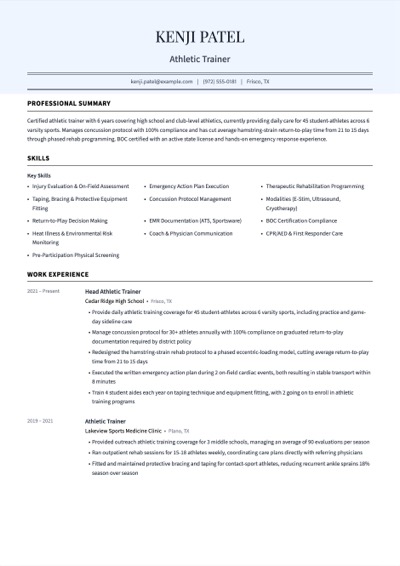
Full Athletic Trainer Resume Example
This is a complete fictional sample. Study the structure and evidence patterns, then replace every name, employer, number, skill, and accomplishment with information that is true for you.
Professional Summary
Certified athletic trainer with 6 years covering high school and club-level athletics, currently providing daily care for 45 student-athletes across 6 varsity sports. Manages concussion protocol with 100% compliance and has cut average hamstring-strain return-to-play time from 21 to 15 days through phased rehab programming. BOC certified with an active state license and hands-on emergency response experience.
Work Experience
Head Athletic Trainer
2021 – PresentCedar Ridge High School — Frisco, TX
- Provide daily athletic training coverage for 45 student-athletes across 6 varsity sports, including practice and game-day sideline care
- Manage concussion protocol for 30+ athletes annually with 100% compliance on graduated return-to-play documentation required by district policy
- Redesigned the hamstring-strain rehab protocol to a phased eccentric-loading model, cutting average return-to-play time from 21 to 15 days
- Executed the written emergency action plan during 2 on-field cardiac events, both resulting in stable transport within 8 minutes
- Train 4 student aides each year on taping technique and equipment fitting, with 2 going on to enroll in athletic training programs
Athletic Trainer
2019 – 2021Lakeview Sports Medicine Clinic — Plano, TX
- Provided outreach athletic training coverage for 3 middle schools, managing an average of 90 evaluations per season
- Ran outpatient rehab sessions for 15-18 athletes weekly, coordinating care plans directly with referring physicians
- Fitted and maintained protective bracing and taping for contact-sport athletes, reducing recurrent ankle sprains 18% season over season
Athletic Training Intern
2018 – 2019Westbrook University Athletics — Denton, TX
- Assisted certified staff with sideline coverage for NCAA Division II football, soccer, and track programs
- Logged 900+ supervised clinical hours across evaluation, rehab, and modality application under BOC-approved preceptors
- Shadowed emergency action plan drills twice per semester, including simulated cardiac and heat-illness scenarios
Education
- Master of Science, Athletic Training — Texas State University · 2019
- BS, Kinesiology — University of North Texas · 2017
Certifications
- Board of Certification (BOC) Certified Athletic Trainer
- Texas Athletic Trainer License (active)
- CPR/AED for the Professional Rescuer
Achievement bullet patterns
Adapt the sentence pattern to your work. Never copy an employer, number, tool, or outcome that is not true for you.
- 1
Delivered daily athletic training coverage for 45 student-athletes across 6 varsity sports, logging over 500 evaluations per school year
Adapt the pattern; do not copy facts that are not yours.
- 2
Managed concussion protocol for 30+ athletes annually with a 100% compliance rate on graduated return-to-play documentation
Adapt the pattern; do not copy facts that are not yours.
- 3
Reduced average hamstring-strain return-to-play time from 21 to 15 days by introducing a phased eccentric-loading rehab protocol
Adapt the pattern; do not copy facts that are not yours.
- 4
Executed the written emergency action plan during 2 on-field cardiac events, both resulting in stable transport within 8 minutes
Adapt the pattern; do not copy facts that are not yours.
Practical writing guidance
- 1
State your athlete caseload directly: 'Provided daily coverage for 45 student-athletes across 6 varsity sports' shows scope employers can picture
- 2
Report injury volume and return-to-play speed, such as average days from evaluation to clearance for common injuries you manage
- 3
Name your emergency response record: cardiac events, heat illness cases, or concussions managed under your written emergency action plan
- 4
Cite your BOC certification status and state licensure by name, since both are hard screening filters before a resume is read further
- 5
Quantify rehab caseload and outcomes, like the number of athletes moved through a rehab protocol each week and re-injury rate
- 6
Show multi-sport or multi-site range if you have it; covering several teams or campuses signals scheduling flexibility hiring managers value
How to write an athletic trainer resume
Open with caseload and sport coverage, not a mission statement
Turn rehab and return-to-play work into measurable outcomes
Document your emergency-response record with specifics
Frequently Asked Questions
What certifications should an athletic trainer list on a resume?
Lead with your BOC (Board of Certification) credential and current state athletic training license, both by name and status. Add CPR/AED for the Professional Rescuer, and any specialty certificates such as manual therapy or dry needling that match the job posting's requirements.
How long should an athletic trainer resume be?
One page works for early-career athletic trainers; two pages are acceptable once you have several seasons of coverage, rehab outcomes, and emergency response experience to document. Prioritize caseload numbers and clinical results over a long list of duties.
Should I mention specific sports or teams I've covered?
Yes. Naming the sports and competition level (high school varsity, NCAA Division I, professional) tells a hiring committee whether your experience matches their setting. Include athlete counts per sport when you can, since caseload size is a key screening factor for staffing decisions.
How do I show emergency-response experience without overstating it?
Describe your role in your facility's written emergency action plan and cite specific incidents you managed, including response time and outcome. State facts plainly, such as number of cardiac or heat-illness events handled, rather than dramatizing routine sideline care.