
Turn inspiration into your own evidence
Do not copy the career. Learn how the career is communicated.
Read the evidence
Notice where the example uses scale, change, ownership, and context.
Replace every fact
Write from your real work, even when your numbers or setting are different.
Check the result
Make sure the document remains readable, truthful, and aligned to the role.
Key Skills
Use only the skills you can support with real experience. The example shows the vocabulary; your evidence makes it credible.
Full Auto Body Technician Resume Example
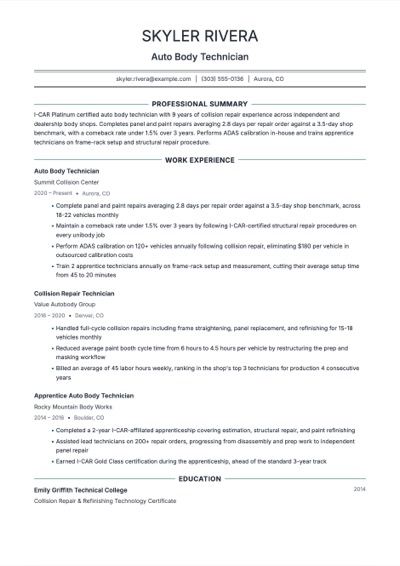
This is a complete fictional sample. Study the structure and evidence patterns, then replace every name, employer, number, skill, and accomplishment with information that is true for you.
Professional Summary
I-CAR Platinum certified auto body technician with 9 years of collision repair experience across independent and dealership body shops. Completes panel and paint repairs averaging 2.8 days per repair order against a 3.5-day shop benchmark, with a comeback rate under 1.5% over 3 years. Performs ADAS calibration in-house and trains apprentice technicians on frame-rack setup and structural repair procedure.
Work Experience
Auto Body Technician
2020 – PresentSummit Collision Center — Aurora, CO
- Complete panel and paint repairs averaging 2.8 days per repair order against a 3.5-day shop benchmark, across 18-22 vehicles monthly
- Maintain a comeback rate under 1.5% over 3 years by following I-CAR-certified structural repair procedures on every unibody job
- Perform ADAS calibration on 120+ vehicles annually following collision repair, eliminating $180 per vehicle in outsourced calibration costs
- Train 2 apprentice technicians annually on frame-rack setup and measurement, cutting their average setup time from 45 to 20 minutes
Collision Repair Technician
2016 – 2020Value Autobody Group — Denver, CO
- Handled full-cycle collision repairs including frame straightening, panel replacement, and refinishing for 15-18 vehicles monthly
- Reduced average paint booth cycle time from 6 hours to 4.5 hours per vehicle by restructuring the prep and masking workflow
- Billed an average of 45 labor hours weekly, ranking in the shop's top 3 technicians for production 4 consecutive years
Apprentice Auto Body Technician
2014 – 2016Rocky Mountain Body Works — Boulder, CO
- Completed a 2-year I-CAR-affiliated apprenticeship covering estimation, structural repair, and paint refinishing
- Assisted lead technicians on 200+ repair orders, progressing from disassembly and prep work to independent panel repair
- Earned I-CAR Gold Class certification during the apprenticeship, ahead of the standard 3-year track
Education
- Collision Repair & Refinishing Technology Certificate — Emily Griffith Technical College · 2014
Certifications
- I-CAR Platinum Individual Certification
- ASE B4 Collision Repair Certification
- ASE B5 Non-Structural Analysis Certification
Achievement bullet patterns
Adapt the sentence pattern to your work. Never copy an employer, number, tool, or outcome that is not true for you.
- 1
Completed panel and paint repairs averaging 2.8 days per repair order against a 3.5-day shop benchmark, across 18-22 vehicles monthly
Adapt the pattern; do not copy facts that are not yours.
- 2
Maintained a comeback rate under 1.5% over 3 years by following I-CAR-certified structural repair procedures on every unibody job
Adapt the pattern; do not copy facts that are not yours.
- 3
Performed ADAS calibration on 120+ vehicles annually following collision repair, eliminating outsourced calibration costs of $180 per vehicle
Adapt the pattern; do not copy facts that are not yours.
- 4
Trained 2 apprentice technicians on frame-rack setup and measurement, cutting their average setup time from 45 to 20 minutes
Adapt the pattern; do not copy facts that are not yours.
Practical writing guidance
- 1
State your average cycle time by repair type: 'Completed panel and paint repairs averaging 2.8 days per RO against a 3.5-day shop target'
- 2
Report your comeback rate, since a low comeback percentage proves repair quality more convincingly than any adjective can
- 3
Name your I-CAR or ASE certifications by exact title (I-CAR Platinum, ASE B4/B5) since these are direct keyword matches in shop hiring systems
- 4
Include ADAS calibration or EV/hybrid experience if you have it; these skills are in short supply and command higher pay
- 5
Quantify your production volume, such as repair orders completed per week or gross labor hours billed monthly
- 6
Mention specific makes or unibody/frame systems you're certified on if the shop specializes in a particular brand or repair type
How to write an auto body technician resume
Lead with cycle time and comeback rate, the two numbers shops track
List I-CAR and ASE credentials by exact name and level
Show production volume and specialty repair range
Frequently Asked Questions
What certifications matter most on an auto body technician resume?
I-CAR certifications (Platinum or Gold Class Professional) are the industry standard and should be listed by exact title and level. ASE B4/B5 collision repair certifications also carry weight. List manufacturer-specific structural repair training too, since shops search for exact matches.
How do I show repair quality on a resume without inflating claims?
Use your shop's own tracked metrics: comeback rate, average cycle time per repair order, and customer satisfaction scores if available. These come from your estimating or management software, so they hold up in an interview far better than general statements about attention to detail.
Should I list specific vehicle makes I've worked on?
Yes, if you have depth on brands the shop specializes in, especially aluminum-intensive or EV/hybrid platforms that require specialized certification. Naming makes and repair systems signals you can start productive work immediately without extensive retraining on shop-specific procedures.