
Turn inspiration into your own evidence
Do not copy the career. Learn how the career is communicated.
Read the evidence
Notice where the example uses scale, change, ownership, and context.
Replace every fact
Write from your real work, even when your numbers or setting are different.
Check the result
Make sure the document remains readable, truthful, and aligned to the role.
Key Skills
Use only the skills you can support with real experience. The example shows the vocabulary; your evidence makes it credible.
Full Butcher Resume Example
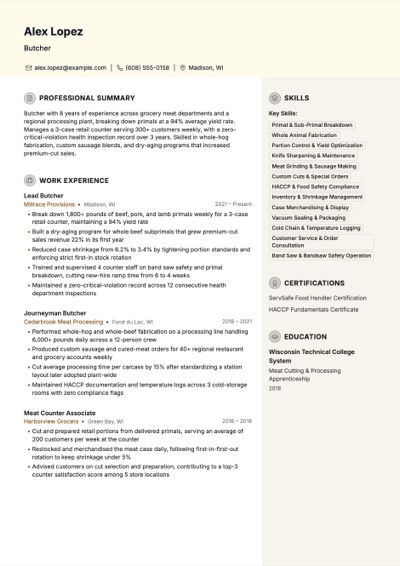
This is a complete fictional sample. Study the structure and evidence patterns, then replace every name, employer, number, skill, and accomplishment with information that is true for you.
Professional Summary
Butcher with 8 years of experience across grocery meat departments and a regional processing plant, breaking down primals at a 94% average yield rate. Manages a 3-case retail counter serving 300+ customers weekly, with a zero-critical-violation health inspection record over 3 years. Skilled in whole-hog fabrication, custom sausage blends, and dry-aging programs that increased premium-cut sales.
Work Experience
Lead Butcher
2021 – PresentMillrace Provisions — Madison, WI
- Break down 1,800+ pounds of beef, pork, and lamb primals weekly for a 3-case retail counter, maintaining a 94% yield rate
- Built a dry-aging program for whole beef subprimals that grew premium-cut sales revenue 22% in its first year
- Reduced case shrinkage from 6.2% to 3.4% by tightening portion standards and enforcing strict first-in stock rotation
- Trained and supervised 4 counter staff on band saw safety and primal breakdown, cutting new-hire ramp time from 6 to 4 weeks
- Maintained a zero-critical-violation record across 12 consecutive health department inspections
Journeyman Butcher
2018 – 2021Cedarbrook Meat Processing — Fond du Lac, WI
- Performed whole-hog and whole-beef fabrication on a processing line handling 6,000+ pounds daily across a 12-person crew
- Produced custom sausage and cured-meat orders for 40+ regional restaurant and grocery accounts weekly
- Cut average processing time per carcass by 15% after standardizing a station layout later adopted plant-wide
- Maintained HACCP documentation and temperature logs across 3 cold-storage rooms with zero compliance flags
Meat Counter Associate
2016 – 2018Harborview Grocers — Green Bay, WI
- Cut and prepared retail portions from delivered primals, serving an average of 200 customers per week at the counter
- Restocked and merchandised the meat case daily, following first-in-first-out rotation to keep shrinkage under 5%
- Advised customers on cut selection and preparation, contributing to a top-3 counter satisfaction score among 5 store locations
Education
- Meat Cutting & Processing Apprenticeship — Wisconsin Technical College System · 2018
Certifications
- ServSafe Food Handler Certification
- HACCP Fundamentals Certificate
Achievement bullet patterns
Adapt the sentence pattern to your work. Never copy an employer, number, tool, or outcome that is not true for you.
- 1
Broke down 1,800+ pounds of beef and pork primals weekly, maintaining a 94% yield rate against a department target of 90%
Adapt the pattern; do not copy facts that are not yours.
- 2
Reduced case shrinkage from 6.2% to 3.4% over one year by tightening portion-control standards and rotating stock on a strict first-in schedule
Adapt the pattern; do not copy facts that are not yours.
- 3
Trained 4 new counter staff on safe band saw operation and primal breakdown, cutting onboarding time from 6 weeks to 4
Adapt the pattern; do not copy facts that are not yours.
- 4
Passed 12 consecutive health department inspections with zero critical violations while managing a 3-case display counter
Adapt the pattern; do not copy facts that are not yours.
Practical writing guidance
- 1
State your daily or weekly cutting volume in pounds so employers can judge your throughput against their department's needs
- 2
Report yield percentage on primal breakdowns, since a butcher who wastes less product is worth more than one who cuts fast but sloppy
- 3
Mention specialty skills like whole-hog fabrication, dry-aging, or sausage making that set you apart from counter-only candidates
- 4
Include your food-safety record explicitly, such as consecutive passed health inspections, to reassure risk-averse hiring managers
- 5
Quantify shrinkage or waste reduction if you improved it, since controlling loss directly affects a department's margin
- 6
List any certifications like ServSafe or state meat-handling licenses near the top since they are often screened first
How to write a butcher resume
Lead with volume and yield, not general knife skills
Prove your food-safety record with inspection history
Differentiate counter work from whole-animal fabrication
Frequently Asked Questions
What should a butcher include on their resume if they have no formal training?
Focus on hands-on experience: cutting volume, specialty cuts you can produce, and any on-the-job training completed. List food-handler certifications like ServSafe, which are inexpensive and quick to earn. Employers in this trade often value demonstrated speed and accuracy over formal schooling.
How do I show cutting skill on a resume without sounding vague?
Replace phrases like 'skilled with a knife' with specifics: pounds processed weekly, yield percentage on primal breakdowns, or the range of cuts you can produce, from standard retail cuts to whole-hog fabrication. Numbers and named techniques prove skill in a way adjectives cannot.
Should I list food-safety certifications on a butcher resume?
Yes, place them near the top in a dedicated certifications line. ServSafe Food Handler, state meat-cutter licenses, and HACCP training are frequently required or preferred, and hiring managers scan for them before reading your experience in detail.
How long should a butcher resume be?
One page is standard for grocery and shop positions. Lead with your cutting volume, specialties, and food-safety record, then list experience in reverse chronological order. A second page is acceptable only for plant roles with extensive whole-animal fabrication history.