
Turn inspiration into your own evidence
Do not copy the career. Learn how the career is communicated.
Read the evidence
Notice where the example uses scale, change, ownership, and context.
Replace every fact
Write from your real work, even when your numbers or setting are different.
Check the result
Make sure the document remains readable, truthful, and aligned to the role.
Key Skills
Use only the skills you can support with real experience. The example shows the vocabulary; your evidence makes it credible.
Full Corporate Trainer Resume Example
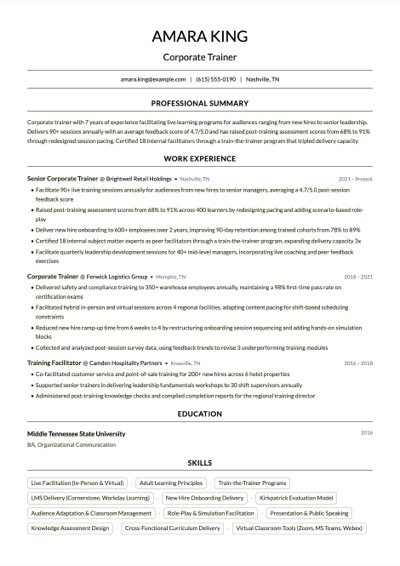
This is a complete fictional sample. Study the structure and evidence patterns, then replace every name, employer, number, skill, and accomplishment with information that is true for you.
Professional Summary
Corporate trainer with 7 years of experience facilitating live learning programs for audiences ranging from new hires to senior leadership. Delivers 90+ sessions annually with an average feedback score of 4.7/5.0 and has raised post-training assessment scores from 68% to 91% through redesigned session pacing. Certified 18 internal facilitators through a train-the-trainer program that tripled delivery capacity.
Work Experience
Senior Corporate Trainer
2021 – PresentBrightwell Retail Holdings — Nashville, TN
- Facilitate 90+ live training sessions annually for audiences from new hires to senior managers, averaging a 4.7/5.0 post-session feedback score
- Raised post-training assessment scores from 68% to 91% across 400 learners by redesigning pacing and adding scenario-based role-play
- Deliver new hire onboarding to 600+ employees over 2 years, improving 90-day retention among trained cohorts from 78% to 89%
- Certified 18 internal subject matter experts as peer facilitators through a train-the-trainer program, expanding delivery capacity 3x
- Facilitate quarterly leadership development sessions for 40+ mid-level managers, incorporating live coaching and peer feedback exercises
Corporate Trainer
2018 – 2021Fenwick Logistics Group — Memphis, TN
- Delivered safety and compliance training to 350+ warehouse employees annually, maintaining a 98% first-time pass rate on certification exams
- Facilitated hybrid in-person and virtual sessions across 4 regional facilities, adapting content pacing for shift-based scheduling constraints
- Reduced new hire ramp-up time from 6 weeks to 4 by restructuring onboarding session sequencing and adding hands-on simulation blocks
- Collected and analyzed post-session survey data, using feedback trends to revise 3 underperforming training modules
Training Facilitator
2016 – 2018Camden Hospitality Partners — Knoxville, TN
- Co-facilitated customer service and point-of-sale training for 200+ new hires across 6 hotel properties
- Supported senior trainers in delivering leadership fundamentals workshops to 30 shift supervisors annually
- Administered post-training knowledge checks and compiled completion reports for the regional training director
Education
- BA, Organizational Communication — Middle Tennessee State University · 2016
Certifications
- Association for Talent Development (ATD) Training Certificate
- DDI Certified Facilitator
Achievement bullet patterns
Adapt the sentence pattern to your work. Never copy an employer, number, tool, or outcome that is not true for you.
- 1
Facilitated 90+ live training sessions annually for audiences ranging from new hires to senior managers, averaging a 4.7/5.0 post-session feedback score
Adapt the pattern; do not copy facts that are not yours.
- 2
Raised post-training assessment scores from 68% to 91% across 400 learners by redesigning session pacing and adding scenario-based role-play
Adapt the pattern; do not copy facts that are not yours.
- 3
Delivered new hire onboarding to 600+ employees over 2 years, improving 90-day retention among trained cohorts from 78% to 89%
Adapt the pattern; do not copy facts that are not yours.
- 4
Certified 18 internal subject matter experts as peer facilitators through a train-the-trainer program, expanding delivery capacity by 3x
Adapt the pattern; do not copy facts that are not yours.
Practical writing guidance
- 1
Report knowledge-check or skill-assessment gains, such as 'raised post-training assessment scores from 68% to 91% across 400 learners' to prove retention, not just attendance
- 2
Quantify your delivery volume: number of sessions led per year, average class size, and completion rate across the audiences you trained
- 3
Show train-the-trainer results if applicable, like the number of internal facilitators you certified who then delivered content independently
- 4
Separate live facilitation from course design if you did both — this role is judged on delivery skill, so keep design credit distinct and proportional
- 5
Include feedback scores from post-session surveys when available, since a consistent 4.5+ rating across dozens of sessions is a strong, verifiable signal
- 6
Name every delivery format you've handled (in-person, virtual, hybrid, train-the-trainer) since employers often need coverage across all of them
How to write a corporate trainer resume
Prove your delivery skill with feedback and assessment numbers
Keep delivery credit distinct from design credit
Show range across formats and audiences
Frequently Asked Questions
How is a corporate trainer resume different from an instructional designer resume?
A corporate trainer resume should emphasize live delivery: facilitation volume, feedback scores, and post-training gains. An instructional designer resume focuses on course architecture instead. If you do both, keep the sections distinct so a hiring manager sees which skill you're claiming.
What if I don't have knowledge-assessment scores to report?
Use completion rates, attendance consistency, or survey ratings instead. A metric like 'maintained 95% session completion across 200 participants' still shows engagement. If your organization doesn't track assessments, propose a simple pre/post quiz so you can report a gain next time.
Should I include virtual and in-person delivery separately?
List both formats but don't split them into separate resume sections unless volume differs dramatically. Note your comfort with virtual classroom tools like Zoom or Teams explicitly, since many employers now require trainers to deliver hybrid programs and screen for that flexibility directly.
How much delivery experience do I need for a corporate trainer role?
Entry-level roles often accept 1-2 years of facilitation experience, sometimes from retail, hospitality, or military training. Mid-level and senior trainer roles typically expect 3-5+ years of documented facilitation volume with measurable retention or assessment improvements attached.