
Turn inspiration into your own evidence
Do not copy the career. Learn how the career is communicated.
Read the evidence
Notice where the example uses scale, change, ownership, and context.
Replace every fact
Write from your real work, even when your numbers or setting are different.
Check the result
Make sure the document remains readable, truthful, and aligned to the role.
Key Skills
Use only the skills you can support with real experience. The example shows the vocabulary; your evidence makes it credible.
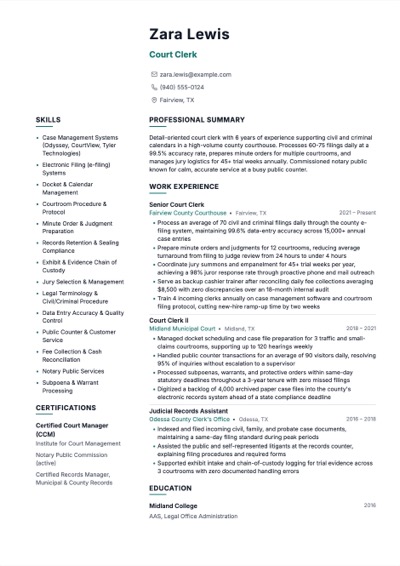
Full Court Clerk Resume Example
This is a complete fictional sample. Study the structure and evidence patterns, then replace every name, employer, number, skill, and accomplishment with information that is true for you.
Professional Summary
Detail-oriented court clerk with 6 years of experience supporting civil and criminal calendars in a high-volume county courthouse. Processes 60-75 filings daily at a 99.5% accuracy rate, prepares minute orders for multiple courtrooms, and manages jury logistics for 45+ trial weeks annually. Commissioned notary public known for calm, accurate service at a busy public counter.
Work Experience
Senior Court Clerk
2021 – PresentFairview County Courthouse — Fairview, TX
- Process an average of 70 civil and criminal filings daily through the county e-filing system, maintaining 99.6% data-entry accuracy across 15,000+ annual case entries
- Prepare minute orders and judgments for 12 courtrooms, reducing average turnaround from filing to judge review from 24 hours to under 4 hours
- Coordinate jury summons and empanelment for 45+ trial weeks per year, achieving a 98% juror response rate through proactive phone and mail outreach
- Serve as backup cashier trainer after reconciling daily fee collections averaging $8,500 with zero discrepancies over an 18-month internal audit
- Train 4 incoming clerks annually on case management software and courtroom filing protocol, cutting new-hire ramp-up time by two weeks
Court Clerk II
2018 – 2021Midland Municipal Court — Midland, TX
- Managed docket scheduling and case file preparation for 3 traffic and small-claims courtrooms, supporting up to 120 hearings weekly
- Handled public counter transactions for an average of 90 visitors daily, resolving 95% of inquiries without escalation to a supervisor
- Processed subpoenas, warrants, and protective orders within same-day statutory deadlines throughout a 3-year tenure with zero missed filings
- Digitized a backlog of 4,000 archived paper case files into the county's electronic records system ahead of a state compliance deadline
Judicial Records Assistant
2016 – 2018Odessa County Clerk's Office — Odessa, TX
- Indexed and filed incoming civil, family, and probate case documents, maintaining a same-day filing standard during peak periods
- Assisted the public and self-represented litigants at the records counter, explaining filing procedures and required forms
- Supported exhibit intake and chain-of-custody logging for trial evidence across 3 courtrooms with zero documented handling errors
Education
- AAS, Legal Office Administration — Midland College · 2016
Certifications
- Certified Court Manager (CCM) — Institute for Court Management
- Notary Public Commission (active)
- Certified Records Manager, Municipal & County Records
Achievement bullet patterns
Adapt the sentence pattern to your work. Never copy an employer, number, tool, or outcome that is not true for you.
- 1
Processed an average of 70 civil and criminal filings daily through the county e-filing portal, maintaining a 99.6% data-entry accuracy rate across 15,000+ annual entries
Adapt the pattern; do not copy facts that are not yours.
- 2
Prepared minute orders and judgments for 12 courtrooms, cutting average turnaround from same-day filing to judge review from 24 hours to under 4 hours
Adapt the pattern; do not copy facts that are not yours.
- 3
Managed jury summons and empanelment logistics for 45+ trial weeks per year, maintaining a 98% juror response rate through proactive outreach calls
Adapt the pattern; do not copy facts that are not yours.
- 4
Reconciled daily fee collections averaging $8,500 with zero discrepancies over an 18-month audit period, earning selection as backup cashier trainer
Adapt the pattern; do not copy facts that are not yours.
Practical writing guidance
- 1
Quantify your filing volume: "Processed 60-75 case filings daily with a 99.5% data-entry accuracy rate" proves both speed and reliability
- 2
Cite courtroom throughput, such as the number of hearings or calendars you supported per week and how you kept dockets on schedule
- 3
Highlight error-reduction or backlog-clearing projects, like reconciling a case backlog or catching filing errors before they reached a judge
- 4
Mention any cross-training across departments (civil, criminal, family, traffic) since courts value clerks who can float between calendars
- 5
Include public-facing metrics, such as counter transactions handled per day or reductions in average wait time
- 6
List technical systems by name (Odyssey, CourtView, C-Track, Journal Technologies) because hiring managers and ATS both scan for exact platform match
How to write a court clerk resume
Open with filing volume and accuracy, not a list of duties
Name your case management systems exactly, every time
Match civil-service formatting rules to the letter
Frequently Asked Questions
What skills should a court clerk highlight on a resume?
Emphasize case management software experience (Odyssey, CourtView, Tyler Technologies), e-filing proficiency, docket coordination, and data-entry accuracy. Also highlight courtroom procedure knowledge and any notary commission, since these often determine which vacancies you qualify for.
Do I need courtroom experience to apply for a court clerk position?
Not always. Many courts hire from administrative or customer service backgrounds and train clerks on courtroom procedure. Highlight transferable skills like high-volume data entry, records management, deadline accuracy, and public-facing service, then note any legal or municipal experience.
How should I format a court clerk resume for a civil-service application?
Use a clean reverse chronological format with a summary, core skills, experience, and education. Many courts require exact job titles and dates for civil-service verification, so match your resume precisely to your employment records. List certifications and any notary commission near the top.
Should I mention specific case management systems on my resume?
Yes. Court hiring managers and applicant tracking systems both search for exact platform names like Odyssey, CourtView, or Journal Technologies. If you trained on a different system, note your experience anyway and add that you adapt quickly to new case management platforms.