
Turn inspiration into your own evidence
Do not copy the career. Learn how the career is communicated.
Read the evidence
Notice where the example uses scale, change, ownership, and context.
Replace every fact
Write from your real work, even when your numbers or setting are different.
Check the result
Make sure the document remains readable, truthful, and aligned to the role.
Key Skills
Use only the skills you can support with real experience. The example shows the vocabulary; your evidence makes it credible.
Full Entrepreneur Resume Example
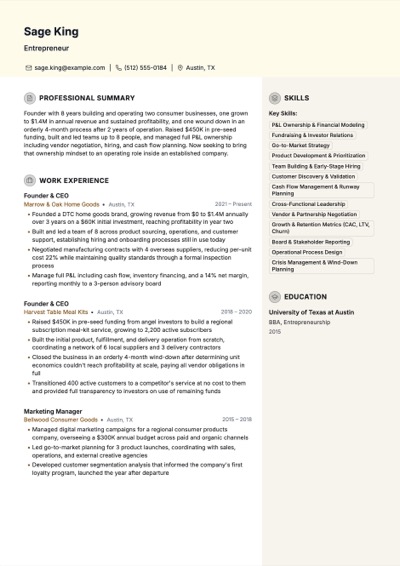
This is a complete fictional sample. Study the structure and evidence patterns, then replace every name, employer, number, skill, and accomplishment with information that is true for you.
Professional Summary
Founder with 8 years building and operating two consumer businesses, one grown to $1.4M in annual revenue and sustained profitability, and one wound down in an orderly 4-month process after 2 years of operation. Raised $450K in pre-seed funding, built and led teams up to 8 people, and managed full P&L ownership including vendor negotiation, hiring, and cash flow planning. Now seeking to bring that ownership mindset to an operating role inside an established company.
Work Experience
Founder & CEO
2021 – PresentMarrow & Oak Home Goods — Austin, TX
- Founded a DTC home goods brand, growing revenue from $0 to $1.4M annually over 3 years on a $60K initial investment, reaching profitability in year two
- Built and led a team of 8 across product sourcing, operations, and customer support, establishing hiring and onboarding processes still in use today
- Negotiated manufacturing contracts with 4 overseas suppliers, reducing per-unit cost 22% while maintaining quality standards through a formal inspection process
- Manage full P&L including cash flow, inventory financing, and a 14% net margin, reporting monthly to a 3-person advisory board
Founder & CEO
2018 – 2020Harvest Table Meal Kits — Austin, TX
- Raised $450K in pre-seed funding from angel investors to build a regional subscription meal-kit service, growing to 2,200 active subscribers
- Built the initial product, fulfillment, and delivery operation from scratch, coordinating a network of 6 local suppliers and 3 delivery contractors
- Closed the business in an orderly 4-month wind-down after determining unit economics couldn't reach profitability at scale, paying all vendor obligations in full
- Transitioned 400 active customers to a competitor's service at no cost to them and provided full transparency to investors on use of remaining funds
Marketing Manager
2015 – 2018Bellwood Consumer Goods — Austin, TX
- Managed digital marketing campaigns for a regional consumer products company, overseeing a $300K annual budget across paid and organic channels
- Led go-to-market planning for 3 product launches, coordinating with sales, operations, and external creative agencies
- Developed customer segmentation analysis that informed the company's first loyalty program, launched the year after departure
Education
- BBA, Entrepreneurship — University of Texas at Austin · 2015
Achievement bullet patterns
Adapt the sentence pattern to your work. Never copy an employer, number, tool, or outcome that is not true for you.
- 1
Founded and grew a DTC home goods brand from $0 to $1.4M in annual revenue over 3 years, reaching profitability in year two on a $60K initial investment
Adapt the pattern; do not copy facts that are not yours.
- 2
Raised $450K in pre-seed funding from angel investors to build a subscription meal-kit startup, growing to 2,200 active subscribers before wind-down
Adapt the pattern; do not copy facts that are not yours.
- 3
Closed the business in an orderly 4-month wind-down, paying all vendor obligations in full and transitioning 400 active customers to a competitor at no cost to them
Adapt the pattern; do not copy facts that are not yours.
- 4
Built and led a team of 8 across product, operations, and customer support, establishing hiring and onboarding processes still in use after the founder's departure
Adapt the pattern; do not copy facts that are not yours.
Practical writing guidance
- 1
Treat each venture as a real job: the venture's name, your title, dates, and 3-5 quantified bullets, not a single vague line about 'entrepreneurial experience'
- 2
State the outcome plainly, whether it was acquired, sold, sustainably profitable, or wound down, since employers can usually tell when a resume is dodging the question
- 3
If a venture closed, include one bullet on the wind-down itself: how you handled it (severance, customer transition, creditor resolution) since this shows operational maturity under pressure
- 4
Quantify what you built regardless of outcome: revenue at peak, customers acquired, team size managed, funding raised, since scale matters more than survival alone
- 5
Translate founder skills into functional language the target role uses: 'built the sales process from zero' becomes 'developed and scaled outbound sales pipeline'
- 6
Address the employment gap or overlap question directly in a brief summary line rather than letting a reviewer guess at your timeline
How to write an entrepreneur resume
List every venture as a real job, not a single vague summary line
Handle a wind-down as evidence of operational maturity, not a liability to hide
Translate founder responsibilities into the functional language of your target role
Frequently Asked Questions
How do I list a failed business on my resume without it looking bad?
List it like any other job: the venture's name, title, dates, and outcome stated plainly. Include what you built (revenue, customers, team size) and one honest line on why it closed. Employers respect founders who state outcomes directly far more than ones who bury or omit them.
Should I include a venture that never generated significant revenue?
Include it if it demonstrates real skills: customer discovery, product development, or fundraising attempts. Frame it by effort and learning, not inflated results. A venture with modest traction described honestly is more credible than one with vague claims that don't hold up in an interview.
How do I explain gaps between ventures or after a shutdown?
Address it briefly in your summary or a short line in the relevant entry: consulting work, a job search period, or caregiving, whatever is true. Hiring managers are less concerned about the gap itself than about a resume that seems to be avoiding the question, so state it plainly and move on.
What if I never raised outside funding? Does that hurt my resume?
No. Bootstrapped ventures are often viewed favorably since they show financial discipline and direct accountability for every dollar spent. Frame your numbers around revenue, profitability, and efficient resource use instead of funding raised, and note the business ran without outside capital.