
Turn inspiration into your own evidence
Do not copy the career. Learn how the career is communicated.
Read the evidence
Notice where the example uses scale, change, ownership, and context.
Replace every fact
Write from your real work, even when your numbers or setting are different.
Check the result
Make sure the document remains readable, truthful, and aligned to the role.
Key Skills
Use only the skills you can support with real experience. The example shows the vocabulary; your evidence makes it credible.
Full Librarian Resume Example
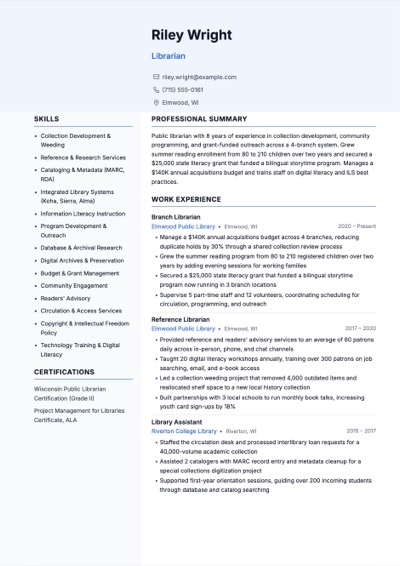
This is a complete fictional sample. Study the structure and evidence patterns, then replace every name, employer, number, skill, and accomplishment with information that is true for you.
Professional Summary
Public librarian with 8 years of experience in collection development, community programming, and grant-funded outreach across a 4-branch system. Grew summer reading enrollment from 80 to 210 children over two years and secured a $25,000 state literacy grant that funded a bilingual storytime program. Manages a $140K annual acquisitions budget and trains staff on digital literacy and ILS best practices.
Work Experience
Branch Librarian
2020 – PresentElmwood Public Library — Elmwood, WI
- Manage a $140K annual acquisitions budget across 4 branches, reducing duplicate holds by 30% through a shared collection review process
- Grew the summer reading program from 80 to 210 registered children over two years by adding evening sessions for working families
- Secured a $25,000 state literacy grant that funded a bilingual storytime program now running in 3 branch locations
- Supervise 5 part-time staff and 12 volunteers, coordinating scheduling for circulation, programming, and outreach
Reference Librarian
2017 – 2020Elmwood Public Library — Elmwood, WI
- Provided reference and readers' advisory services to an average of 60 patrons daily across in-person, phone, and chat channels
- Taught 20 digital literacy workshops annually, training over 300 patrons on job searching, email, and e-book access
- Led a collection weeding project that removed 4,000 outdated items and reallocated shelf space to a new local history collection
- Built partnerships with 3 local schools to run monthly book talks, increasing youth card sign-ups by 18%
Library Assistant
2015 – 2017Riverton College Library — Riverton, WI
- Staffed the circulation desk and processed interlibrary loan requests for a 40,000-volume academic collection
- Assisted 2 catalogers with MARC record entry and metadata cleanup for a special collections digitization project
- Supported first-year orientation sessions, guiding over 200 incoming students through database and catalog searching
Education
- Master of Library and Information Science (MLIS) — University of Wisconsin-Madison · 2017
- BA, English — University of Wisconsin-Eau Claire · 2014
Certifications
- Wisconsin Public Librarian Certification (Grade II)
- Project Management for Libraries Certificate, ALA
Achievement bullet patterns
Adapt the sentence pattern to your work. Never copy an employer, number, tool, or outcome that is not true for you.
- 1
Grew the summer reading program from 80 to 210 registered children over two years by adding evening sessions for working families
Adapt the pattern; do not copy facts that are not yours.
- 2
Managed a $140K annual acquisitions budget across 4 branches, reducing duplicate holds by 30% through a shared collection review
Adapt the pattern; do not copy facts that are not yours.
- 3
Secured a $25,000 state literacy grant that funded a bilingual storytime program now running in 3 branch locations
Adapt the pattern; do not copy facts that are not yours.
- 4
Taught 45 information literacy sessions per academic year to over 900 undergraduates, raising database usage among first-year students by 35%
Adapt the pattern; do not copy facts that are not yours.
Practical writing guidance
- 1
Quantify program attendance, such as 'Grew summer reading program enrollment from 80 to 210 children over two years'
- 2
State collection size and scope you managed, including budget figures if you controlled acquisitions spending
- 3
Cite grant or funding wins by dollar amount, since libraries increasingly expect librarians to help sustain outside funding
- 4
Include instruction numbers, like the number of information literacy sessions taught per semester and student reach
- 5
Mention any technology or digital literacy training you delivered, including patron counts served
- 6
Tailor your resume to the library type: public library outreach differs from academic reference or special collections work
How to write a librarian resume
Lead with the outcomes of your programs and collections, not job duties
Match your resume's focus to the library type in the posting
Name your systems, certifications, and standards precisely
Frequently Asked Questions
Do I need an MLIS to apply for most librarian roles?
Most professional librarian roles in public and academic libraries require an ALA-accredited MLIS, so list it under education with your graduation year. Paraprofessional and library assistant roles typically do not require it, so check the posting's requirements first.
How should I show program planning experience on my resume?
List each major program by name with attendance figures and any funding or partnerships involved, such as a summer reading series or a community literacy event. Attendance growth over time is especially persuasive, since it shows the program's success was not a one-time result.
Should academic and public librarian resumes look different?
Yes, academic library resumes should emphasize instruction sessions, faculty liaison work, and research support, while public library resumes should emphasize community programming and outreach. Tailor your skills and bullets to match the specific library type and the posting's stated priorities.
How do I present cataloging or technical services experience?
State the systems you used by name, such as MARC and RDA standards or a specific ILS like Koha or Alma, along with volume figures like records processed monthly. Technical services work is often screened by exact keyword match, so precise system names matter more than general descriptions.