
Turn inspiration into your own evidence
Do not copy the career. Learn how the career is communicated.
Read the evidence
Notice where the example uses scale, change, ownership, and context.
Replace every fact
Write from your real work, even when your numbers or setting are different.
Check the result
Make sure the document remains readable, truthful, and aligned to the role.
Key Skills
Use only the skills you can support with real experience. The example shows the vocabulary; your evidence makes it credible.
Full Market Research Analyst Resume Example
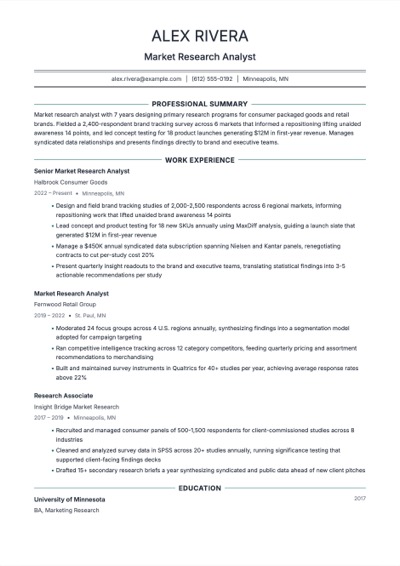
This is a complete fictional sample. Study the structure and evidence patterns, then replace every name, employer, number, skill, and accomplishment with information that is true for you.
Professional Summary
Market research analyst with 7 years designing primary research programs for consumer packaged goods and retail brands. Fielded a 2,400-respondent brand tracking survey across 6 markets that informed a repositioning lifting unaided awareness 14 points, and led concept testing for 18 product launches generating $12M in first-year revenue. Manages syndicated data relationships and presents findings directly to brand and executive teams.
Work Experience
Senior Market Research Analyst
2022 – PresentHalbrook Consumer Goods — Minneapolis, MN
- Design and field brand tracking studies of 2,000-2,500 respondents across 6 regional markets, informing repositioning work that lifted unaided brand awareness 14 points
- Lead concept and product testing for 18 new SKUs annually using MaxDiff analysis, guiding a launch slate that generated $12M in first-year revenue
- Manage a $450K annual syndicated data subscription spanning Nielsen and Kantar panels, renegotiating contracts to cut per-study cost 20%
- Present quarterly insight readouts to the brand and executive teams, translating statistical findings into 3-5 actionable recommendations per study
Market Research Analyst
2019 – 2022Fernwood Retail Group — St. Paul, MN
- Moderated 24 focus groups across 4 U.S. regions annually, synthesizing findings into a segmentation model adopted for campaign targeting
- Ran competitive intelligence tracking across 12 category competitors, feeding quarterly pricing and assortment recommendations to merchandising
- Built and maintained survey instruments in Qualtrics for 40+ studies per year, achieving average response rates above 22%
Research Associate
2017 – 2019Insight Bridge Market Research — Minneapolis, MN
- Recruited and managed consumer panels of 500-1,500 respondents for client-commissioned studies across 8 industries
- Cleaned and analyzed survey data in SPSS across 20+ studies annually, running significance testing that supported client-facing findings decks
- Drafted 15+ secondary research briefs a year synthesizing syndicated and public data ahead of new client pitches
Education
- BA, Marketing Research — University of Minnesota · 2017
Certifications
- Professional Researcher Certification (PRC) — Insights Association
- Qualtrics XM Certification
Achievement bullet patterns
Adapt the sentence pattern to your work. Never copy an employer, number, tool, or outcome that is not true for you.
- 1
Designed and fielded a 2,400-respondent brand tracking survey across 6 markets, informing a repositioning that lifted unaided brand awareness 14 points
Adapt the pattern; do not copy facts that are not yours.
- 2
Led concept testing for 18 new product concepts annually using MaxDiff analysis, guiding a launch slate that generated $12M in first-year revenue
Adapt the pattern; do not copy facts that are not yours.
- 3
Directed 24 focus groups across 4 U.S. regions and synthesized findings into a segmentation model the marketing team adopted for campaign targeting
Adapt the pattern; do not copy facts that are not yours.
- 4
Managed a $450K annual syndicated data subscription across Nielsen and Kantar panels, cutting per-study cost 20% through renegotiated multi-study contracts
Adapt the pattern; do not copy facts that are not yours.
Practical writing guidance
- 1
State sample size, response rate, and confidence level for any study you cite, since a reviewer will ask if you omit them
- 2
Name the marketing or business decision your research shaped, such as a pricing change, launch go/no-go, or repositioning
- 3
Distinguish primary research skills (surveys, focus groups) from secondary and syndicated data work (Nielsen, Kantar), since they draw different candidate pools
- 4
Report any research budget or vendor and panel relationships you managed, which signals you can run a program, not just a study
- 5
List statistical methods by name (conjoint, MaxDiff, regression) rather than a vague 'data analysis' since these are specific screening terms
- 6
Note how many studies you complete annually and the audiences you present findings to, such as brand or executive teams
How to write a market research analyst resume
Report sample size, methodology, and confidence level for every study
Connect each study to the business decision it changed
Separate primary research skills from secondary and syndicated data work
Frequently Asked Questions
What statistical skills should a market research analyst highlight?
Highlight the specific methods you have applied, such as conjoint analysis, MaxDiff, regression, or significance testing, rather than a generic 'statistics' line. Name the software you use (SPSS, Qualtrics, R) and give an example of a study where the method changed a marketing decision, not just that you ran it.
Should I include the marketing decisions my research influenced?
Yes, this is the single most persuasive element on a market research analyst resume. A study is only valuable if it changed something, so state the decision it informed: a pricing shift, a repositioning, a launch go or no-go call. This distinguishes analysts who deliver usable insight from those who only deliver a report.
How is a market research analyst resume different from a data analyst resume?
A market research analyst designs and fields original studies, primary research, panels, and surveys, aimed at marketing and brand decisions, while a data analyst typically works from existing internal data and dashboards. If you do both, separate the sections so a reviewer can tell which skill set is stronger.
What software should I list on a market research analyst resume?
List survey platforms (Qualtrics, SurveyMonkey), statistical software (SPSS, R), and syndicated data sources you have direct access experience with (Nielsen, Kantar, IRI). Recruiters and ATS systems search these exact product names, so avoid folding them into a generic 'research tools' phrase.