
Turn inspiration into your own evidence
Do not copy the career. Learn how the career is communicated.
Read the evidence
Notice where the example uses scale, change, ownership, and context.
Replace every fact
Write from your real work, even when your numbers or setting are different.
Check the result
Make sure the document remains readable, truthful, and aligned to the role.
Key Skills
Use only the skills you can support with real experience. The example shows the vocabulary; your evidence makes it credible.
Full Mason Resume Example
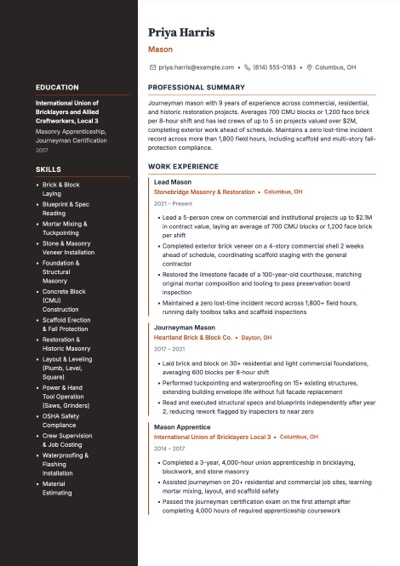
This is a complete fictional sample. Study the structure and evidence patterns, then replace every name, employer, number, skill, and accomplishment with information that is true for you.
Professional Summary
Journeyman mason with 9 years of experience across commercial, residential, and historic restoration projects. Averages 700 CMU blocks or 1,200 face brick per 8-hour shift and has led crews of up to 5 on projects valued over $2M, completing exterior work ahead of schedule. Maintains a zero lost-time incident record across more than 1,800 field hours, including scaffold and multi-story fall-protection compliance.
Work Experience
Lead Mason
2021 – PresentStonebridge Masonry & Restoration — Columbus, OH
- Lead a 5-person crew on commercial and institutional projects up to $2.1M in contract value, laying an average of 700 CMU blocks or 1,200 face brick per shift
- Completed exterior brick veneer on a 4-story commercial shell 2 weeks ahead of schedule, coordinating scaffold staging with the general contractor
- Restored the limestone facade of a 100-year-old courthouse, matching original mortar composition and tooling to pass preservation board inspection
- Maintained a zero lost-time incident record across 1,800+ field hours, running daily toolbox talks and scaffold inspections
Journeyman Mason
2017 – 2021Heartland Brick & Block Co. — Dayton, OH
- Laid brick and block on 30+ residential and light commercial foundations, averaging 600 blocks per 8-hour shift
- Performed tuckpointing and waterproofing on 15+ existing structures, extending building envelope life without full facade replacement
- Read and executed structural specs and blueprints independently after year 2, reducing rework flagged by inspectors to near zero
Mason Apprentice
2014 – 2017International Union of Bricklayers Local 3 — Columbus, OH
- Completed a 3-year, 4,000-hour union apprenticeship in bricklaying, blockwork, and stone masonry
- Assisted journeymen on 20+ residential and commercial job sites, learning mortar mixing, layout, and scaffold safety
- Passed the journeyman certification exam on the first attempt after completing 4,000 hours of required apprenticeship coursework
Education
- Masonry Apprenticeship, Journeyman Certification — International Union of Bricklayers and Allied Craftworkers, Local 3 · 2017
Certifications
- OSHA 30-Hour Construction Safety Certification
- Scaffold User Certification
- First Aid & CPR Certified
Achievement bullet patterns
Adapt the sentence pattern to your work. Never copy an employer, number, tool, or outcome that is not true for you.
- 1
Laid an average of 700 CMU blocks or 1,200 face brick per 8-hour shift across commercial and residential foundations, consistently meeting project schedules
Adapt the pattern; do not copy facts that are not yours.
- 2
Led a 5-person masonry crew on a $2.1M commercial building shell, completing exterior brick veneer 2 weeks ahead of schedule
Adapt the pattern; do not copy facts that are not yours.
- 3
Maintained a zero lost-time incident record across 1,800+ field hours, including scaffold and fall-protection compliance on multi-story work
Adapt the pattern; do not copy facts that are not yours.
- 4
Restored the limestone facade of a 100-year-old courthouse, matching original mortar composition and tooling to pass preservation board inspection
Adapt the pattern; do not copy facts that are not yours.
Practical writing guidance
- 1
State your output per shift, such as blocks or bricks laid in an 8-hour day, since it is the clearest productivity signal a foreman can compare
- 2
Note project scale and dollar value, since a $2M commercial shell reads differently than a single-family foundation
- 3
Report your safety record in hours or days worked without a lost-time incident, especially on multi-story or scaffold work
- 4
List your apprenticeship program and journeyman status by name if union-trained, since it signals a verified skill level
- 5
Mention crew size led or supervised if you have moved into a lead role, since it shows scheduling and quality-control responsibility
- 6
Call out restoration or historic masonry separately from new construction, since it draws a different, often higher-paying client base
How to write a mason resume
Quantify output in units laid and project scale, not job duties
Prove safety and code compliance with a record, not a claim
Separate apprenticeship, journeyman, and lead experience clearly
Frequently Asked Questions
Do I need to be union-trained to list masonry experience?
No, but if you completed a union apprenticeship, such as through the International Union of Bricklayers and Allied Craftworkers, name it directly since it signals a verified, standardized skill level to contractors. Non-union and self-taught masons should instead lean on specific project scale, output numbers, and any state licensing or OSHA training.
What certifications matter most on a mason resume?
OSHA 10 or 30-hour construction safety cards are close to standard expectations, and scaffold or forklift certifications matter for larger commercial jobs. Journeyman status from a recognized apprenticeship carries significant weight. First aid and CPR certification is a smaller but useful addition, especially for lead or crew-supervisor roles.
How do I show productivity on a mason resume?
Quantify units laid per shift, such as blocks or bricks per day, and cite total project scale in square footage or dollar value. If you led a crew, state its size and any schedule outcome, like finishing ahead of deadline. These numbers are what a foreman compares directly against their own production benchmarks.
Should I separate residential and commercial masonry experience?
Yes, since the two involve different scale, code requirements, and equipment. Commercial and structural masonry often involves scaffold work, engineered specs, and larger crews, while residential work emphasizes finish quality and direct client interaction. Label each job entry by project type so a reviewer can match you to their specific need.