
Turn inspiration into your own evidence
Do not copy the career. Learn how the career is communicated.
Read the evidence
Notice where the example uses scale, change, ownership, and context.
Replace every fact
Write from your real work, even when your numbers or setting are different.
Check the result
Make sure the document remains readable, truthful, and aligned to the role.
Key Skills
Use only the skills you can support with real experience. The example shows the vocabulary; your evidence makes it credible.
Full Midwife Resume Example
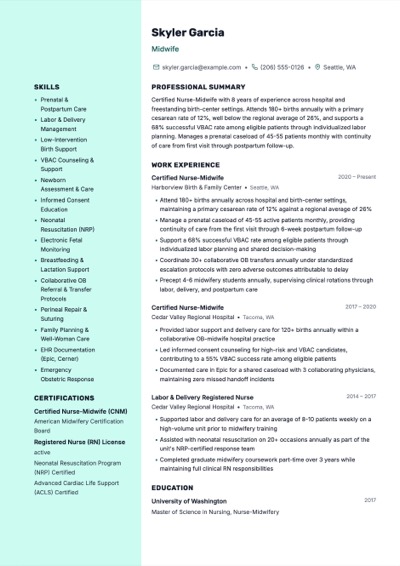
This is a complete fictional sample. Study the structure and evidence patterns, then replace every name, employer, number, skill, and accomplishment with information that is true for you.
Professional Summary
Certified Nurse-Midwife with 8 years of experience across hospital and freestanding birth-center settings. Attends 180+ births annually with a primary cesarean rate of 12%, well below the regional average of 26%, and supports a 68% successful VBAC rate among eligible patients through individualized labor planning. Manages a prenatal caseload of 45-55 patients monthly with continuity of care from first visit through postpartum follow-up.
Work Experience
Certified Nurse-Midwife
2020 – PresentHarborview Birth & Family Center — Seattle, WA
- Attend 180+ births annually across hospital and birth-center settings, maintaining a primary cesarean rate of 12% against a regional average of 26%
- Manage a prenatal caseload of 45-55 active patients monthly, providing continuity of care from the first visit through 6-week postpartum follow-up
- Support a 68% successful VBAC rate among eligible patients through individualized labor planning and shared decision-making
- Coordinate 30+ collaborative OB transfers annually under standardized escalation protocols with zero adverse outcomes attributable to delay
- Precept 4-6 midwifery students annually, supervising clinical rotations through labor, delivery, and postpartum care
Certified Nurse-Midwife
2017 – 2020Cedar Valley Regional Hospital — Tacoma, WA
- Provided labor support and delivery care for 120+ births annually within a collaborative OB-midwife hospital practice
- Led informed consent counseling for high-risk and VBAC candidates, contributing to a 55% VBAC success rate among eligible patients
- Documented care in Epic for a shared caseload with 3 collaborating physicians, maintaining zero missed handoff incidents
Labor & Delivery Registered Nurse
2014 – 2017Cedar Valley Regional Hospital — Tacoma, WA
- Supported labor and delivery care for an average of 8-10 patients weekly on a high-volume unit prior to midwifery training
- Assisted with neonatal resuscitation on 20+ occasions annually as part of the unit's NRP-certified response team
- Completed graduate midwifery coursework part-time over 3 years while maintaining full clinical RN responsibilities
Education
- Master of Science in Nursing, Nurse-Midwifery — University of Washington · 2017
- BSN, Nursing — Washington State University · 2012
Certifications
- Certified Nurse-Midwife (CNM) — American Midwifery Certification Board
- Registered Nurse (RN) License — active
- Neonatal Resuscitation Program (NRP) Certified
- Advanced Cardiac Life Support (ACLS) Certified
Achievement bullet patterns
Adapt the sentence pattern to your work. Never copy an employer, number, tool, or outcome that is not true for you.
- 1
Attended 180+ births annually across hospital and birth-center settings, maintaining a primary cesarean rate of 12%, well below the regional average of 26%
Adapt the pattern; do not copy facts that are not yours.
- 2
Managed a prenatal caseload of 45-55 active patients monthly, providing continuity of care from the first visit through 6-week postpartum follow-up
Adapt the pattern; do not copy facts that are not yours.
- 3
Supported a 68% successful VBAC rate among eligible patients through individualized labor planning and shared decision-making
Adapt the pattern; do not copy facts that are not yours.
- 4
Coordinated 30+ collaborative OB transfers annually under standardized protocols, maintaining zero adverse outcomes attributable to transfer delay
Adapt the pattern; do not copy facts that are not yours.
Practical writing guidance
- 1
State births attended annually alongside your primary cesarean rate compared to a regional or national benchmark, since that comparison is the strongest outcome signal you can offer
- 2
Report your VBAC success rate among eligible patients if you support vaginal birth after cesarean, since it is a closely tracked quality metric
- 3
Describe continuity of care explicitly, from first prenatal visit through the postpartum window, rather than listing labor support in isolation
- 4
Distinguish your practice setting (hospital, freestanding birth center, home birth), since each implies a different scope and collaborative structure
- 5
Quantify collaborative OB transfers and their outcomes, since smooth escalation is a core competency reviewers evaluate
- 6
List your credential precisely (CNM, CPM, or CM) along with NRP and any advanced life support certifications
How to write a midwife resume
Lead with birth volume and an intervention rate benchmark
Show continuity across the full prenatal-to-postpartum arc
Make collaborative and emergency protocols visible, not implied
Frequently Asked Questions
Should I distinguish CNM from CPM credentials on my resume?
Yes, list your exact credential (Certified Nurse-Midwife, Certified Professional Midwife, or Certified Midwife) prominently, since scope of practice, licensing, and hospital privileges differ significantly between them. Include your issuing board (AMCB for CNM/CM, NARM for CPM) and confirm active status without listing license numbers.
How do I show birth volume and outcomes without breaching patient privacy?
Use aggregate statistics only: births attended per year, primary cesarean rate, VBAC success rate, and transfer counts. These figures describe your practice pattern, not individual patients, and are standard in midwifery hiring. Never include identifying patient details or case-specific narratives on a resume.
What should a new midwife highlight without much independent experience?
Emphasize clinical rotation and preceptorship birth counts, the range of settings you trained in (hospital, birth center, home birth), and any specific competencies completed, such as suturing or NRP certification. Include supervised catch numbers if your program tracked them, since volume still matters even under supervision.
How does a hospital-based midwife resume differ from a home birth midwife resume?
Hospital-based midwives should emphasize collaborative physician relationships, electronic fetal monitoring proficiency, and integration with a larger care team. Home birth and birth-center midwives should emphasize independent risk assessment, transfer protocol outcomes, and continuity of care, since they typically carry full clinical responsibility for a longer stretch of the birth.