
Turn inspiration into your own evidence
Do not copy the career. Learn how the career is communicated.
Read the evidence
Notice where the example uses scale, change, ownership, and context.
Replace every fact
Write from your real work, even when your numbers or setting are different.
Check the result
Make sure the document remains readable, truthful, and aligned to the role.
Key Skills
Use only the skills you can support with real experience. The example shows the vocabulary; your evidence makes it credible.
Full Petroleum Engineer Resume Example
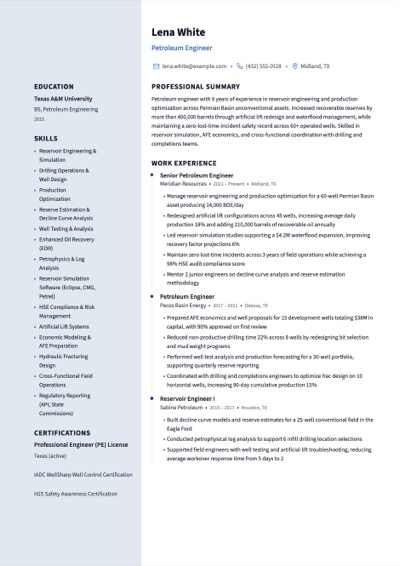
This is a complete fictional sample. Study the structure and evidence patterns, then replace every name, employer, number, skill, and accomplishment with information that is true for you.
Professional Summary
Petroleum engineer with 9 years of experience in reservoir engineering and production optimization across Permian Basin unconventional assets. Increased recoverable reserves by more than 400,000 barrels through artificial lift redesign and waterflood management, while maintaining a zero-lost-time-incident safety record across 60+ operated wells. Skilled in reservoir simulation, AFE economics, and cross-functional coordination with drilling and completions teams.
Work Experience
Senior Petroleum Engineer
2021 – PresentMeridian Resources — Midland, TX
- Manage reservoir engineering and production optimization for a 60-well Permian Basin asset producing 14,000 BOE/day
- Redesigned artificial lift configurations across 45 wells, increasing average daily production 18% and adding 210,000 barrels of recoverable oil annually
- Led reservoir simulation studies supporting a $4.2M waterflood expansion, improving recovery factor projections 6%
- Maintain zero lost-time incidents across 3 years of field operations while achieving a 98% HSE audit compliance score
- Mentor 2 junior engineers on decline curve analysis and reserve estimation methodology
Petroleum Engineer
2017 – 2021Pecos Basin Energy — Odessa, TX
- Prepared AFE economics and well proposals for 15 development wells totaling $38M in capital, with 90% approved on first review
- Reduced non-productive drilling time 22% across 8 wells by redesigning bit selection and mud weight programs
- Performed well test analysis and production forecasting for a 30-well portfolio, supporting quarterly reserve reporting
- Coordinated with drilling and completions engineers to optimize frac design on 10 horizontal wells, increasing 90-day cumulative production 15%
Reservoir Engineer I
2015 – 2017Sabine Petroleum — Houston, TX
- Built decline curve models and reserve estimates for a 25-well conventional field in the Eagle Ford
- Conducted petrophysical log analysis to support 6 infill drilling location selections
- Supported field engineers with well testing and artificial lift troubleshooting, reducing average workover response time from 5 days to 2
Education
- BS, Petroleum Engineering — Texas A&M University · 2015
Certifications
- Professional Engineer (PE) License — Texas (active)
- IADC WellSharp Well Control Certification
- H2S Safety Awareness Certification
Achievement bullet patterns
Adapt the sentence pattern to your work. Never copy an employer, number, tool, or outcome that is not true for you.
- 1
Optimized artificial lift design across 45 wells, increasing average daily production 18% and adding 210,000 barrels of recoverable oil annually
Adapt the pattern; do not copy facts that are not yours.
- 2
Led reservoir simulation studies for a 12-well waterflood project, improving recovery factor projections 6% and supporting a $4.2M capital allocation decision
Adapt the pattern; do not copy facts that are not yours.
- 3
Reduced non-productive drilling time 22% across 8 development wells by redesigning bit selection and mud weight programs
Adapt the pattern; do not copy facts that are not yours.
- 4
Managed AFE preparation and economic modeling for 15 well proposals totaling $38M in capital, with 90% approved on first review
Adapt the pattern; do not copy facts that are not yours.
Practical writing guidance
- 1
Quantify production gains with a specific figure and cause: 'Increased field production 18% through artificial lift redesign' outperforms 'improved well performance.'
- 2
State reserve volumes and economic impact you influenced, such as barrels added, NPV improvement, or capital deferred, since operators hire on measurable reserve growth.
- 3
List the reservoir simulation and modeling software you use by name (Eclipse, CMG, Petrel, OFM), since these are exact-match keywords technical recruiters filter on.
- 4
Highlight your safety record: incident-free field hours, wells drilled without a lost-time accident, or HSE audit scores.
- 5
Note your PE license status and specialized certifications such as well control training, since operators verify these early in screening.
- 6
Show cross-discipline coordination by naming the geologists, drilling engineers, or completions teams you worked with and the shared outcome.
How to write a petroleum engineer resume
Open with a summary that states your basin, well count, and production impact
Turn reserve and production numbers into resume-ready metrics
Separate rig-site rotations from office reservoir and completions work
Frequently Asked Questions
What certifications should a petroleum engineer include on their resume?
List your Professional Engineer (PE) license status, well control certification such as IWCF or IADC, and any API standards training. Include simulation software certifications like Eclipse or CMG if you hold them, plus field safety credentials such as H2S awareness.
How should I present reserve and production numbers on my resume?
Tie every reserve or production figure to your specific contribution, not the field's overall output. State the well count, formation, and time frame, then quantify the change: barrels added, recovery improvement, or capital deferred.
Should I separate rig-site experience from office engineering work?
Yes. Separate rotations or hitches at the rig site from reservoir or completions engineering performed in the office, since operators often screen for both. Note the basin or play, such as Permian or Bakken, for each role, because regional experience frequently determines which candidates advance.
How long should a petroleum engineer resume be?
One page for engineers with under eight years of experience, two pages beyond that if you have led multiple major projects. Prioritize your most technically complex and highest-impact projects over a complete chronological list of every well you touched.