
Turn inspiration into your own evidence
Do not copy the career. Learn how the career is communicated.
Read the evidence
Notice where the example uses scale, change, ownership, and context.
Replace every fact
Write from your real work, even when your numbers or setting are different.
Check the result
Make sure the document remains readable, truthful, and aligned to the role.
Key Skills
Use only the skills you can support with real experience. The example shows the vocabulary; your evidence makes it credible.
Full Pipefitter Resume Example
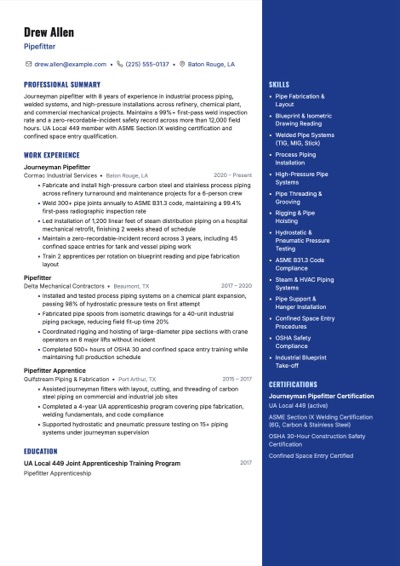
This is a complete fictional sample. Study the structure and evidence patterns, then replace every name, employer, number, skill, and accomplishment with information that is true for you.
Professional Summary
Journeyman pipefitter with 8 years of experience in industrial process piping, welded systems, and high-pressure installations across refinery, chemical plant, and commercial mechanical projects. Maintains a 99%+ first-pass weld inspection rate and a zero-recordable-incident safety record across more than 12,000 field hours. UA Local 449 member with ASME Section IX welding certification and confined space entry qualification.
Work Experience
Journeyman Pipefitter
2020 – PresentCormac Industrial Services — Baton Rouge, LA
- Fabricate and install high-pressure carbon steel and stainless process piping across refinery turnaround and maintenance projects for a 6-person crew
- Weld 300+ pipe joints annually to ASME B31.3 code, maintaining a 99.4% first-pass radiographic inspection rate
- Led installation of 1,200 linear feet of steam distribution piping on a hospital mechanical retrofit, finishing 2 weeks ahead of schedule
- Maintain a zero-recordable-incident record across 3 years, including 45 confined space entries for tank and vessel piping work
- Train 2 apprentices per rotation on blueprint reading and pipe fabrication layout
Pipefitter
2017 – 2020Delta Mechanical Contractors — Beaumont, TX
- Installed and tested process piping systems on a chemical plant expansion, passing 98% of hydrostatic pressure tests on first attempt
- Fabricated pipe spools from isometric drawings for a 40-unit industrial piping package, reducing field fit-up time 20%
- Coordinated rigging and hoisting of large-diameter pipe sections with crane operators on 6 major lifts without incident
- Completed 500+ hours of OSHA 30 and confined space entry training while maintaining full production schedule
Pipefitter Apprentice
2015 – 2017Gulfstream Piping & Fabrication — Port Arthur, TX
- Assisted journeyman fitters with layout, cutting, and threading of carbon steel piping on commercial and industrial job sites
- Completed a 4-year UA apprenticeship program covering pipe fabrication, welding fundamentals, and code compliance
- Supported hydrostatic and pneumatic pressure testing on 15+ piping systems under journeyman supervision
Education
- Pipefitter Apprenticeship — UA Local 449 Joint Apprenticeship Training Program · 2017
Certifications
- Journeyman Pipefitter Certification — UA Local 449 (active)
- ASME Section IX Welding Certification (6G, Carbon & Stainless Steel)
- OSHA 30-Hour Construction Safety Certification
- Confined Space Entry Certified
Achievement bullet patterns
Adapt the sentence pattern to your work. Never copy an employer, number, tool, or outcome that is not true for you.
- 1
Fabricated and installed 1,200+ linear feet of high-pressure carbon steel process piping across a refinery turnaround, passing 100% of hydrostatic pressure tests on first attempt
Adapt the pattern; do not copy facts that are not yours.
- 2
Welded 340 pipe joints to ASME B31.3 code on a chemical plant expansion with a 99.4% first-pass radiographic inspection rate
Adapt the pattern; do not copy facts that are not yours.
- 3
Led a 4-person crew installing steam distribution piping for a hospital renovation, completing the project 2 weeks ahead of schedule
Adapt the pattern; do not copy facts that are not yours.
- 4
Maintained a zero-recordable-incident record across 3,000+ field hours, including 45 confined space entries during tank and vessel piping work
Adapt the pattern; do not copy facts that are not yours.
Practical writing guidance
- 1
Lead with your journeyman or master pipefitter certification and union local, since these credentials filter which candidates get an interview call.
- 2
Quantify installation volume: 'Fabricated and installed 1,200 linear feet of high-pressure steam piping' gives supervisors a concrete sense of capacity.
- 3
List welding certifications by process and position (6G TIG, ASME Section IX), since industrial contractors screen for exact qualifications.
- 4
Highlight pressure test pass rates or first-pass weld inspection records to show your work holds up under code review.
- 5
Note experience with specific piping materials and systems, such as carbon steel, stainless, or process versus HVAC piping, to match the contractor's project type.
- 6
Mention your safety record: confined space entries completed, OSHA training hours, or days worked without a recordable incident.
How to write a pipefitter resume
Distinguish your process-piping expertise from residential plumbing work
Turn weld inspection and pressure test results into resume proof
Lead with certification and union standing, since contractors screen there first
Frequently Asked Questions
How is a pipefitter resume different from a plumber resume?
A pipefitter resume should emphasize industrial process piping, high-pressure systems, and code-driven welding rather than residential fixture work. Highlight ASME code compliance, weld inspection pass rates, and the specific systems you install, since contractors screen for this.
What certifications matter most for a pipefitter?
Journeyman or master pipefitter certification, union apprenticeship completion, and welding certifications tied to specific processes and positions, such as 6G TIG per ASME Section IX, carry the most weight. Confined space entry and OSHA 10 or 30 training are also commonly required on industrial job sites.
Should I include my union affiliation on my resume?
Yes, if you belong to a union local such as UA (United Association), list it near your certifications. Many industrial and commercial contractors staff through union hiring halls, so this affiliation can be a fast screening signal for recruiters and project superintendents.
How do I show weld quality on my resume without exaggerating?
Cite pass rates from actual inspection methods you were subject to, such as radiographic or hydrostatic testing, along with the joint count or footage they covered. A specific figure like a 99% first-pass radiographic rate across 340 joints is verifiable in a way a general claim about quality is not.