
Turn inspiration into your own evidence
Do not copy the career. Learn how the career is communicated.
Read the evidence
Notice where the example uses scale, change, ownership, and context.
Replace every fact
Write from your real work, even when your numbers or setting are different.
Check the result
Make sure the document remains readable, truthful, and aligned to the role.
Key Skills
Use only the skills you can support with real experience. The example shows the vocabulary; your evidence makes it credible.
Full Production Worker Resume Example
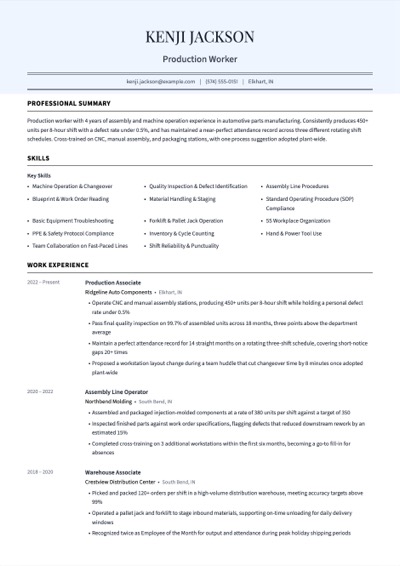
This is a complete fictional sample. Study the structure and evidence patterns, then replace every name, employer, number, skill, and accomplishment with information that is true for you.
Professional Summary
Production worker with 4 years of assembly and machine operation experience in automotive parts manufacturing. Consistently produces 450+ units per 8-hour shift with a defect rate under 0.5%, and has maintained a near-perfect attendance record across three different rotating shift schedules. Cross-trained on CNC, manual assembly, and packaging stations, with one process suggestion adopted plant-wide.
Work Experience
Production Associate
2022 – PresentRidgeline Auto Components — Elkhart, IN
- Operate CNC and manual assembly stations, producing 450+ units per 8-hour shift while holding a personal defect rate under 0.5%
- Pass final quality inspection on 99.7% of assembled units across 18 months, three points above the department average
- Maintain a perfect attendance record for 14 straight months on a rotating three-shift schedule, covering short-notice gaps 20+ times
- Proposed a workstation layout change during a team huddle that cut changeover time by 8 minutes once adopted plant-wide
Assembly Line Operator
2020 – 2022Northbend Molding — South Bend, IN
- Assembled and packaged injection-molded components at a rate of 380 units per shift against a target of 350
- Inspected finished parts against work order specifications, flagging defects that reduced downstream rework by an estimated 15%
- Completed cross-training on 3 additional workstations within the first six months, becoming a go-to fill-in for absences
Warehouse Associate
2018 – 2020Crestview Distribution Center — South Bend, IN
- Picked and packed 120+ orders per shift in a high-volume distribution warehouse, meeting accuracy targets above 99%
- Operated a pallet jack and forklift to stage inbound materials, supporting on-time unloading for daily delivery windows
- Recognized twice as Employee of the Month for output and attendance during peak holiday shipping periods
Education
- High School Diploma — Elkhart Central High School · 2018
Certifications
- OSHA 10-Hour General Industry
- Forklift Operator Certification
- Certified Production Technician (MSSC)
Achievement bullet patterns
Adapt the sentence pattern to your work. Never copy an employer, number, tool, or outcome that is not true for you.
- 1
Operated CNC and manual assembly stations to produce 450+ units per 8-hour shift while holding a personal defect rate under 0.5%
Adapt the pattern; do not copy facts that are not yours.
- 2
Passed final quality inspection on 99.7% of assembled units across 18 months, three points above the department average
Adapt the pattern; do not copy facts that are not yours.
- 3
Maintained a perfect attendance record for 14 straight months on a rotating three-shift schedule, covering short-notice gaps 20+ times
Adapt the pattern; do not copy facts that are not yours.
- 4
Proposed a workstation layout change during a team huddle that cut changeover time by 8 minutes once adopted plant-wide
Adapt the pattern; do not copy facts that are not yours.
Practical writing guidance
- 1
Put a real output number in your first bullet, such as units assembled per shift, since it's the fastest proof you can keep pace
- 2
Report your personal defect or reject rate if your plant tracks individual quality, since it separates you from someone who just showed up
- 3
Turn attendance into a stat: months without an unplanned absence, or shifts you covered on short notice
- 4
List every machine, tool, or certification you're qualified on by name (CNC, forklift, pallet jack) so keyword scans catch it
- 5
Mention any process idea you raised, even a small one, since employers read suggestions as a sign you'll stay past the first few months
- 6
Note cross-training across stations, which tells a scheduler you're flexible enough to cover gaps without notice
How to write a production worker resume
Start with the number that proves you can keep pace
Prove reliability with attendance and safety specifics
List every machine and certification by its exact name
Frequently Asked Questions
What should an entry-level production worker put on a resume with no factory experience?
Lean on transferable proof of reliability: retail or food service roles where you hit quotas, any forklift or safety certification you've earned, and specific numbers like hours per week or items processed. Employers hiring entry-level mainly screen for dependability.
How do I quantify manual, repetitive work on a resume?
Count what you can: units produced per shift, boxes packed per hour, orders fulfilled per day, or your defect rate if tracked. An honest estimate of typical output beats a duty like 'assembled products,' since it gives a hiring manager a number to compare against their line's target.
Which certifications actually help a production worker resume?
OSHA 10-Hour General Industry and a forklift operator certification are the two most requested. A Certified Production Technician (MSSC) credential helps for advanced manufacturing roles. Skip certifications unrelated to the posting; a short, relevant list reads better than a generic one.
How long should a production worker resume be?
One page. Hiring for these roles moves quickly and screeners spend seconds per resume, so keep it to your two or three most recent, relevant jobs with quantified bullets rather than a full work history stretching back a decade.