
Turn inspiration into your own evidence
Do not copy the career. Learn how the career is communicated.
Read the evidence
Notice where the example uses scale, change, ownership, and context.
Replace every fact
Write from your real work, even when your numbers or setting are different.
Check the result
Make sure the document remains readable, truthful, and aligned to the role.
Key Skills
Use only the skills you can support with real experience. The example shows the vocabulary; your evidence makes it credible.
Full Risk Manager Resume Example
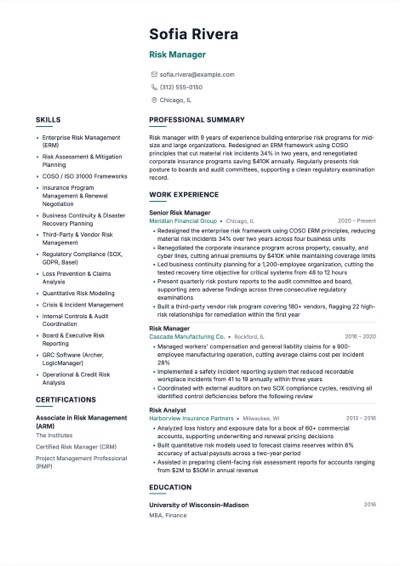
This is a complete fictional sample. Study the structure and evidence patterns, then replace every name, employer, number, skill, and accomplishment with information that is true for you.
Professional Summary
Risk manager with 9 years of experience building enterprise risk programs for mid-size and large organizations. Redesigned an ERM framework using COSO principles that cut material risk incidents 34% in two years, and renegotiated corporate insurance programs saving $410K annually. Regularly presents risk posture to boards and audit committees, supporting a clean regulatory examination record.
Work Experience
Senior Risk Manager
2020 – PresentMeridian Financial Group — Chicago, IL
- Redesigned the enterprise risk framework using COSO ERM principles, reducing material risk incidents 34% over two years across four business units
- Renegotiated the corporate insurance program across property, casualty, and cyber lines, cutting annual premiums by $410K while maintaining coverage limits
- Led business continuity planning for a 1,200-employee organization, cutting the tested recovery time objective for critical systems from 48 to 12 hours
- Present quarterly risk posture reports to the audit committee and board, supporting zero adverse findings across three consecutive regulatory examinations
- Built a third-party vendor risk program covering 180+ vendors, flagging 22 high-risk relationships for remediation within the first year
Risk Manager
2016 – 2020Cascade Manufacturing Co. — Rockford, IL
- Managed workers' compensation and general liability claims for a 900-employee manufacturing operation, cutting average claims cost per incident 28%
- Implemented a safety incident reporting system that reduced recordable workplace incidents from 41 to 19 annually within three years
- Coordinated with external auditors on two SOX compliance cycles, resolving all identified control deficiencies before the following review
Risk Analyst
2013 – 2016Harborview Insurance Partners — Milwaukee, WI
- Analyzed loss history and exposure data for a book of 60+ commercial accounts, supporting underwriting and renewal pricing decisions
- Built quantitative risk models used to forecast claims reserves within 8% accuracy of actual payouts across a two-year period
- Assisted in preparing client-facing risk assessment reports for accounts ranging from $2M to $50M in annual revenue
Education
- MBA, Finance — University of Wisconsin–Madison · 2016
- BS, Business Administration — University of Illinois at Chicago · 2013
Certifications
- Associate in Risk Management (ARM) — The Institutes
- Certified Risk Manager (CRM)
- Project Management Professional (PMP)
Achievement bullet patterns
Adapt the sentence pattern to your work. Never copy an employer, number, tool, or outcome that is not true for you.
- 1
Redesigned the enterprise risk framework using COSO ERM principles, reducing the organization's material risk incidents by 34% over two years
Adapt the pattern; do not copy facts that are not yours.
- 2
Renegotiated the corporate insurance program across property, casualty, and cyber lines, cutting annual premiums by $410K while maintaining coverage limits
Adapt the pattern; do not copy facts that are not yours.
- 3
Led business continuity planning for a 1,200-employee organization, cutting the tested recovery time objective for critical systems from 48 hours to 12
Adapt the pattern; do not copy facts that are not yours.
- 4
Presented quarterly risk posture reports to the audit committee and board, supporting zero adverse findings across three consecutive regulatory examinations
Adapt the pattern; do not copy facts that are not yours.
Practical writing guidance
- 1
Lead with a dollar figure tied to avoided or reduced loss, such as premium savings from a renegotiated insurance program or a documented drop in claims payouts
- 2
Name the specific framework you implemented or matured, such as COSO or ISO 31000, since hiring committees use this as shorthand for how rigorous your program was
- 3
Quantify incident or claims frequency before and after your intervention; a percentage reduction is far more persuasive than describing a program as 'comprehensive'
- 4
Show board or executive-level reporting experience, since risk managers are expected to translate exposure data into decisions leadership can act on
- 5
Include any regulatory exams or audits you supported and their outcome, such as zero findings or a resolved deficiency, as direct proof of program effectiveness
- 6
List relevant certifications like ARM or CRM prominently, since they are commonly used as a screening filter before a resume is even read closely
How to write a risk manager resume
Lead with avoided loss, not a list of responsibilities
Prove program effectiveness with third-party validation
Show you can translate exposure data for a non-technical audience
Frequently Asked Questions
How is a risk manager resume different from a compliance officer resume?
A compliance officer resume proves regulatory adherence: policies written, exams passed. A risk manager resume proves exposure reduction across insurance, operational, and financial risk. Lead with avoided loss and framework implementation, not regulatory citations alone.
What certifications matter most for risk manager roles?
ARM (Associate in Risk Management) and CRM (Certified Risk Manager) are the most screened-for credentials. FRM matters more for financial-risk roles, and PMP helps if the role includes large mitigation projects. List active certifications in the summary or a credentials line.
How do I quantify risk reduction when the outcome is something that didn't happen?
Use before-and-after comparisons: incident frequency, claims cost, or premium spend before your program versus after. Cite audit or examination results as third-party validation. If a specific loss event was avoided through a control you implemented, describe the mechanism and exposure size.
Should I include board or executive reporting experience?
Yes, and prominently. Risk managers are evaluated on their ability to translate technical exposure data into decisions leadership can act on. Mention the audience (board, audit committee, C-suite), the reporting cadence, and any decisions or resource approvals that resulted from your reporting.