
Turn inspiration into your own evidence
Do not copy the career. Learn how the career is communicated.
Read the evidence
Notice where the example uses scale, change, ownership, and context.
Replace every fact
Write from your real work, even when your numbers or setting are different.
Check the result
Make sure the document remains readable, truthful, and aligned to the role.
Key Skills
Use only the skills you can support with real experience. The example shows the vocabulary; your evidence makes it credible.
Full Roofer Resume Example
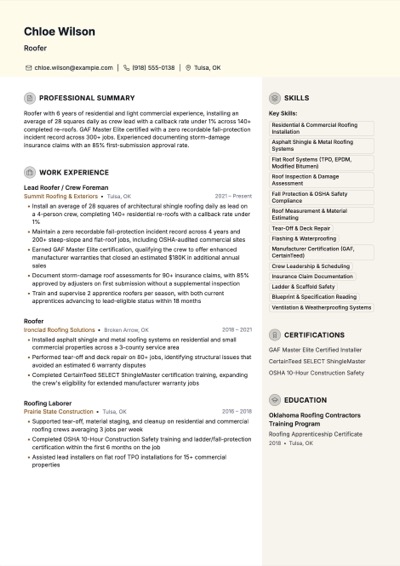
This is a complete fictional sample. Study the structure and evidence patterns, then replace every name, employer, number, skill, and accomplishment with information that is true for you.
Professional Summary
Roofer with 6 years of residential and light commercial experience, installing an average of 28 squares daily as crew lead with a callback rate under 1% across 140+ completed re-roofs. GAF Master Elite certified with a zero recordable fall-protection incident record across 300+ jobs. Experienced documenting storm-damage insurance claims with an 85% first-submission approval rate.
Work Experience
Lead Roofer / Crew Foreman
2021 – PresentSummit Roofing & Exteriors — Tulsa, OK
- Install an average of 28 squares of architectural shingle roofing daily as lead on a 4-person crew, completing 140+ residential re-roofs with a callback rate under 1%
- Maintain a zero recordable fall-protection incident record across 4 years and 200+ steep-slope and flat-roof jobs, including OSHA-audited commercial sites
- Earned GAF Master Elite certification, qualifying the crew to offer enhanced manufacturer warranties that closed an estimated $180K in additional annual sales
- Document storm-damage roof assessments for 90+ insurance claims, with 85% approved by adjusters on first submission without a supplemental inspection
- Train and supervise 2 apprentice roofers per season, with both current apprentices advancing to lead-eligible status within 18 months
Roofer
2018 – 2021Ironclad Roofing Solutions — Broken Arrow, OK
- Installed asphalt shingle and metal roofing systems on residential and small commercial properties across a 3-county service area
- Performed tear-off and deck repair on 80+ jobs, identifying structural issues that avoided an estimated 6 warranty disputes
- Completed CertainTeed SELECT ShingleMaster certification training, expanding the crew's eligibility for extended manufacturer warranty jobs
Roofing Laborer
2016 – 2018Prairie State Construction — Tulsa, OK
- Supported tear-off, material staging, and cleanup on residential and commercial roofing crews averaging 3 jobs per week
- Completed OSHA 10-Hour Construction Safety training and ladder/fall-protection certification within the first 6 months on the job
- Assisted lead installers on flat roof TPO installations for 15+ commercial properties
Education
- Roofing Apprenticeship Certificate — Oklahoma Roofing Contractors Training Program — Tulsa, OK · 2018
Certifications
- GAF Master Elite Certified Installer
- CertainTeed SELECT ShingleMaster
- OSHA 10-Hour Construction Safety
Achievement bullet patterns
Adapt the sentence pattern to your work. Never copy an employer, number, tool, or outcome that is not true for you.
- 1
Installed an average of 28 squares of architectural shingle roofing daily as lead on a 4-person crew, completing 140+ residential re-roofs with a callback rate under 1%
Adapt the pattern; do not copy facts that are not yours.
- 2
Maintained a zero recordable fall-protection incident record across 6 years and 300+ steep-slope and flat-roof jobs, including OSHA-audited commercial sites
Adapt the pattern; do not copy facts that are not yours.
- 3
Earned GAF Master Elite certification, qualifying the crew to offer enhanced manufacturer warranties that closed an estimated $180K in additional annual sales
Adapt the pattern; do not copy facts that are not yours.
- 4
Documented storm-damage roof assessments for 90+ insurance claims, with 85% approved by adjusters on first submission without a supplemental inspection
Adapt the pattern; do not copy facts that are not yours.
Practical writing guidance
- 1
State your production rate in squares per day or per crew, such as '28 squares installed daily on a 4-person crew,' since speed and quality together are what contractors are pricing when they bid a job
- 2
Report your callback or warranty-claim rate; a low or zero callback rate over a stated number of jobs is the single strongest signal of installation quality
- 3
List every manufacturer certification by name (GAF Master Elite, CertainTeed SELECT ShingleMaster), since these let a contractor offer extended warranties and directly affect what jobs you can be assigned to
- 4
Include your fall-protection and safety record explicitly, such as zero recordable incidents across a stated number of jobs or years, since roofing carries the highest injury risk in construction
- 5
Quantify crew leadership if applicable: crew size supervised, jobs completed on schedule, or training provided to apprentices
- 6
Mention experience with insurance-claim roofs (storm or hail damage) if relevant, since documentation skills for adjusters are a distinct and valued skill in residential roofing
How to write a roofer resume
Lead with production speed and callback rate together
Treat manufacturer certifications and safety record as hard credentials
Use insurance-claim and structural-repair experience to stand out
Frequently Asked Questions
What should I highlight if I'm new to roofing?
Emphasize any apprenticeship or trade program training, general construction experience, and comfort with heights and physical work. Mention tear-off, ladder, or fall-protection experience specifically, and note OSHA 10 training if completed, since safety awareness matters even at entry level.
How do I show production speed without a formal metric from my employer?
Estimate conservatively from job records you remember: typical squares per day on your crew, jobs completed per month, or average duration for a standard re-roof. A reasonable, honest estimate stated as approximate is more credible than an unquantified claim of being fast or efficient.
Are manufacturer certifications worth listing even if my employer held them, not me personally?
List them if you were the certified installer of record or part of the certified crew, and note that context. Contractors care whether you can execute to the standard a certification requires, which is a real skill regardless of whose name is on the certificate with the manufacturer.
How do I handle seasonal gaps common in roofing work?
List roofing jobs by season if that's how the work was structured, and don't leave unexplained gaps between them. If you worked a related trade or general labor during off-seasons, include it briefly; contractors in seasonal climates expect and understand this pattern.