
Turn inspiration into your own evidence
Do not copy the career. Learn how the career is communicated.
Read the evidence
Notice where the example uses scale, change, ownership, and context.
Replace every fact
Write from your real work, even when your numbers or setting are different.
Check the result
Make sure the document remains readable, truthful, and aligned to the role.
Key Skills
Use only the skills you can support with real experience. The example shows the vocabulary; your evidence makes it credible.
Full Security Engineer Resume Example
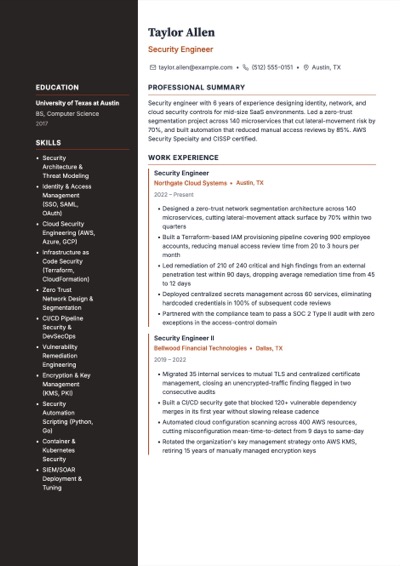
This is a complete fictional sample. Study the structure and evidence patterns, then replace every name, employer, number, skill, and accomplishment with information that is true for you.
Professional Summary
Security engineer with 6 years of experience designing identity, network, and cloud security controls for mid-size SaaS environments. Led a zero-trust segmentation project across 140 microservices that cut lateral-movement risk by 70%, and built automation that reduced manual access reviews by 85%. AWS Security Specialty and CISSP certified.
Work Experience
Security Engineer
2022 – PresentNorthgate Cloud Systems — Austin, TX
- Designed a zero-trust network segmentation architecture across 140 microservices, cutting lateral-movement attack surface by 70% within two quarters
- Built a Terraform-based IAM provisioning pipeline covering 900 employee accounts, reducing manual access review time from 20 to 3 hours per month
- Led remediation of 210 of 240 critical and high findings from an external penetration test within 90 days, dropping average remediation time from 45 to 12 days
- Deployed centralized secrets management across 60 services, eliminating hardcoded credentials in 100% of subsequent code reviews
- Partnered with the compliance team to pass a SOC 2 Type II audit with zero exceptions in the access-control domain
Security Engineer II
2019 – 2022Bellwood Financial Technologies — Dallas, TX
- Migrated 35 internal services to mutual TLS and centralized certificate management, closing an unencrypted-traffic finding flagged in two consecutive audits
- Built a CI/CD security gate that blocked 120+ vulnerable dependency merges in its first year without slowing release cadence
- Automated cloud configuration scanning across 400 AWS resources, cutting misconfiguration mean-time-to-detect from 9 days to same-day
- Rotated the organization's key management strategy onto AWS KMS, retiring 15 years of manually managed encryption keys
Systems Administrator
2017 – 2019Pinehill Data Center Services — San Antonio, TX
- Administered Linux and Windows server fleets of 250+ hosts, including patch management and hardening against CIS benchmarks
- Built the team's first automated backup verification script, catching 12 silent backup failures in its first six months
- Supported quarterly vulnerability scans across the data center and tracked remediation to closure for 3 internal teams
Education
- BS, Computer Science — University of Texas at Austin · 2017
Certifications
- CISSP — (ISC)² (active)
- AWS Certified Security – Specialty
- Offensive Security Certified Professional (OSCP)
- HashiCorp Certified: Terraform Associate
Achievement bullet patterns
Adapt the sentence pattern to your work. Never copy an employer, number, tool, or outcome that is not true for you.
- 1
Designed and rolled out a zero-trust segmentation architecture across 140 internal microservices, cutting the lateral-movement attack surface by 70% within two quarters
Adapt the pattern; do not copy facts that are not yours.
- 2
Built a Terraform-based IAM provisioning pipeline that reduced manual access review time from 20 hours to 3 hours per month across 900 employee accounts
Adapt the pattern; do not copy facts that are not yours.
- 3
Closed 210 of 240 critical and high vulnerabilities identified in an external penetration test within 90 days, dropping the org's average remediation time from 45 to 12 days
Adapt the pattern; do not copy facts that are not yours.
- 4
Deployed centralized secrets management across 60 services, eliminating hardcoded credentials flagged in 100% of prior security code reviews
Adapt the pattern; do not copy facts that are not yours.
Practical writing guidance
- 1
Lead with what you built, not what you watched: quote the number of services, endpoints, or accounts brought under a new control, such as 'migrated 140 microservices to mutual TLS'
- 2
Quantify risk reduction directly: vulnerabilities closed per quarter, mean time to remediate, or percentage drop in critical findings after a hardening project
- 3
Cite automation you shipped and the manual effort it removed, such as hours of manual access reviews eliminated per month by a provisioning workflow
- 4
Report scale: number of accounts under an IAM overhaul, services behind a new segmentation policy, or pipelines gated by a new security check
- 5
Name the compliance outcome your engineering work supported, like passing a SOC 2 Type II audit with zero exceptions in a control area you owned
- 6
List certifications (CISSP, OSCP, AWS Security Specialty) in a dedicated section since they are common screening filters for this title
How to write a security engineer resume
Write like a builder, not a watcher
Attach a number to every control you shipped
Keep certifications and coding languages in their own sections
Frequently Asked Questions
How is a security engineer resume different from a cybersecurity analyst resume?
An analyst resume centers on detection: alerts triaged, incidents investigated, threats hunted. A security engineer resume centers on construction: architectures designed, controls deployed, and vulnerabilities closed at the system level, not monitored from a dashboard.
Which certifications matter most for a security engineer resume?
CISSP and cloud-specific credentials like AWS or Azure Security Specialty carry the most weight for mid-to-senior roles, since they map to architecture work. OSCP helps for roles with offensive-security overlap. List active certifications in a dedicated section, not folded into your skills list.
How do I show impact without revealing sensitive security details?
Describe scope and outcome without naming specific vulnerabilities, tool configurations, or exploit paths tied to a live environment. 'Reduced critical findings 65% after a segmentation project' proves impact without exposing anything an attacker could reuse.
Should a security engineer resume include coding skills?
Yes. List the languages you actually used to automate controls, most commonly Python, Go, or PowerShell, and connect them to a specific outcome such as a provisioning script or a custom scanning tool. Coding ability signals you can build tooling rather than only configure vendor products.