
Turn inspiration into your own evidence
Do not copy the career. Learn how the career is communicated.
Read the evidence
Notice where the example uses scale, change, ownership, and context.
Replace every fact
Write from your real work, even when your numbers or setting are different.
Check the result
Make sure the document remains readable, truthful, and aligned to the role.
Key Skills
Use only the skills you can support with real experience. The example shows the vocabulary; your evidence makes it credible.
Full Structural Engineer Resume Example
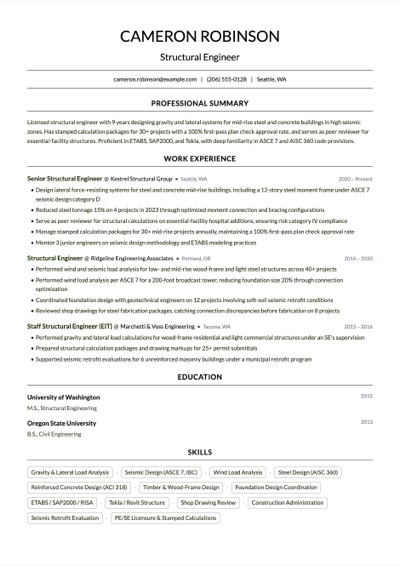
This is a complete fictional sample. Study the structure and evidence patterns, then replace every name, employer, number, skill, and accomplishment with information that is true for you.
Professional Summary
Licensed structural engineer with 9 years designing gravity and lateral systems for mid-rise steel and concrete buildings in high seismic zones. Has stamped calculation packages for 30+ projects with a 100% first-pass plan check approval rate, and serves as peer reviewer for essential-facility structures. Proficient in ETABS, SAP2000, and Tekla, with deep familiarity in ASCE 7 and AISC 360 code provisions.
Work Experience
Senior Structural Engineer
2020 – PresentKestrel Structural Group — Seattle, WA
- Design lateral force-resisting systems for steel and concrete mid-rise buildings, including a 12-story steel moment frame under ASCE 7 seismic design category D
- Reduced steel tonnage 15% on 4 projects in 2023 through optimized moment connection and bracing configurations
- Serve as peer reviewer for structural calculations on essential-facility hospital additions, ensuring risk category IV compliance
- Manage stamped calculation packages for 30+ mid-rise projects annually, maintaining a 100% first-pass plan check approval rate
- Mentor 3 junior engineers on seismic design methodology and ETABS modeling practices
Structural Engineer
2016 – 2020Ridgeline Engineering Associates — Portland, OR
- Performed wind and seismic load analysis for low- and mid-rise wood-frame and light steel structures across 40+ projects
- Performed wind load analysis per ASCE 7 for a 200-foot broadcast tower, reducing foundation size 20% through connection optimization
- Coordinated foundation design with geotechnical engineers on 12 projects involving soft-soil seismic retrofit conditions
- Reviewed shop drawings for steel fabrication packages, catching connection discrepancies before fabrication on 8 projects
Staff Structural Engineer (EIT)
2015 – 2016Marchetti & Voss Engineering — Tacoma, WA
- Performed gravity and lateral load calculations for wood-frame residential and light commercial structures under an SE's supervision
- Prepared structural calculation packages and drawing markups for 25+ permit submittals
- Supported seismic retrofit evaluations for 6 unreinforced masonry buildings under a municipal retrofit program
Education
- M.S., Structural Engineering — University of Washington · 2015
- B.S., Civil Engineering — Oregon State University · 2013
Certifications
- Licensed Structural Engineer (SE) — Washington (active)
- Licensed Professional Engineer (PE) — Oregon (active)
Achievement bullet patterns
Adapt the sentence pattern to your work. Never copy an employer, number, tool, or outcome that is not true for you.
- 1
Designed the lateral force-resisting system for a 12-story steel moment frame under ASCE 7 seismic design category D, reducing steel tonnage by 15%
Adapt the pattern; do not copy facts that are not yours.
- 2
Performed wind load analysis per ASCE 7 for a 200-foot broadcast tower, optimizing the moment connection to reduce foundation size by 20%
Adapt the pattern; do not copy facts that are not yours.
- 3
Served as peer reviewer for structural calculations on 6 essential-facility hospital additions, ensuring compliance with risk category IV requirements
Adapt the pattern; do not copy facts that are not yours.
- 4
Managed structural calculation packages for 30+ mid-rise projects annually, maintaining a 100% first-pass plan check approval rate over 3 years
Adapt the pattern; do not copy facts that are not yours.
Practical writing guidance
- 1
State your specialty (steel, concrete, timber) and seismic design category experience directly in your summary, not just a generic engineering title
- 2
Attach code editions and load types to each project: "designed lateral system per ASCE 7 seismic design category D" proves applied code knowledge
- 3
Quantify material savings or efficiency gains, such as steel tonnage or foundation size reductions achieved through optimized design
- 4
Pair each analysis software listed with the structure type you used it for, rather than a bare software list
- 5
Note your peer review experience by building risk category (essential facilities, high-occupancy) if applicable, since this signals a higher trust level
- 6
List your PE or SE license and state as active in a dedicated section, but never include the license number itself
How to write a structural engineer resume
State your load-resisting specialty and project scale up front
Attach load numbers and code references, not just "designed structural systems"
List your license, peer review role, and analysis software separately
Frequently Asked Questions
Should I list my PE or SE license number on my resume?
List your license type and state as active, but never the license number itself, for security reasons. A line such as "Licensed Structural Engineer (SE), California, active" is sufficient. Save the number for your application forms and reference checks, where employers verify it directly.
How is a structural engineer resume different from a civil engineer resume?
A structural engineer resume centers on gravity and lateral load design, seismic and wind analysis, and stamped calculations for a building type. Civil engineer resumes span broader site infrastructure like grading and stormwater, so keep structural resumes focused on the load-resisting system.
What software should I list on a structural engineer resume?
List the analysis and modeling software you actually used for design, such as ETABS, SAP2000, RISA, or Tekla, and pair each with the type of structure you applied it to. A reviewer weighs "ETABS for 12-story steel moment frames" far more heavily than a bare software list.
How do I present peer review experience on a structural engineer resume?
Note the building risk category you reviewed (essential facilities, high-occupancy structures) and your role, whether preparing calculations for review or serving as reviewer. Peer review experience on essential facilities signals a level of trust most structural roles specifically screen for.