
Turn inspiration into your own evidence
Do not copy the career. Learn how the career is communicated.
Read the evidence
Notice where the example uses scale, change, ownership, and context.
Replace every fact
Write from your real work, even when your numbers or setting are different.
Check the result
Make sure the document remains readable, truthful, and aligned to the role.
Key Skills
Use only the skills you can support with real experience. The example shows the vocabulary; your evidence makes it credible.
Full Veterinary Technician Resume Example
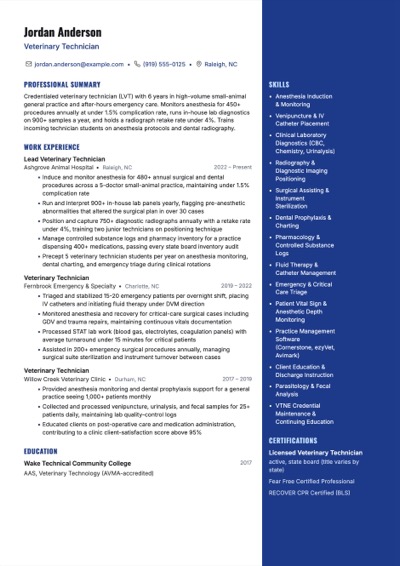
This is a complete fictional sample. Study the structure and evidence patterns, then replace every name, employer, number, skill, and accomplishment with information that is true for you.
Professional Summary
Credentialed veterinary technician (LVT) with 6 years in high-volume small-animal general practice and after-hours emergency care. Monitors anesthesia for 450+ procedures annually at under 1.5% complication rate, runs in-house lab diagnostics on 900+ samples a year, and holds a radiograph retake rate under 4%. Trains incoming technician students on anesthesia protocols and dental radiography.
Work Experience
Lead Veterinary Technician
2022 – PresentAshgrove Animal Hospital — Raleigh, NC
- Induce and monitor anesthesia for 480+ annual surgical and dental procedures across a 5-doctor small-animal practice, maintaining under 1.5% complication rate
- Run and interpret 900+ in-house lab panels yearly, flagging pre-anesthetic abnormalities that altered the surgical plan in over 30 cases
- Position and capture 750+ diagnostic radiographs annually with a retake rate under 4%, training two junior technicians on positioning technique
- Manage controlled substance logs and pharmacy inventory for a practice dispensing 400+ medications, passing every state board inventory audit
- Precept 5 veterinary technician students per year on anesthesia monitoring, dental charting, and emergency triage during clinical rotations
Veterinary Technician
2019 – 2022Fernbrook Emergency & Specialty — Charlotte, NC
- Triaged and stabilized 15-20 emergency patients per overnight shift, placing IV catheters and initiating fluid therapy under DVM direction
- Monitored anesthesia and recovery for critical-care surgical cases including GDV and trauma repairs, maintaining continuous vitals documentation
- Processed STAT lab work (blood gas, electrolytes, coagulation panels) with average turnaround under 15 minutes for critical patients
- Assisted in 200+ emergency surgical procedures annually, managing surgical suite sterilization and instrument turnover between cases
Veterinary Technician
2017 – 2019Willow Creek Veterinary Clinic — Durham, NC
- Provided anesthesia monitoring and dental prophylaxis support for a general practice seeing 1,000+ patients monthly
- Collected and processed venipuncture, urinalysis, and fecal samples for 25+ patients daily, maintaining lab quality-control logs
- Educated clients on post-operative care and medication administration, contributing to a clinic client-satisfaction score above 95%
Education
- AAS, Veterinary Technology (AVMA-accredited) — Wake Technical Community College · 2017
Certifications
- Licensed Veterinary Technician — active, state board (title varies by state)
- Fear Free Certified Professional
- RECOVER CPR Certified (BLS)
Achievement bullet patterns
Adapt the sentence pattern to your work. Never copy an employer, number, tool, or outcome that is not true for you.
- 1
Induced and monitored anesthesia for 480+ surgical and dental procedures annually, maintaining a complication rate under 1.5% across general and geriatric patients
Adapt the pattern; do not copy facts that are not yours.
- 2
Ran and interpreted 900+ in-house lab panels yearly (CBC, chemistry, urinalysis), flagging pre-anesthetic abnormalities that changed the surgical plan in 30+ cases
Adapt the pattern; do not copy facts that are not yours.
- 3
Positioned and captured 750+ diagnostic radiographs annually with a retake rate under 4%, reducing repeat radiation exposure for patients and staff
Adapt the pattern; do not copy facts that are not yours.
- 4
Trained and signed off 5 incoming veterinary technician students on anesthesia monitoring and dental radiography during clinical rotations
Adapt the pattern; do not copy facts that are not yours.
Practical writing guidance
- 1
State your credential in the header generically — Licensed/Credentialed Veterinary Technician (title varies LVT, CVT, RVT by state) — and confirm active status, never a license number
- 2
Quantify anesthesia cases you have monitored per week or year alongside a complication or recovery-time metric to prove hands-on scope beyond assisting
- 3
Give a number for in-house lab samples processed weekly since diagnostic throughput is a concrete measure of technical skill hospitals screen for
- 4
Report radiograph volume and retake rate — a low retake rate signals positioning skill that saves the practice time and radiation exposure
- 5
Note any specialty track toward a Veterinary Technician Specialist (VTS) designation, even in progress, since it signals depth beyond general practice
- 6
Separate technician-scope tasks (anesthesia, lab, radiology) from assistant-scope tasks (restraint, kennel care) in your bullets so the credential difference is unmistakable
How to write a veterinary technician resume
State your credential and its scope in the first two lines
Quantify the three tasks that define technician-level scope
Structure licenses and continuing education for ATS and human reviewers
Frequently Asked Questions
How should I show my credential (LVT/CVT/RVT) on my resume?
State it plainly in your header and summary — 'Licensed Veterinary Technician' or the equivalent title your state uses — and note that it is active and in good standing. Do not include the license number on your resume; that belongs on a job application form, not a document that circulates publicly.
What's the difference between a veterinary technician and veterinary assistant resume?
A technician resume foregrounds credentialed work — anesthesia, lab diagnostics, radiography — since these tasks legally require the credential in most states. An assistant resume centers restraint and support. If you hold the credential, lead with it and quantify procedures, not just patient count.
Do I need to list my VTNE score on my resume?
No. List that you passed the Veterinary Technician National Exam and hold an active state credential; the score itself is not something employers ask to see on a resume. If you are still awaiting exam results, say so directly rather than implying you are already credentialed.
Should I pursue a VTS specialty before applying to specialty hospitals?
Not necessarily — many specialty hospitals hire general-practice technicians and support VTS study on the job. Noting you're working toward a Veterinary Technician Specialist designation in a relevant area signals ambition and can offset a shorter track record.