
Turn inspiration into your own evidence
Do not copy the career. Learn how the career is communicated.
Read the evidence
Notice where the example uses scale, change, ownership, and context.
Replace every fact
Write from your real work, even when your numbers or setting are different.
Check the result
Make sure the document remains readable, truthful, and aligned to the role.
Key Skills
Use only the skills you can support with real experience. The example shows the vocabulary; your evidence makes it credible.
Full AI Engineer Resume Example
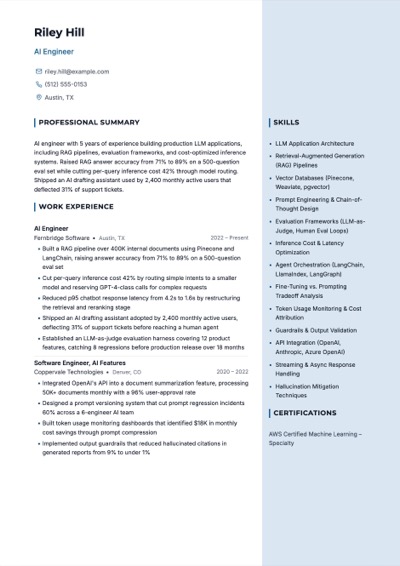
This is a complete fictional sample. Study the structure and evidence patterns, then replace every name, employer, number, skill, and accomplishment with information that is true for you.
Professional Summary
AI engineer with 5 years of experience building production LLM applications, including RAG pipelines, evaluation frameworks, and cost-optimized inference systems. Raised RAG answer accuracy from 71% to 89% on a 500-question eval set while cutting per-query inference cost 42% through model routing. Shipped an AI drafting assistant used by 2,400 monthly active users that deflected 31% of support tickets.
Work Experience
AI Engineer
2022 – PresentFernbridge Software — Austin, TX
- Built a RAG pipeline over 400K internal documents using Pinecone and LangChain, raising answer accuracy from 71% to 89% on a 500-question eval set
- Cut per-query inference cost 42% by routing simple intents to a smaller model and reserving GPT-4-class calls for complex requests
- Reduced p95 chatbot response latency from 4.2s to 1.6s by restructuring the retrieval and reranking stage
- Shipped an AI drafting assistant adopted by 2,400 monthly active users, deflecting 31% of support tickets before reaching a human agent
- Established an LLM-as-judge evaluation harness covering 12 product features, catching 8 regressions before production release over 18 months
Software Engineer, AI Features
2020 – 2022Coppervale Technologies — Denver, CO
- Integrated OpenAI's API into a document summarization feature, processing 50K+ documents monthly with a 96% user-approval rate
- Designed a prompt versioning system that cut prompt regression incidents 60% across a 6-engineer AI team
- Built token usage monitoring dashboards that identified $18K in monthly cost savings through prompt compression
- Implemented output guardrails that reduced hallucinated citations in generated reports from 9% to under 1%
Backend Engineer
2018 – 2020Hollowcreek Data — Denver, CO
- Built REST APIs supporting 200K daily requests for an internal analytics platform, maintaining 99.9% uptime
- Migrated a batch data pipeline to async processing, cutting nightly job runtime from 3 hours to 40 minutes
- Contributed early prototyping work on an internal search tool that later evolved into the company's first LLM-powered feature
Education
- BS, Computer Science — University of Texas at Austin · 2018
Certifications
- AWS Certified Machine Learning – Specialty
Achievement bullet patterns
Adapt the sentence pattern to your work. Never copy an employer, number, tool, or outcome that is not true for you.
- 1
Built a RAG pipeline over 400K internal documents that raised answer accuracy from 71% to 89% on a 500-question eval set
Adapt the pattern; do not copy facts that are not yours.
- 2
Cut per-query inference cost 42% by routing simple intents to a smaller model and reserving GPT-4-class calls for complex requests
Adapt the pattern; do not copy facts that are not yours.
- 3
Reduced p95 response latency from 4.2s to 1.6s by restructuring the retrieval and reranking stage of a customer support chatbot
Adapt the pattern; do not copy facts that are not yours.
- 4
Shipped an AI drafting assistant adopted by 2,400 monthly active users, deflecting 31% of support tickets before reaching a human agent
Adapt the pattern; do not copy facts that are not yours.
Practical writing guidance
- 1
Quantify inference economics: 'Cut per-query cost 42% by routing simple requests to a smaller model and reserving GPT-4-class calls for complex intents'
- 2
Report eval scores against a held-out test set, since a raw model quality claim without a measured baseline is not credible to a technical reviewer
- 3
State latency targets you hit, such as p95 response time, since production LLM features live or die on responsiveness as much as accuracy
- 4
Name the retrieval and orchestration stack explicitly (Pinecone, LangChain, LlamaIndex), since these are the literal terms recruiters and ATS systems search for
- 5
Distinguish your work from classical ML: emphasize application-layer decisions like chunking strategy and retrieval reranking rather than model training
- 6
Cite adoption or business metrics for the feature you shipped, such as query volume or ticket deflection rate, not just model quality metrics alone
How to write an AI engineer resume
Position yourself against ML engineer and data scientist resumes explicitly
Report eval scores with a baseline, never a bare quality claim
Show that you manage inference cost and latency, not just model quality
Frequently Asked Questions
How is an AI engineer resume different from a machine learning engineer resume?
An AI engineer resume emphasizes building applications on existing large language models, such as RAG pipelines, prompt design, and agent orchestration, rather than training custom models. Lead with application outcomes like eval accuracy, latency, and inference cost instead of model training metrics.
Do I need model training experience to be an AI engineer?
No. Most AI engineer roles focus on integrating and optimizing existing foundation models rather than training new ones. Fine-tuning experience is a plus, but pipeline design, retrieval quality, evaluation rigor, and cost-latency tradeoffs matter more to employers hiring for this role.
How should I show evaluation rigor on an AI engineer resume?
State the eval methodology and a before-and-after number: the size of your test set, whether it used human review or an LLM-as-judge approach, and the accuracy or quality score change. A claim like 'improved the chatbot' means nothing without a measured baseline attached.
Which tools should I list if I've only used one LLM provider?
List the provider and models you have real production experience with, such as OpenAI GPT-4 or Anthropic Claude, rather than padding the list with providers you haven't used. Depth with one provider's API, including function calling and cost controls, reads stronger than shallow familiarity with several.