
Turn inspiration into your own evidence
Do not copy the career. Learn how the career is communicated.
Read the evidence
Notice where the example uses scale, change, ownership, and context.
Replace every fact
Write from your real work, even when your numbers or setting are different.
Check the result
Make sure the document remains readable, truthful, and aligned to the role.
Key Skills
Use only the skills you can support with real experience. The example shows the vocabulary; your evidence makes it credible.
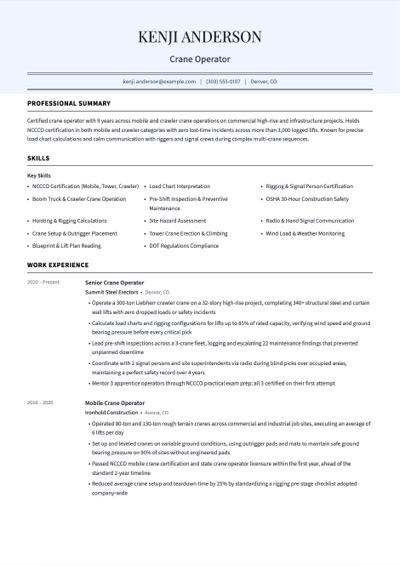
Full Crane Operator Resume Example
This is a complete fictional sample. Study the structure and evidence patterns, then replace every name, employer, number, skill, and accomplishment with information that is true for you.
Professional Summary
Certified crane operator with 9 years across mobile and crawler crane operations on commercial high-rise and infrastructure projects. Holds NCCCO certification in both mobile and crawler categories with zero lost-time incidents across more than 3,000 logged lifts. Known for precise load chart calculations and calm communication with riggers and signal crews during complex multi-crane sequences.
Work Experience
Senior Crane Operator
2020 – PresentSummit Steel Erectors — Denver, CO
- Operate a 300-ton Liebherr crawler crane on a 32-story high-rise project, completing 340+ structural steel and curtain wall lifts with zero dropped loads or safety incidents
- Calculate load charts and rigging configurations for lifts up to 85% of rated capacity, verifying wind speed and ground bearing pressure before every critical pick
- Lead pre-shift inspections across a 3-crane fleet, logging and escalating 22 maintenance findings that prevented unplanned downtime
- Coordinate with 2 signal persons and site superintendents via radio during blind picks over occupied areas, maintaining a perfect safety record over 4 years
- Mentor 3 apprentice operators through NCCCO practical exam prep; all 3 certified on their first attempt
Mobile Crane Operator
2016 – 2020Ironhold Construction — Aurora, CO
- Operated 80-ton and 130-ton rough terrain cranes across commercial and industrial job sites, executing an average of 6 lifts per day
- Set up and leveled cranes on variable ground conditions, using outrigger pads and mats to maintain safe ground bearing pressure on 90% of sites without engineered pads
- Passed NCCCO mobile crane certification and state crane operator licensure within the first year, ahead of the standard 2-year timeline
- Reduced average crane setup and teardown time by 25% by standardizing a rigging pre-stage checklist adopted company-wide
Rigger / Crane Operator Trainee
2014 – 2016Bedrock Industrial — Colorado Springs, CO
- Rigged and signaled for crane lifts on industrial plant maintenance projects, handling loads up to 40 tons under journeyman supervision
- Completed 500+ hours of logged crane operation time toward NCCCO certification eligibility while working full-time as a rigger
- Earned OSHA 30-hour construction safety certification and a qualified rigger credential within the first 8 months on the job
Education
- Crane Operator Apprenticeship, NCCCO-Accredited Program — International Union of Operating Engineers Local 9 · 2016
Certifications
- NCCCO Certified Crane Operator — Mobile & Crawler (active)
- OSHA 30-Hour Construction Safety Certification
- Qualified Rigger & Signal Person Certification
- State Crane Operator License (active)
Achievement bullet patterns
Adapt the sentence pattern to your work. Never copy an employer, number, tool, or outcome that is not true for you.
- 1
Operated a 300-ton hydraulic crawler crane through 340+ structural steel lifts on a 32-story build, finishing with zero dropped loads or recordable safety incidents.
Adapt the pattern; do not copy facts that are not yours.
- 2
Maintained 100% pre-shift inspection completion across a 3-crane fleet, flagging 22 maintenance issues before they caused unplanned downtime.
Adapt the pattern; do not copy facts that are not yours.
- 3
Directed a 45-ton wind turbine blade lift in gusting conditions alongside 2 signal persons, completing the sequence 2 hours ahead of the site's lift plan schedule.
Adapt the pattern; do not copy facts that are not yours.
- 4
Coached 3 apprentice operators through load chart calculations and rigging setup, with all 3 passing NCCCO practical exams on the first attempt.
Adapt the pattern; do not copy facts that are not yours.
Practical writing guidance
- 1
State your NCCCO certification class and crane category together — "NCCCO Certified, Mobile & Crawler" tells a hiring manager exactly which cranes you can be assigned to.
- 2
Quantify lift volume and safety record: "Completed 340+ structural lifts with zero dropped loads" proves capability faster than years of tenure.
- 3
List the maximum rated capacity you have operated, since job postings often specify tonnage requirements a candidate must meet.
- 4
Track pre-shift inspection completion and maintenance findings you caught — superintendents read this as proactive safety culture, not just compliance.
- 5
Name specific crane makes (Liebherr, Manitowoc, Grove, Terex) if you have deep experience, since familiarity with a brand's control system shortens onboarding.
- 6
Separate mobile, tower, and crawler experience into distinct lines rather than one blended skills list, so recruiters can match you to the posting's exact crane type.
How to write a crane operator resume
Lead with certification class, crane category, and safety streak
Convert lift count and tonnage into numbers a hiring manager can verify
Organize certifications and crane categories the way staffing coordinators search for them
Frequently Asked Questions
What certifications does a crane operator need on a resume?
NCCCO certification is the industry standard — list it by crane category (mobile, tower, crawler, articulating boom) along with your certified load class. Add your state crane operator license if your state requires one, plus any rigger or signal person credentials you hold.
How should I present my safety record on a crane operator resume?
State your streak without a lost-time incident or dropped load, and your pre-shift inspection completion rate if your employer tracked it. Mention safety training you delivered to ground crews. A clean safety record often outweighs raw years of experience in hiring decisions.
Should I list the specific crane models and tonnage I've operated?
Yes. List the crane types and maximum rated capacities you've run, since postings frequently specify tonnage requirements. Note manufacturer names for equipment you know well — Liebherr, Manitowoc, Grove — because familiarity with a brand's controls reduces onboarding time for the employer.
How do I handle a resume that mixes mobile and tower crane experience?
Split the experience into clearly labeled sections if you've logged meaningful time on both, since most employers staff for one specialty per project. Lead with whichever category matches the posting, and list NCCCO certification separately for each crane type rather than combining them.