
Turn inspiration into your own evidence
Do not copy the career. Learn how the career is communicated.
Read the evidence
Notice where the example uses scale, change, ownership, and context.
Replace every fact
Write from your real work, even when your numbers or setting are different.
Check the result
Make sure the document remains readable, truthful, and aligned to the role.
Key Skills
Use only the skills you can support with real experience. The example shows the vocabulary; your evidence makes it credible.
Full Heavy Equipment Operator Resume Example
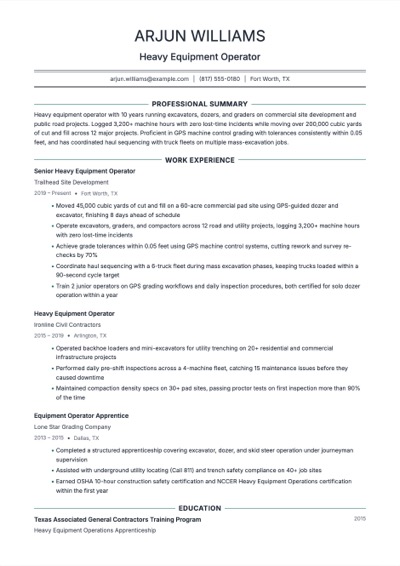
This is a complete fictional sample. Study the structure and evidence patterns, then replace every name, employer, number, skill, and accomplishment with information that is true for you.
Professional Summary
Heavy equipment operator with 10 years running excavators, dozers, and graders on commercial site development and public road projects. Logged 3,200+ machine hours with zero lost-time incidents while moving over 200,000 cubic yards of cut and fill across 12 major projects. Proficient in GPS machine control grading with tolerances consistently within 0.05 feet, and has coordinated haul sequencing with truck fleets on multiple mass-excavation jobs.
Work Experience
Senior Heavy Equipment Operator
2019 – PresentTrailhead Site Development — Fort Worth, TX
- Moved 45,000 cubic yards of cut and fill on a 60-acre commercial pad site using GPS-guided dozer and excavator, finishing 8 days ahead of schedule
- Operate excavators, graders, and compactors across 12 road and utility projects, logging 3,200+ machine hours with zero lost-time incidents
- Achieve grade tolerances within 0.05 feet using GPS machine control systems, cutting rework and survey re-checks by 70%
- Coordinate haul sequencing with a 6-truck fleet during mass excavation phases, keeping trucks loaded within a 90-second cycle target
- Train 2 junior operators on GPS grading workflows and daily inspection procedures, both certified for solo dozer operation within a year
Heavy Equipment Operator
2015 – 2019Ironline Civil Contractors — Arlington, TX
- Operated backhoe loaders and mini-excavators for utility trenching on 20+ residential and commercial infrastructure projects
- Performed daily pre-shift inspections across a 4-machine fleet, catching 15 maintenance issues before they caused downtime
- Maintained compaction density specs on 30+ pad sites, passing proctor tests on first inspection more than 90% of the time
Equipment Operator Apprentice
2013 – 2015Lone Star Grading Company — Dallas, TX
- Completed a structured apprenticeship covering excavator, dozer, and skid steer operation under journeyman supervision
- Assisted with underground utility locating (Call 811) and trench safety compliance on 40+ job sites
- Earned OSHA 10-hour construction safety certification and NCCER Heavy Equipment Operations certification within the first year
Education
- Heavy Equipment Operations Apprenticeship — Texas Associated General Contractors Training Program · 2015
Certifications
- NCCER Heavy Equipment Operations Certification
- OSHA 10-Hour Construction Safety Certification
- Commercial Driver's License (CDL Class B, active)
Achievement bullet patterns
Adapt the sentence pattern to your work. Never copy an employer, number, tool, or outcome that is not true for you.
- 1
Moved 45,000 cubic yards of cut and fill on a 60-acre commercial pad site using GPS-guided dozer and excavator, finishing 8 days ahead of schedule
Adapt the pattern; do not copy facts that are not yours.
- 2
Operated excavators, graders, and compactors across 12 road and utility projects, logging 3,200+ machine hours with zero lost-time incidents
Adapt the pattern; do not copy facts that are not yours.
- 3
Achieved grade tolerances within 0.05 feet using GPS machine control systems, cutting rework and survey re-checks by 70%
Adapt the pattern; do not copy facts that are not yours.
- 4
Coordinated haul sequencing with a 6-truck fleet during a 15,000-yard mass excavation, keeping trucks loaded within a 90-second cycle target
Adapt the pattern; do not copy facts that are not yours.
Practical writing guidance
- 1
State cubic yards of cut and fill moved per project or shift, since production volume is the first thing a superintendent staffs against
- 2
List every machine type you run by name (excavator, dozer, grader, loader) rather than a blended 'heavy equipment' line, so you match specific job requirements
- 3
Report grading accuracy under GPS machine control, such as tolerance achieved, since it shows precision beyond raw dirt-moving speed
- 4
Track total logged machine hours, since it is a direct, verifiable measure of experience that hiring managers compare across candidates
- 5
State your safety record as an incident-free streak, since a clean history often outweighs additional years of tenure in hiring decisions
- 6
Mention haul coordination or cycle-time results if you have worked with truck fleets, since it shows you manage production flow, not just a single machine
How to write a heavy equipment operator resume
Open with cubic yards moved and total machine hours
Show machine versatility and GPS grading precision, not just tenure
Structure safety record and certifications so a scheduler can verify them fast
Frequently Asked Questions
Which machines should I list by name on my resume?
List every machine type you are qualified to run individually — excavator, bulldozer, motor grader, backhoe, skid steer — rather than a generic 'heavy equipment' line. Postings frequently require a specific machine, and a superintendent scanning for 'grader operator' will skip a vaguer resume.
How do I show my safety record effectively?
State a specific incident-free streak, such as years or machine hours without a lost-time incident, and mention any safety training you delivered to a crew. A verifiable clean record is one of the strongest hiring signals in earthwork, often weighed above raw tenure.
Is GPS machine control experience worth highlighting?
Yes. GPS and GNSS machine control is now standard on most commercial sites, and operators fluent in it produce tighter grading tolerances with less rework. State the accuracy you have achieved, since it separates you from operators with only manual grade-stake experience.
How does a heavy equipment operator resume differ from a crane operator resume?
A heavy equipment operator resume centers on earthmoving production: cubic yards moved, grading tolerances, and machine versatility. A crane operator resume centers on rigging, lift counts, and certification class. If you hold both, keep the sections distinct for each hiring audience.