
Turn inspiration into your own evidence
Do not copy the career. Learn how the career is communicated.
Read the evidence
Notice where the example uses scale, change, ownership, and context.
Replace every fact
Write from your real work, even when your numbers or setting are different.
Check the result
Make sure the document remains readable, truthful, and aligned to the role.
Key Skills
Use only the skills you can support with real experience. The example shows the vocabulary; your evidence makes it credible.
Full Database Administrator Resume Example
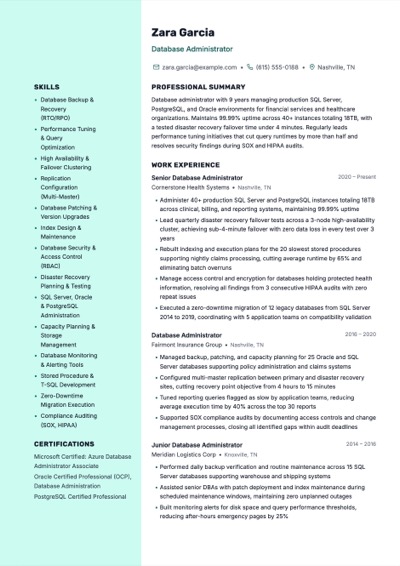
This is a complete fictional sample. Study the structure and evidence patterns, then replace every name, employer, number, skill, and accomplishment with information that is true for you.
Professional Summary
Database administrator with 9 years managing production SQL Server, PostgreSQL, and Oracle environments for financial services and healthcare organizations. Maintains 99.99% uptime across 40+ instances totaling 18TB, with a tested disaster recovery failover time under 4 minutes. Regularly leads performance tuning initiatives that cut query runtimes by more than half and resolves security findings during SOX and HIPAA audits.
Work Experience
Senior Database Administrator
2020 – PresentCornerstone Health Systems — Nashville, TN
- Administer 40+ production SQL Server and PostgreSQL instances totaling 18TB across clinical, billing, and reporting systems, maintaining 99.99% uptime
- Lead quarterly disaster recovery failover tests across a 3-node high-availability cluster, achieving sub-4-minute failover with zero data loss in every test over 3 years
- Rebuilt indexing and execution plans for the 20 slowest stored procedures supporting nightly claims processing, cutting average runtime by 65% and eliminating batch overruns
- Manage access control and encryption for databases holding protected health information, resolving all findings from 3 consecutive HIPAA audits with zero repeat issues
- Executed a zero-downtime migration of 12 legacy databases from SQL Server 2014 to 2019, coordinating with 5 application teams on compatibility validation
Database Administrator
2016 – 2020Fairmont Insurance Group — Nashville, TN
- Managed backup, patching, and capacity planning for 25 Oracle and SQL Server databases supporting policy administration and claims systems
- Configured multi-master replication between primary and disaster recovery sites, cutting recovery point objective from 4 hours to 15 minutes
- Tuned reporting queries flagged as slow by application teams, reducing average execution time by 40% across the top 30 reports
- Supported SOX compliance audits by documenting access controls and change management processes, closing all identified gaps within audit deadlines
Junior Database Administrator
2014 – 2016Meridian Logistics Corp — Knoxville, TN
- Performed daily backup verification and routine maintenance across 15 SQL Server databases supporting warehouse and shipping systems
- Assisted senior DBAs with patch deployment and index maintenance during scheduled maintenance windows, maintaining zero unplanned outages
- Built monitoring alerts for disk space and query performance thresholds, reducing after-hours emergency pages by 25%
Education
- BS, Computer Science — Middle Tennessee State University · 2014
Certifications
- Microsoft Certified: Azure Database Administrator Associate
- Oracle Certified Professional (OCP), Database Administration
- PostgreSQL Certified Professional
Achievement bullet patterns
Adapt the sentence pattern to your work. Never copy an employer, number, tool, or outcome that is not true for you.
- 1
Administer 40+ production SQL Server and PostgreSQL instances totaling 18TB, maintaining 99.99% uptime and a 15-minute recovery point objective across all critical databases.
Adapt the pattern; do not copy facts that are not yours.
- 2
Rebuilt indexing and query execution plans for the top 20 slowest stored procedures, cutting average query runtime by 65% and eliminating nightly batch job overruns.
Adapt the pattern; do not copy facts that are not yours.
- 3
Led quarterly disaster recovery failover tests across a 3-node high-availability cluster, achieving a sub-4-minute failover time with zero data loss in every test.
Adapt the pattern; do not copy facts that are not yours.
- 4
Executed a zero-downtime migration of 12 legacy databases from SQL Server 2014 to 2019, coordinating with 5 application teams to validate compatibility before cutover.
Adapt the pattern; do not copy facts that are not yours.
Practical writing guidance
- 1
Quantify uptime and recovery metrics: "Maintained 99.99% uptime across 40 production databases with a 15-minute recovery point objective" proves reliability instantly.
- 2
State database platforms and versions you administer by name (SQL Server 2019, Oracle 19c, PostgreSQL 15) since postings often require platform-specific experience.
- 3
Highlight performance tuning wins with before/after numbers — query runtime reductions, index rebuilds, or resource utilization improvements.
- 4
Mention disaster recovery testing frequency and results, not just that a DR plan exists. Employers want proof failover has actually worked.
- 5
Include database size and instance count you manage, since scale is a primary qualifier for senior DBA roles.
- 6
List security and compliance work — access control audits, encryption implementation, or findings resolved during SOX or HIPAA audits.
How to write a database administrator resume
Open with uptime, scale, and recovery numbers
Prove disaster recovery and security work with test results, not policy statements
Turn performance tuning into a before-and-after metric every time
Frequently Asked Questions
What should a database administrator resume emphasize over a data engineer resume?
Focus on operational reliability: uptime, backup and recovery metrics, performance tuning, and security administration. A data engineer resume emphasizes building pipelines that move data between systems; a DBA resume emphasizes keeping the databases themselves running, fast, and recoverable.
How do I show disaster recovery experience effectively?
State how often you test failover, not just that a DR plan exists on paper. Include the recovery time achieved, whether any data was lost, and the size or criticality of the databases covered. A tested, documented recovery time is far more credible than a claim of "disaster recovery planning" alone.
Should I list every database platform I've touched?
List the platforms you can administer independently, with version numbers where relevant, rather than every system you've briefly encountered. Depth on 2-3 platforms reads stronger than a long list of tools you've only assisted with. Match your listed platforms to the posting's requirements.
How important are performance tuning metrics on a DBA resume?
Very important — tuning is one of the most concrete ways to prove skill. Include before-and-after numbers whenever possible: query runtime reduced, index rebuild results, resource utilization improved. These are easy to verify and more persuasive than a general skill listing.