
Turn inspiration into your own evidence
Do not copy the career. Learn how the career is communicated.
Read the evidence
Notice where the example uses scale, change, ownership, and context.
Replace every fact
Write from your real work, even when your numbers or setting are different.
Check the result
Make sure the document remains readable, truthful, and aligned to the role.
Key Skills
Use only the skills you can support with real experience. The example shows the vocabulary; your evidence makes it credible.
Full Data Architect Resume Example
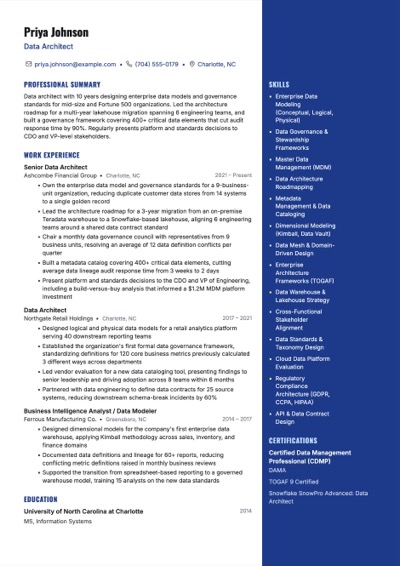
This is a complete fictional sample. Study the structure and evidence patterns, then replace every name, employer, number, skill, and accomplishment with information that is true for you.
Professional Summary
Data architect with 10 years designing enterprise data models and governance standards for mid-size and Fortune 500 organizations. Led the architecture roadmap for a multi-year lakehouse migration spanning 6 engineering teams, and built a governance framework covering 400+ critical data elements that cut audit response time by 90%. Regularly presents platform and standards decisions to CDO and VP-level stakeholders.
Work Experience
Senior Data Architect
2021 – PresentAshcombe Financial Group — Charlotte, NC
- Own the enterprise data model and governance standards for a 9-business-unit organization, reducing duplicate customer data stores from 14 systems to a single golden record
- Lead the architecture roadmap for a 3-year migration from an on-premise Teradata warehouse to a Snowflake-based lakehouse, aligning 6 engineering teams around a shared data contract standard
- Chair a monthly data governance council with representatives from 9 business units, resolving an average of 12 data definition conflicts per quarter
- Built a metadata catalog covering 400+ critical data elements, cutting average data lineage audit response time from 3 weeks to 2 days
- Present platform and standards decisions to the CDO and VP of Engineering, including a build-versus-buy analysis that informed a $1.2M MDM platform investment
Data Architect
2017 – 2021Northgate Retail Holdings — Charlotte, NC
- Designed logical and physical data models for a retail analytics platform serving 40 downstream reporting teams
- Established the organization's first formal data governance framework, standardizing definitions for 120 core business metrics previously calculated 3 different ways across departments
- Led vendor evaluation for a new data cataloging tool, presenting findings to senior leadership and driving adoption across 8 teams within 6 months
- Partnered with data engineering to define data contracts for 25 source systems, reducing downstream schema-break incidents by 60%
Business Intelligence Analyst / Data Modeler
2014 – 2017Ferrous Manufacturing Co. — Greensboro, NC
- Designed dimensional models for the company's first enterprise data warehouse, applying Kimball methodology across sales, inventory, and finance domains
- Documented data definitions and lineage for 60+ reports, reducing conflicting metric definitions raised in monthly business reviews
- Supported the transition from spreadsheet-based reporting to a governed warehouse model, training 15 analysts on the new data standards
Education
- MS, Information Systems — University of North Carolina at Charlotte · 2014
Certifications
- Certified Data Management Professional (CDMP) — DAMA
- TOGAF 9 Certified
- Snowflake SnowPro Advanced: Data Architect
Achievement bullet patterns
Adapt the sentence pattern to your work. Never copy an employer, number, tool, or outcome that is not true for you.
- 1
Designed the enterprise data model and governance standards adopted across 9 business units, reducing duplicate customer data stores from 14 systems to a single golden record.
Adapt the pattern; do not copy facts that are not yours.
- 2
Led the architecture roadmap for a multi-year migration from a legacy on-premise warehouse to a Snowflake-based lakehouse, aligning 6 engineering teams around a shared data contract standard.
Adapt the pattern; do not copy facts that are not yours.
- 3
Established a data governance framework covering 400+ critical data elements, cutting the average time to resolve a data lineage audit request from 3 weeks to 2 days.
Adapt the pattern; do not copy facts that are not yours.
- 4
Evaluated and selected the organization's master data management platform, presenting a build-versus-buy analysis to the CDO that informed a $1.2M platform investment decision.
Adapt the pattern; do not copy facts that are not yours.
Practical writing guidance
- 1
Quantify the scope of your data landscape — number of domains, systems, or business units governed under your architecture — since architects are hired to manage complexity at scale.
- 2
Distinguish architecture from engineering in every bullet: you design the models, standards, and roadmap; engineers implement the pipelines. Blur that line and reviewers assume the wrong role.
- 3
Show stakeholder reach — how many teams, business units, or executives you aligned around a data standard or platform decision.
- 4
Include governance outcomes: reduced duplicate data stores, standardized definitions across teams, or audit findings resolved.
- 5
Name the platforms and methodologies you've architected on or migrated between (Snowflake, Databricks, Kimball, Data Vault, data mesh).
- 6
Mention cost or risk outcomes from architectural decisions, such as consolidated systems, reduced vendor spend, or compliance exposure closed.
How to write a data architect resume
Frame your summary around scope of governance, not tool proficiency
Separate design decisions from implementation work in every bullet
Quantify stakeholder reach the same way you quantify technical scope
Frequently Asked Questions
How is a data architect resume different from a data engineer resume?
A data architect resume emphasizes design decisions, standards, and cross-team alignment. A data engineer resume emphasizes hands-on pipeline building. If your bullets describe writing ETL code or tuning Spark jobs, they belong on an engineering resume, not an architecture one.
Should I include specific frameworks like TOGAF or Kimball on my resume?
Yes, if you've applied them. Naming a methodology (Kimball modeling, Data Vault, TOGAF) signals structured thinking to reviewers who screen for it. Pair the framework name with an outcome, such as domains modeled, rather than listing it as a bare keyword.
How much stakeholder or leadership work should I include?
A meaningful amount. Architecture is as much about alignment as design, since standards only work if teams adopt them. Describe how many teams or executives you influenced, any governance councils you led, and decisions presented to leadership.
What if I've only architected for a single platform, not multiple?
That's fine — depth on one platform is valuable if you show scope: domains modeled, data elements governed, or teams standardized around your architecture. Breadth matters more for roles requiring multi-cloud work; read the posting before assuming you're underqualified.