
Turn inspiration into your own evidence
Do not copy the career. Learn how the career is communicated.
Read the evidence
Notice where the example uses scale, change, ownership, and context.
Replace every fact
Write from your real work, even when your numbers or setting are different.
Check the result
Make sure the document remains readable, truthful, and aligned to the role.
Key Skills
Use only the skills you can support with real experience. The example shows the vocabulary; your evidence makes it credible.
Full Electrical Engineer Resume Example
This is a complete fictional sample. Study the structure and evidence patterns, then replace every name, employer, number, skill, and accomplishment with information that is true for you.
Professional Summary
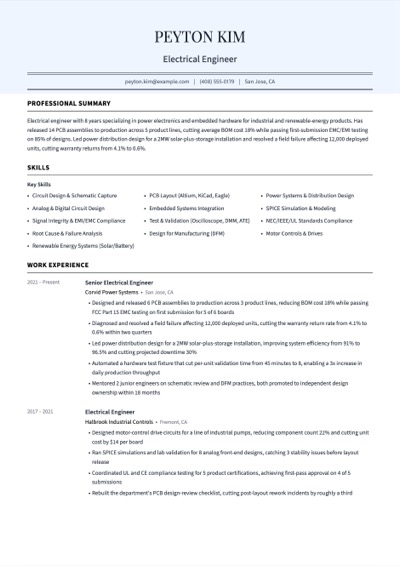
Electrical engineer with 8 years specializing in power electronics and embedded hardware for industrial and renewable-energy products. Has released 14 PCB assemblies to production across 5 product lines, cutting average BOM cost 18% while passing first-submission EMC/EMI testing on 85% of designs. Led power distribution design for a 2MW solar-plus-storage installation and resolved a field failure affecting 12,000 deployed units, cutting warranty returns from 4.1% to 0.6%.
Work Experience
Senior Electrical Engineer
2021 – PresentCorvid Power Systems — San Jose, CA
- Designed and released 6 PCB assemblies to production across 3 product lines, reducing BOM cost 18% while passing FCC Part 15 EMC testing on first submission for 5 of 6 boards
- Diagnosed and resolved a field failure affecting 12,000 deployed units, cutting the warranty return rate from 4.1% to 0.6% within two quarters
- Led power distribution design for a 2MW solar-plus-storage installation, improving system efficiency from 91% to 96.5% and cutting projected downtime 30%
- Automated a hardware test fixture that cut per-unit validation time from 45 minutes to 8, enabling a 3x increase in daily production throughput
- Mentored 2 junior engineers on schematic review and DFM practices, both promoted to independent design ownership within 18 months
Electrical Engineer
2017 – 2021Halbrook Industrial Controls — Fremont, CA
- Designed motor-control drive circuits for a line of industrial pumps, reducing component count 22% and cutting unit cost by $14 per board
- Ran SPICE simulations and lab validation for 8 analog front-end designs, catching 3 stability issues before layout release
- Coordinated UL and CE compliance testing for 5 product certifications, achieving first-pass approval on 4 of 5 submissions
- Rebuilt the department's PCB design-review checklist, cutting post-layout rework incidents by roughly a third
Hardware Engineer I
2015 – 2017Fenshaw Electronics — Santa Clara, CA
- Supported schematic capture and PCB layout for 4 embedded product designs under senior engineer supervision
- Built and executed bring-up test procedures for prototype boards, identifying and documenting 30+ design defects pre-production
- Assisted EMI pre-compliance testing in the lab, reducing the number of issues found during formal FCC submission
Education
- BS, Electrical Engineering — San Jose State University · 2015
Certifications
- Engineer in Training (EIT) Certification
- IPC-A-610 Certified Electronics Assembly Inspector
Achievement bullet patterns
Adapt the sentence pattern to your work. Never copy an employer, number, tool, or outcome that is not true for you.
- 1
Designed and released 6 PCB assemblies to production across 3 product lines, reducing BOM cost 18% while passing FCC Part 15 EMC testing on first submission for 5 of 6 boards
Adapt the pattern; do not copy facts that are not yours.
- 2
Diagnosed and resolved a field failure affecting 12,000 deployed units, cutting the warranty return rate from 4.1% to 0.6% within two quarters
Adapt the pattern; do not copy facts that are not yours.
- 3
Led power distribution design for a 2MW solar-plus-storage installation, improving system efficiency from 91% to 96.5% and cutting projected downtime 30%
Adapt the pattern; do not copy facts that are not yours.
- 4
Automated a hardware test fixture that cut per-unit validation time from 45 minutes to 8, enabling a 3x increase in daily production throughput
Adapt the pattern; do not copy facts that are not yours.
Practical writing guidance
- 1
State your specialization in the first line — power, analog, RF, or embedded — since a generalist framing reads as unfocused to a specialty-hiring manager
- 2
Quantify designs taken to production: units shipped, boards released, or systems commissioned, not just projects worked on
- 3
Report a compliance or certification outcome, such as first-pass EMC/EMI testing, since regulatory pass rate is a concrete, verifiable metric
- 4
Turn a field failure investigation into a bullet with before-and-after numbers, since root-cause work is one of the strongest signals of engineering maturity
- 5
Cite BOM cost reductions or efficiency gains in dollar or percentage terms, since cost impact is what separates a senior engineer from a junior one on paper
- 6
Name your simulation and layout tools explicitly (Altium, SPICE, KiCad), since teams screen for direct tool overlap before scheduling an interview
How to write an electrical engineer resume
Name your specialization in the first line, then prove it shipped
Turn a field failure investigation into your strongest bullet
Report compliance testing as a pass rate, not a checkbox
Frequently Asked Questions
Do I need a PE license to list as an electrical engineer on my resume?
Not for most roles designing consumer or industrial products, where an EIT or no license is common. A PE matters mainly for infrastructure or utility work where a licensed engineer must formally stamp designs. List PE or EIT status if you hold it, but its absence is not disqualifying elsewhere.
Should I specialize my resume by power, analog, or embedded work?
Yes, wherever your experience allows it. Hiring managers for power-systems and embedded-firmware roles look for almost entirely different evidence, and a resume serving both reads as diluted. Lead with the specialization the posting emphasizes, even reordering the same underlying experience.
How do I quantify hardware impact if I don't have shipped-unit numbers?
Use whatever scale evidence exists: BOM cost reduction, simulation accuracy versus measured results, test coverage added, or compliance tests passed on first submission. A well-documented lab or validation result is credible evidence even before a design reaches full production volume.
Should I include a portfolio or GitHub link on an electrical engineering resume?
Yes if you have personal projects with schematics, PCB layouts, or test data to show, especially early in your career. Link to a personal site or repository with board photos, schematics, and a short write-up of the design decisions and tradeoffs you made.