
Turn inspiration into your own evidence
Do not copy the career. Learn how the career is communicated.
Read the evidence
Notice where the example uses scale, change, ownership, and context.
Replace every fact
Write from your real work, even when your numbers or setting are different.
Check the result
Make sure the document remains readable, truthful, and aligned to the role.
Key Skills
Use only the skills you can support with real experience. The example shows the vocabulary; your evidence makes it credible.
Full Embedded Systems Engineer Resume Example
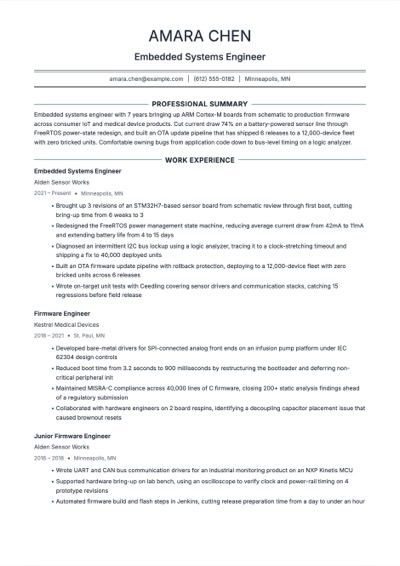
This is a complete fictional sample. Study the structure and evidence patterns, then replace every name, employer, number, skill, and accomplishment with information that is true for you.
Professional Summary
Embedded systems engineer with 7 years bringing up ARM Cortex-M boards from schematic to production firmware across consumer IoT and medical device products. Cut current draw 74% on a battery-powered sensor line through FreeRTOS power-state redesign, and built an OTA update pipeline that has shipped 6 releases to a 12,000-device fleet with zero bricked units. Comfortable owning bugs from application code down to bus-level timing on a logic analyzer.
Work Experience
Embedded Systems Engineer
2021 – PresentAlden Sensor Works — Minneapolis, MN
- Brought up 3 revisions of an STM32H7-based sensor board from schematic review through first boot, cutting bring-up time from 6 weeks to 3
- Redesigned the FreeRTOS power management state machine, reducing average current draw from 42mA to 11mA and extending battery life from 4 to 15 days
- Diagnosed an intermittent I2C bus lockup using a logic analyzer, tracing it to a clock-stretching timeout and shipping a fix to 40,000 deployed units
- Built an OTA firmware update pipeline with rollback protection, deploying to a 12,000-device fleet with zero bricked units across 6 releases
- Wrote on-target unit tests with Ceedling covering sensor drivers and communication stacks, catching 15 regressions before field release
Firmware Engineer
2018 – 2021Kestrel Medical Devices — St. Paul, MN
- Developed bare-metal drivers for SPI-connected analog front ends on an infusion pump platform under IEC 62304 design controls
- Reduced boot time from 3.2 seconds to 900 milliseconds by restructuring the bootloader and deferring non-critical peripheral init
- Maintained MISRA-C compliance across 40,000 lines of C firmware, closing 200+ static analysis findings ahead of a regulatory submission
- Collaborated with hardware engineers on 2 board respins, identifying a decoupling capacitor placement issue that caused brownout resets
Junior Firmware Engineer
2016 – 2018Alden Sensor Works — Minneapolis, MN
- Wrote UART and CAN bus communication drivers for an industrial monitoring product on an NXP Kinetis MCU
- Supported hardware bring-up on lab bench, using an oscilloscope to verify clock and power-rail timing on 4 prototype revisions
- Automated firmware build and flash steps in Jenkins, cutting release preparation time from a day to under an hour
Education
- BS, Electrical Engineering — University of Minnesota · 2016
Certifications
- ARM Accredited Engineer (AAE)
- MISRA-C Compliance Training Certificate
Achievement bullet patterns
Adapt the sentence pattern to your work. Never copy an employer, number, tool, or outcome that is not true for you.
- 1
Brought up 3 revisions of an STM32H7-based sensor board from schematic review through first boot, cutting bring-up time from 6 weeks to 3
Adapt the pattern; do not copy facts that are not yours.
- 2
Redesigned power management state machine in FreeRTOS, reducing average current draw from 42mA to 11mA and extending battery life from 4 to 15 days
Adapt the pattern; do not copy facts that are not yours.
- 3
Diagnosed an intermittent I2C bus lockup using a logic analyzer, tracing it to a clock-stretching timeout and shipping a fix across 40,000 deployed units
Adapt the pattern; do not copy facts that are not yours.
- 4
Built an OTA firmware update pipeline with rollback protection, deploying to a 12,000-device fleet with zero bricked units across 6 releases
Adapt the pattern; do not copy facts that are not yours.
Practical writing guidance
- 1
State the silicon and toolchain explicitly: 'STM32F4 with GCC/OpenOCD toolchain' reads as verified experience in a way that 'embedded C' does not
- 2
Quantify resource constraints you worked within: RAM/flash footprint, boot time, current draw in sleep mode, since these prove real hardware discipline
- 3
Show bring-up ownership: 'brought up 3 board revisions from schematic to first boot' signals you work at the hardware-software boundary, not just above it
- 4
Include debugging depth: bugs traced to race conditions, ISR timing, or bus contention using JTAG or a logic analyzer, not just 'fixed bugs'
- 5
Mention certifications or compliance work relevant to the industry, such as MISRA-C, IEC 62304 for medical, or ISO 26262 for automotive
- 6
List RTOS and bare-metal experience separately if you have both, since job postings often specify one or the other explicitly
How to write an embedded systems engineer resume
Name the exact silicon, toolchain, and RTOS instead of saying 'embedded C'
Prove hardware bring-up experience, not just firmware feature work
Report resource constraints and debugging depth with real numbers
Frequently Asked Questions
Should an embedded systems engineer resume list specific microcontroller families?
Yes, name the exact families you've shipped on, such as STM32, NXP Kinetis, or ESP32, rather than 'various microcontrollers.' Hiring teams often standardize on one vendor, and matching that vendor's family by name is one of the strongest signals recruiters and ATS filters look for.
How do I show RTOS experience versus bare-metal experience?
List them separately since they require different skills. For RTOS work, name the kernel (FreeRTOS, Zephyr, ThreadX) and describe task priority or scheduling decisions. For bare-metal, describe interrupt handling and main-loop architecture directly. Match your framing to what the posting specifies.
What hardware debugging tools should I mention?
List JTAG/SWD debuggers, oscilloscopes, and logic analyzers you've used hands-on, along with a specific bug you traced with them. A line like 'diagnosed an I2C clock-stretching fault using a logic analyzer' proves lab competence far more than simply naming the tool on a skills list.
How important are memory and power constraints on an embedded resume?
Very important. Stating RAM/flash footprint, boot time, or current draw numbers signals you've worked under real hardware constraints rather than treating an MCU like a small computer. Reviewers look for this because it separates candidates who understand embedded tradeoffs from generalists.