
Turn inspiration into your own evidence
Do not copy the career. Learn how the career is communicated.
Read the evidence
Notice where the example uses scale, change, ownership, and context.
Replace every fact
Write from your real work, even when your numbers or setting are different.
Check the result
Make sure the document remains readable, truthful, and aligned to the role.
Key Skills
Use only the skills you can support with real experience. The example shows the vocabulary; your evidence makes it credible.
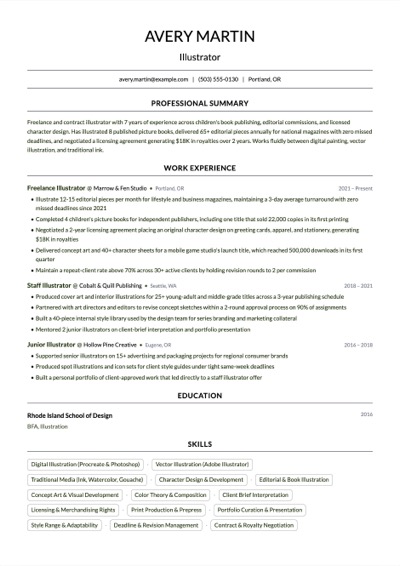
Full Illustrator Resume Example
This is a complete fictional sample. Study the structure and evidence patterns, then replace every name, employer, number, skill, and accomplishment with information that is true for you.
Professional Summary
Freelance and contract illustrator with 7 years of experience across children's book publishing, editorial commissions, and licensed character design. Has illustrated 8 published picture books, delivered 65+ editorial pieces annually for national magazines with zero missed deadlines, and negotiated a licensing agreement generating $18K in royalties over 2 years. Works fluidly between digital painting, vector illustration, and traditional ink.
Work Experience
Freelance Illustrator
2021 – PresentMarrow & Fen Studio — Portland, OR
- Illustrate 12-15 editorial pieces per month for lifestyle and business magazines, maintaining a 3-day average turnaround with zero missed deadlines since 2021
- Completed 4 children's picture books for independent publishers, including one title that sold 22,000 copies in its first printing
- Negotiated a 2-year licensing agreement placing an original character design on greeting cards, apparel, and stationery, generating $18K in royalties
- Delivered concept art and 40+ character sheets for a mobile game studio's launch title, which reached 500,000 downloads in its first quarter
- Maintain a repeat-client rate above 70% across 30+ active clients by holding revision rounds to 2 per commission
Staff Illustrator
2018 – 2021Cobalt & Quill Publishing — Seattle, WA
- Produced cover art and interior illustrations for 25+ young-adult and middle-grade titles across a 3-year publishing schedule
- Partnered with art directors and editors to revise concept sketches within a 2-round approval process on 90% of assignments
- Built a 40-piece internal style library used by the design team for series branding and marketing collateral
- Mentored 2 junior illustrators on client-brief interpretation and portfolio presentation
Junior Illustrator
2016 – 2018Hollow Pine Creative — Eugene, OR
- Supported senior illustrators on 15+ advertising and packaging projects for regional consumer brands
- Produced spot illustrations and icon sets for client style guides under tight same-week deadlines
- Built a personal portfolio of client-approved work that led directly to a staff illustrator offer
Education
- BFA, Illustration — Rhode Island School of Design · 2016
Certifications
- Adobe Certified Professional: Illustrator
Achievement bullet patterns
Adapt the sentence pattern to your work. Never copy an employer, number, tool, or outcome that is not true for you.
- 1
Illustrated 8 picture books for 3 independent publishers over 4 years, with one title selling 22,000 copies in its first printing
Adapt the pattern; do not copy facts that are not yours.
- 2
Completed 65 editorial illustrations for 4 national magazines in 2023, averaging a 3-day turnaround with zero missed deadlines
Adapt the pattern; do not copy facts that are not yours.
- 3
Negotiated a licensing agreement placing an original character design on greeting cards, apparel, and stationery, generating $18K in royalties over 2 years
Adapt the pattern; do not copy facts that are not yours.
- 4
Delivered concept art and 40+ character sheets for a mobile game studio's launch title, which reached 500,000 downloads in its first quarter
Adapt the pattern; do not copy facts that are not yours.
Practical writing guidance
- 1
Lead with your portfolio URL and a one-line style descriptor, such as 'editorial and children's book illustrator,' rather than a generic objective statement
- 2
Quantify commissioned output: 'Completed 65 paid commissions in 2023' proves you can sustain a freelance workload, not just produce nice art
- 3
Name the publications, brands, or platforms you've illustrated for whenever contracts allow it, since recognizable credits carry more weight than a skills list
- 4
Track licensing and reprint income separately from project fees, and mention it if it shows ongoing revenue from a single piece of art
- 5
State your average turnaround time and revision-round discipline, since art directors screen for reliability as much as style
- 6
Group your skills by medium, digital, traditional, and vector, so both keyword scans and a human reviewer can quickly place your range
How to write an illustrator resume
Open with a portfolio link and a precise style descriptor, not a generic summary
Quantify commissioned output the way art directors actually evaluate reliability
Name real clients and publications, and group smaller commissions by category
Frequently Asked Questions
Do I need a personal website, or is a portfolio platform enough?
A platform like Behance or Instagram builds an audience, but a personal website you control signals professionalism to art directors who bookmark illustrators for future briefs. Use the site link as your primary reference and platform accounts as supporting proof of output.
How many pieces should be in an illustrator portfolio?
Twelve to twenty of your strongest, most consistent pieces beat fifty uneven ones. Curate by the type of work you want next, whether editorial, children's books, or licensing, and lead with your three strongest images since reviewers often decide within seconds.
Should freelance illustrators list every client on their resume?
List representative clients and project types rather than every commission, especially with dozens of small clients. Group similar work, such as '15+ editorial commissions for lifestyle and business publications,' and name only the clients whose recognition adds credibility.
How do I show licensing or royalty income on a resume?
Treat licensing deals as measurable outcomes, not just credits. Note the product category, the agreement's duration, and the revenue or unit volume if you can share it, such as 'licensed a character design for stationery and apparel, generating $18K over 2 years.'