
Turn inspiration into your own evidence
Do not copy the career. Learn how the career is communicated.
Read the evidence
Notice where the example uses scale, change, ownership, and context.
Replace every fact
Write from your real work, even when your numbers or setting are different.
Check the result
Make sure the document remains readable, truthful, and aligned to the role.
Key Skills
Use only the skills you can support with real experience. The example shows the vocabulary; your evidence makes it credible.
Full Fashion Designer Resume Example
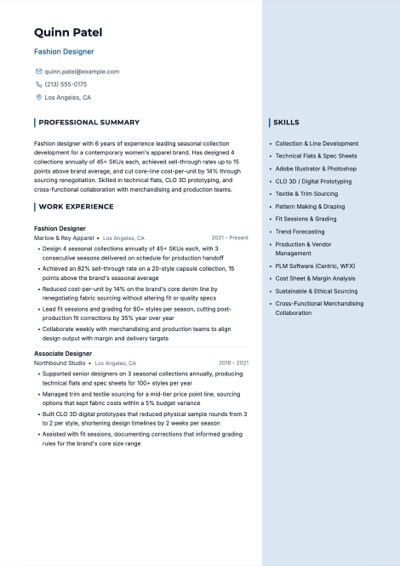
This is a complete fictional sample. Study the structure and evidence patterns, then replace every name, employer, number, skill, and accomplishment with information that is true for you.
Professional Summary
Fashion designer with 6 years of experience leading seasonal collection development for a contemporary women's apparel brand. Has designed 4 collections annually of 45+ SKUs each, achieved sell-through rates up to 15 points above brand average, and cut core-line cost-per-unit by 14% through sourcing renegotiation. Skilled in technical flats, CLO 3D prototyping, and cross-functional collaboration with merchandising and production teams.
Work Experience
Fashion Designer
2021 – PresentMarlow & Rey Apparel — Los Angeles, CA
- Design 4 seasonal collections annually of 45+ SKUs each, with 3 consecutive seasons delivered on schedule for production handoff
- Achieved an 82% sell-through rate on a 20-style capsule collection, 15 points above the brand's seasonal average
- Reduced cost-per-unit by 14% on the brand's core denim line by renegotiating fabric sourcing without altering fit or quality specs
- Lead fit sessions and grading for 60+ styles per season, cutting post-production fit corrections by 35% year over year
- Collaborate weekly with merchandising and production teams to align design output with margin and delivery targets
Associate Designer
2018 – 2021Northbound Studio — Los Angeles, CA
- Supported senior designers on 3 seasonal collections annually, producing technical flats and spec sheets for 100+ styles per year
- Managed trim and textile sourcing for a mid-tier price point line, sourcing options that kept fabric costs within a 5% budget variance
- Built CLO 3D digital prototypes that reduced physical sample rounds from 3 to 2 per style, shortening design timelines by 2 weeks per season
- Assisted with fit sessions, documenting corrections that informed grading rules for the brand's core size range
Design Assistant
2016 – 2018Harlan Denim Co. — Vernon, CA
- Assisted the design team with mood boards, trend research, and technical flats for 2 seasonal collections annually
- Maintained the PLM system for 200+ active styles, keeping cost sheets and spec data current for production handoff
- Coordinated sample tracking between design and 4 overseas manufacturing partners
Education
- BFA, Fashion Design — Fashion Institute of Design & Merchandising · 2016
Achievement bullet patterns
Adapt the sentence pattern to your work. Never copy an employer, number, tool, or outcome that is not true for you.
- 1
Designed 4 seasonal collections annually of 45+ SKUs each, with 3 consecutive seasons delivered on schedule for production handoff
Adapt the pattern; do not copy facts that are not yours.
- 2
Achieved an 82% sell-through rate on a capsule collection of 20 styles, 15 points above the brand's seasonal average
Adapt the pattern; do not copy facts that are not yours.
- 3
Reduced cost-per-unit by 14% across a core denim line by renegotiating fabric sourcing without changing fit or quality specs
Adapt the pattern; do not copy facts that are not yours.
- 4
Led fit sessions and grading for 60+ styles per season, cutting post-production fit corrections by 35% year over year
Adapt the pattern; do not copy facts that are not yours.
Practical writing guidance
- 1
Quantify collection output: 'Designed 4 seasonal collections of 40+ SKUs each' shows volume and reliability under recurring deadlines
- 2
Report commercial results where you have access to them, such as sell-through rate, margin, or units sold on styles you designed
- 3
Name your technical skills explicitly (pattern making, CLO 3D, spec sheets) since production teams and ATS software screen for them directly
- 4
Highlight sourcing or cost wins, such as reducing cost-per-unit while maintaining quality, since margin matters as much as aesthetics to employers
- 5
Include on-time delivery performance, since missed production deadlines are one of the most costly failures in apparel design
- 6
Mention cross-functional work with merchandising, production, or marketing teams, since design rarely happens in isolation at most brands
How to write a fashion designer resume
Open with collection output and commercial results, not design philosophy
Attach numbers to sell-through, cost, and delivery, not just SKU counts
List technical software and production skills where reviewers expect them
Frequently Asked Questions
What should a fashion design portfolio link look like on a resume?
Include a direct link to a portfolio website or PDF near your contact information, and make sure it loads quickly and shows finished, market-ready work rather than only sketches. Curate it to 10-15 of your strongest, most relevant pieces rather than including every project you have completed.
How do I show commercial results if I mostly worked on design, not sales?
Ask your merchandising or sales team for sell-through or margin data on styles you designed, since many brands track this by designer or collection. If exact figures are unavailable, use production metrics instead, such as on-time delivery rate or the number of SKUs shipped per season.
Should I list specific software like CLO 3D or Illustrator on my resume?
Yes, list the specific design and PLM software you use, since production and technical design teams often require proficiency in named tools like CLO 3D, Illustrator, or Centric PLM. Being specific also helps ATS software match you to postings that name these tools as requirements.
How is a fashion designer resume different from a technical designer resume?
A fashion designer resume emphasizes concept development, collection planning, and aesthetic direction. A technical designer resume emphasizes spec sheets and fit corrections in more depth. If you do both, lead with whichever function matches the role and keep the other as supporting detail.