
Turn inspiration into your own evidence
Do not copy the career. Learn how the career is communicated.
Read the evidence
Notice where the example uses scale, change, ownership, and context.
Replace every fact
Write from your real work, even when your numbers or setting are different.
Check the result
Make sure the document remains readable, truthful, and aligned to the role.
Key Skills
Use only the skills you can support with real experience. The example shows the vocabulary; your evidence makes it credible.
Full Interior Designer Resume Example
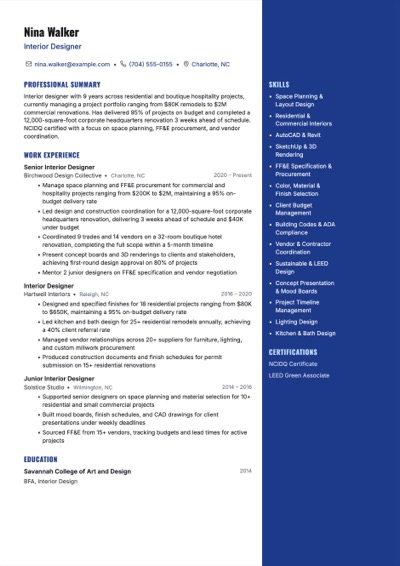
This is a complete fictional sample. Study the structure and evidence patterns, then replace every name, employer, number, skill, and accomplishment with information that is true for you.
Professional Summary
Interior designer with 9 years across residential and boutique hospitality projects, currently managing a project portfolio ranging from $80K remodels to $2M commercial renovations. Has delivered 95% of projects on budget and completed a 12,000-square-foot corporate headquarters renovation 3 weeks ahead of schedule. NCIDQ certified with a focus on space planning, FF&E procurement, and vendor coordination.
Work Experience
Senior Interior Designer
2020 – PresentBirchwood Design Collective — Charlotte, NC
- Manage space planning and FF&E procurement for commercial and hospitality projects ranging from $200K to $2M, maintaining a 95% on-budget delivery rate
- Led design and construction coordination for a 12,000-square-foot corporate headquarters renovation, delivering 3 weeks ahead of schedule and $40K under budget
- Coordinated 9 trades and 14 vendors on a 32-room boutique hotel renovation, completing the full scope within a 5-month timeline
- Present concept boards and 3D renderings to clients and stakeholders, achieving first-round design approval on 80% of projects
- Mentor 2 junior designers on FF&E specification and vendor negotiation
Interior Designer
2016 – 2020Hartwell Interiors — Raleigh, NC
- Designed and specified finishes for 18 residential projects ranging from $80K to $650K, maintaining a 95% on-budget delivery rate
- Led kitchen and bath design for 25+ residential remodels annually, achieving a 40% client referral rate
- Managed vendor relationships across 20+ suppliers for furniture, lighting, and custom millwork procurement
- Produced construction documents and finish schedules for permit submission on 15+ residential renovations
Junior Interior Designer
2014 – 2016Solstice Studio — Wilmington, NC
- Supported senior designers on space planning and material selection for 10+ residential and small commercial projects
- Built mood boards, finish schedules, and CAD drawings for client presentations under weekly deadlines
- Sourced FF&E from 15+ vendors, tracking budgets and lead times for active projects
Education
- BFA, Interior Design — Savannah College of Art and Design · 2014
Certifications
- NCIDQ Certificate
- LEED Green Associate
Achievement bullet patterns
Adapt the sentence pattern to your work. Never copy an employer, number, tool, or outcome that is not true for you.
- 1
Managed space planning and FF&E procurement for a 12,000-square-foot corporate headquarters renovation, delivering 3 weeks ahead of schedule and $40K under budget
Adapt the pattern; do not copy facts that are not yours.
- 2
Designed and specified finishes for 18 residential projects ranging from $80K to $650K, maintaining a 95% on-budget delivery rate
Adapt the pattern; do not copy facts that are not yours.
- 3
Coordinated 9 trades and 14 vendors on a boutique hotel renovation spanning 32 guest rooms, completing the project within a 5-month timeline
Adapt the pattern; do not copy facts that are not yours.
- 4
Led kitchen and bath design for 25+ residential remodels annually, achieving a 40% referral rate from past clients
Adapt the pattern; do not copy facts that are not yours.
Practical writing guidance
- 1
Quantify project scope: square footage, budget size, and number of completed projects prove you can execute, not just conceptualize
- 2
State your on-time and on-budget delivery rate if you track it, since firms lose more money to schedule and budget overruns than to design missteps
- 3
Name the software you design in, AutoCAD, Revit, SketchUp, precisely, since firms search resumes for the exact platform their studio runs on
- 4
Include NCIDQ certification prominently if you hold it, since it is the credential clients and licensing boards recognize as proof of competency
- 5
Show vendor and contractor coordination explicitly, such as the number of trades you managed on a project, to prove you can run a job site, not just a mood board
- 6
Separate residential and commercial project types if you've done both, since firms often specialize and want to see relevant scope fast
How to write an interior designer resume
Lead with project scope, not style descriptors, since firms hire for execution first
Prove budget and schedule discipline the way clients and firms actually measure it
Put your NCIDQ credential and software stack where ATS and licensing-aware reviewers can find them
Frequently Asked Questions
Do I need NCIDQ certification to work as an interior designer?
It depends on the state. NCIDQ certification is required to use the title 'Certified Interior Designer' in some states and is often expected for commercial code-compliance work. Even where it isn't mandatory, it signals competency, so list it if you hold it or note if you're pursuing it.
How should I show my portfolio on an interior design resume?
Include a portfolio link near the top and reference specific project types in your experience bullets, such as '12,000-square-foot corporate renovation.' The resume should make a reviewer want to open the portfolio; the portfolio carries the visual proof through photos and floor plans.
Should I separate residential and commercial experience?
Yes, if you have meaningful experience in both. Firms typically specialize, and a hiring manager scanning for commercial hospitality experience wants to find it fast. Group your bullets or use a summary line stating your split, such as '70% commercial, 30% residential.'