
Turn inspiration into your own evidence
Do not copy the career. Learn how the career is communicated.
Read the evidence
Notice where the example uses scale, change, ownership, and context.
Replace every fact
Write from your real work, even when your numbers or setting are different.
Check the result
Make sure the document remains readable, truthful, and aligned to the role.
Key Skills
Use only the skills you can support with real experience. The example shows the vocabulary; your evidence makes it credible.
Full Product Designer Resume Example
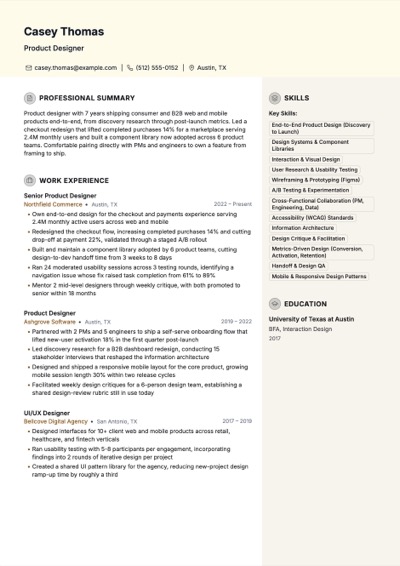
This is a complete fictional sample. Study the structure and evidence patterns, then replace every name, employer, number, skill, and accomplishment with information that is true for you.
Professional Summary
Product designer with 7 years shipping consumer and B2B web and mobile products end-to-end, from discovery research through post-launch metrics. Led a checkout redesign that lifted completed purchases 14% for a marketplace serving 2.4M monthly users and built a component library now adopted across 6 product teams. Comfortable pairing directly with PMs and engineers to own a feature from framing to ship.
Work Experience
Senior Product Designer
2022 – PresentNorthfield Commerce — Austin, TX
- Own end-to-end design for the checkout and payments experience serving 2.4M monthly active users across web and mobile
- Redesigned the checkout flow, increasing completed purchases 14% and cutting drop-off at payment 22%, validated through a staged A/B rollout
- Built and maintain a component library adopted by 6 product teams, cutting design-to-dev handoff time from 3 weeks to 8 days
- Ran 24 moderated usability sessions across 3 testing rounds, identifying a navigation issue whose fix raised task completion from 61% to 89%
- Mentor 2 mid-level designers through weekly critique, with both promoted to senior within 18 months
Product Designer
2019 – 2022Ashgrove Software — Austin, TX
- Partnered with 2 PMs and 5 engineers to ship a self-serve onboarding flow that lifted new-user activation 18% in the first quarter post-launch
- Led discovery research for a B2B dashboard redesign, conducting 15 stakeholder interviews that reshaped the information architecture
- Designed and shipped a responsive mobile layout for the core product, growing mobile session length 30% within two release cycles
- Facilitated weekly design critiques for a 6-person design team, establishing a shared design-review rubric still in use today
UI/UX Designer
2017 – 2019Bellcove Digital Agency — San Antonio, TX
- Designed interfaces for 10+ client web and mobile products across retail, healthcare, and fintech verticals
- Ran usability testing with 5-8 participants per engagement, incorporating findings into 2 rounds of iterative design per project
- Created a shared UI pattern library for the agency, reducing new-project design ramp-up time by roughly a third
Education
- BFA, Interaction Design — University of Texas at Austin · 2017
Achievement bullet patterns
Adapt the sentence pattern to your work. Never copy an employer, number, tool, or outcome that is not true for you.
- 1
Redesigned the checkout flow for a marketplace app used by 2.4M monthly users, increasing completed purchases 14% and cutting drop-off at payment by 22%
Adapt the pattern; do not copy facts that are not yours.
- 2
Built and shipped a component library adopted by 6 product teams, cutting average feature design-to-dev handoff time from 3 weeks to 8 days
Adapt the pattern; do not copy facts that are not yours.
- 3
Ran 24 moderated usability sessions across 3 rounds of testing, surfacing a navigation issue that, once fixed, raised task completion from 61% to 89%
Adapt the pattern; do not copy facts that are not yours.
- 4
Partnered with 2 PMs and 5 engineers to ship a self-serve onboarding flow that lifted new-user activation 18% within the first quarter post-launch
Adapt the pattern; do not copy facts that are not yours.
Practical writing guidance
- 1
Lead each bullet with the feature you shipped and the metric that changed after launch, not the design activity: "Redesigned onboarding, lifting activation 18%" beats "created onboarding wireframes"
- 2
Name the design system or component library you built or scaled, and how many teams or products adopted it
- 3
Quantify research: number of usability sessions run, participants interviewed, or findings that changed a roadmap decision
- 4
Show cross-functional ownership by naming the PM, engineering, or data partners you worked with and what you delivered together, not just "collaborated with stakeholders"
- 5
Link your portfolio prominently, but make the resume stand alone; a recruiter should understand your impact before ever opening the link
- 6
Mention scale: number of users the product served, platforms supported, or the size of the design team you worked within
How to write a product designer resume
Open with the products you have shipped, not the tools you know
Pair every project bullet with a metric and a partner
Use your portfolio to extend the resume, not replace it
Frequently Asked Questions
How is a product designer resume different from a UX or graphic designer resume?
A product designer resume centers on shipped features and business metrics across the full lifecycle, not just research artifacts or visual polish. Show ownership from problem framing through post-launch measurement, and pair each project with a PM or engineering partner.
Should I attach my portfolio link or embed images in the resume?
Attach a clear portfolio link near the top of your resume, but never embed images. The resume itself should communicate your impact in words and numbers so a recruiter can qualify you in 30 seconds; save the visual walkthrough of your process for the portfolio and the interview.
What metrics matter most for a product designer resume?
Prioritize metrics tied to user behavior and business outcomes: activation, conversion, task completion, or retention. Design-system adoption and handoff speed also matter if you worked on infrastructure rather than a single feature. Avoid vanity metrics like screens produced.
How do I handle a resume when most of my best work is under NDA?
Describe the problem, process, and outcome in general terms while omitting confidential specifics like exact revenue figures or unreleased features. Use relative metrics such as percentage improvements, and note in your portfolio which case studies you can discuss further in an interview.