
Turn inspiration into your own evidence
Do not copy the career. Learn how the career is communicated.
Read the evidence
Notice where the example uses scale, change, ownership, and context.
Replace every fact
Write from your real work, even when your numbers or setting are different.
Check the result
Make sure the document remains readable, truthful, and aligned to the role.
Key Skills
Use only the skills you can support with real experience. The example shows the vocabulary; your evidence makes it credible.
Full Journalist Resume Example
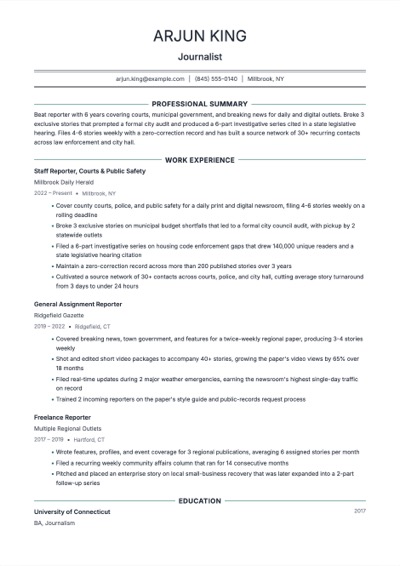
This is a complete fictional sample. Study the structure and evidence patterns, then replace every name, employer, number, skill, and accomplishment with information that is true for you.
Professional Summary
Beat reporter with 6 years covering courts, municipal government, and breaking news for daily and digital outlets. Broke 3 exclusive stories that prompted a formal city audit and produced a 6-part investigative series cited in a state legislative hearing. Files 4-6 stories weekly with a zero-correction record and has built a source network of 30+ recurring contacts across law enforcement and city hall.
Work Experience
Staff Reporter, Courts & Public Safety
2022 – PresentMillbrook Daily Herald — Millbrook, NY
- Cover county courts, police, and public safety for a daily print and digital newsroom, filing 4-6 stories weekly on a rolling deadline
- Broke 3 exclusive stories on municipal budget shortfalls that led to a formal city council audit, with pickup by 2 statewide outlets
- Filed a 6-part investigative series on housing code enforcement gaps that drew 140,000 unique readers and a state legislative hearing citation
- Maintain a zero-correction record across more than 200 published stories over 3 years
- Cultivated a source network of 30+ contacts across courts, police, and city hall, cutting average story turnaround from 3 days to under 24 hours
General Assignment Reporter
2019 – 2022Ridgefield Gazette — Ridgefield, CT
- Covered breaking news, town government, and features for a twice-weekly regional paper, producing 3-4 stories weekly
- Shot and edited short video packages to accompany 40+ stories, growing the paper's video views by 65% over 18 months
- Filed real-time updates during 2 major weather emergencies, earning the newsroom's highest single-day traffic on record
- Trained 2 incoming reporters on the paper's style guide and public-records request process
Freelance Reporter
2017 – 2019Multiple Regional Outlets — Hartford, CT
- Wrote features, profiles, and event coverage for 3 regional publications, averaging 6 assigned stories per month
- Filed a recurring weekly community affairs column that ran for 14 consecutive months
- Pitched and placed an enterprise story on local small-business recovery that was later expanded into a 2-part follow-up series
Education
- BA, Journalism — University of Connecticut · 2017
Certifications
- Poynter News University Ethics Certificate
- Investigative Reporters and Editors (IRE) Member
Achievement bullet patterns
Adapt the sentence pattern to your work. Never copy an employer, number, tool, or outcome that is not true for you.
- 1
Broke 3 exclusive stories on municipal budget shortfalls that prompted a city council audit and were picked up by 2 statewide outlets
Adapt the pattern; do not copy facts that are not yours.
- 2
Filed an average of 5 stories weekly on the county courts beat while maintaining a zero-correction record across 200+ published pieces
Adapt the pattern; do not copy facts that are not yours.
- 3
Produced a 6-part investigative series on housing code violations, cited in a state legislative hearing and viewed by 140,000 readers
Adapt the pattern; do not copy facts that are not yours.
- 4
Cultivated a network of 30+ recurring sources across law enforcement, courts, and city hall, cutting average story turnaround by a full day
Adapt the pattern; do not copy facts that are not yours.
Practical writing guidance
- 1
Quantify your output: "Filed 4-6 stories weekly across breaking news and enterprise features" tells an editor you can sustain a beat's pace
- 2
Cite audience impact where you can verify it, such as pageviews, unique visitors, or syndication pickups a story earned
- 3
Name the scoops and exclusives that were yours alone, and note any follow-on coverage from other outlets that resulted
- 4
List awards, fellowships, and contest finishes by name and year rather than folding them into a generic 'recognized for excellence' line
- 5
Show range across formats if you have it: print, video packages, podcasts, or data visualizations, since multi-platform reporters are in higher demand
- 6
Keep a correction rate note only if it strengthens your case, such as zero corrections issued across a high-volume beat
How to write a journalist resume
Open with your beat, your output, and your biggest story
Turn duty lists into verified impact
Build a clip portfolio that does the proving for you
Frequently Asked Questions
How many published clips should I include on a journalist resume?
Link to a portfolio of 8-12 of your strongest clips rather than pasting full articles into the resume itself. Choose pieces that show range: a breaking news story, an enterprise or investigative piece, and something in a format like video or data visualization if you have it.
Should I list social media following or digital metrics?
Include them only when they are verifiable and meaningfully tied to your reporting, such as pageviews a specific story generated or syndication by other outlets. Vague claims about a personal following without context read as filler rather than journalism credibility.
How do I present a beat I no longer cover?
List the beat by name under the relevant job title so an editor can immediately see your subject-matter depth, such as courts, statehouse, or education. Follow it with the story output and impact from that period, since the beat itself signals source relationships that transfer.
What if I'm moving from freelance to a staff reporting role?
Treat your freelance work as a single consolidated entry listing the outlets you wrote for and your average output, rather than a scattered list of one-off bylines. Highlight any recurring assignments or columns, since editors read those as evidence you can sustain a regular beat.