
Turn inspiration into your own evidence
Do not copy the career. Learn how the career is communicated.
Read the evidence
Notice where the example uses scale, change, ownership, and context.
Replace every fact
Write from your real work, even when your numbers or setting are different.
Check the result
Make sure the document remains readable, truthful, and aligned to the role.
Key Skills
Use only the skills you can support with real experience. The example shows the vocabulary; your evidence makes it credible.
Full Park Ranger Resume Example
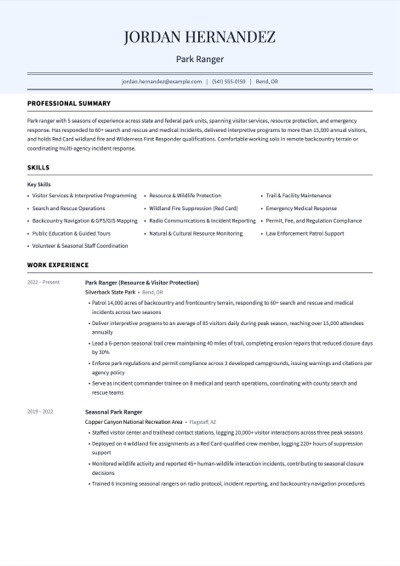
This is a complete fictional sample. Study the structure and evidence patterns, then replace every name, employer, number, skill, and accomplishment with information that is true for you.
Professional Summary
Park ranger with 5 seasons of experience across state and federal park units, spanning visitor services, resource protection, and emergency response. Has responded to 60+ search and rescue and medical incidents, delivered interpretive programs to more than 15,000 annual visitors, and holds Red Card wildland fire and Wilderness First Responder qualifications. Comfortable working solo in remote backcountry terrain or coordinating multi-agency incident response.
Work Experience
Park Ranger (Resource & Visitor Protection)
2022 – PresentSilverback State Park — Bend, OR
- Patrol 14,000 acres of backcountry and frontcountry terrain, responding to 60+ search and rescue and medical incidents across two seasons
- Deliver interpretive programs to an average of 85 visitors daily during peak season, reaching over 15,000 attendees annually
- Lead a 6-person seasonal trail crew maintaining 40 miles of trail, completing erosion repairs that reduced closure days by 30%
- Enforce park regulations and permit compliance across 3 developed campgrounds, issuing warnings and citations per agency policy
- Serve as incident commander trainee on 8 medical and search operations, coordinating with county search and rescue teams
Seasonal Park Ranger
2019 – 2022Copper Canyon National Recreation Area — Flagstaff, AZ
- Staffed visitor center and trailhead contact stations, logging 20,000+ visitor interactions across three peak seasons
- Deployed on 4 wildland fire assignments as a Red Card-qualified crew member, logging 220+ hours of suppression support
- Monitored wildlife activity and reported 45+ human-wildlife interaction incidents, contributing to seasonal closure decisions
- Trained 6 incoming seasonal rangers on radio protocol, incident reporting, and backcountry navigation procedures
Trail Crew Technician
2018 – 2019Vermillion Cliffs Conservation Corps — Kanab, UT
- Constructed and rehabilitated 18 miles of backcountry trail using hand tools and light power equipment across desert terrain
- Assisted certified rangers with visitor safety checkpoints during a 3-week high-visitation holiday period
- Completed wilderness first aid and Leave No Trace trainer certification while logging 900+ field hours
Education
- BS, Parks, Recreation & Natural Resource Management — Northern Arizona University · 2018
Certifications
- Wilderness First Responder (WFR)
- Wildland Fire Red Card — Firefighter Type 2 (FFT2)
- ICS-100 and ICS-200 Incident Command Certification
- CPR/AED Certification — American Red Cross
Achievement bullet patterns
Adapt the sentence pattern to your work. Never copy an employer, number, tool, or outcome that is not true for you.
- 1
Patrolled 14,000 acres of backcountry and frontcountry terrain, responding to 60+ search and rescue and medical incidents over two seasons
Adapt the pattern; do not copy facts that are not yours.
- 2
Delivered interpretive programs to an average of 85 visitors daily during peak season, reaching over 15,000 total attendees annually
Adapt the pattern; do not copy facts that are not yours.
- 3
Maintained 40 miles of trail through a 6-person seasonal crew, completing erosion repairs that reduced closure days by 30%
Adapt the pattern; do not copy facts that are not yours.
- 4
Deployed on 4 wildland fire assignments as a Red Card-qualified crew member, logging 220+ hours of suppression and mop-up support
Adapt the pattern; do not copy facts that are not yours.
Practical writing guidance
- 1
Quantify visitor contact volume, such as daily interpretive program attendance or annual visitor center interactions, to show public-facing capacity
- 2
State the acreage, trail mileage, or park unit size you patrolled so reviewers can gauge the scope of your responsibility
- 3
List search and rescue or medical incident counts you responded to, since this signals readiness for the job's unpredictable moments
- 4
Include every relevant certification separately — Wilderness First Responder, EMT, Red Card, ICS-100/200 — as agencies often screen by credential before reading duties
- 5
Note any interpretive programs or educational materials you developed, along with attendance or engagement figures
- 6
If your background includes seasonal appointments, list each season distinctly with park unit and dates rather than collapsing them into one vague range
How to write a park ranger resume
Translate acreage and visitor volume into scope reviewers can picture
Separate your certifications instead of burying them in a skills paragraph
Show incident response as a distinct line of experience
Frequently Asked Questions
Do I need law enforcement authority to work as a park ranger?
It depends on the role. Interpretive and resource rangers usually lack law enforcement authority, while law enforcement rangers complete a separate academy and carry a commission. State your authority level clearly, since agencies hire against distinct job series.
How should I list multiple seasonal ranger positions?
List each season as its own entry with the specific park unit, dates, and duties rather than combining several seasons under one heading. Agencies want to see continuity and increasing responsibility across seasons, and a single collapsed entry hides both.
Which certifications matter most for park ranger applications?
Wilderness First Responder or EMT certification, ICS-100/200 incident command training, and a Red Card wildland fire qualification are what most agencies screen for first. Law enforcement rangers add an academy certification. List each with current status rather than one grouped line.
How long should a park ranger resume be?
One page for entry-level or early-season applicants, up to two pages once you have multiple seasons, incident response experience, or specialized certifications. Federal USAJOBS applications often need more narrative detail than a typical private-sector resume.