
Turn inspiration into your own evidence
Do not copy the career. Learn how the career is communicated.
Read the evidence
Notice where the example uses scale, change, ownership, and context.
Replace every fact
Write from your real work, even when your numbers or setting are different.
Check the result
Make sure the document remains readable, truthful, and aligned to the role.
Key Skills
Use only the skills you can support with real experience. The example shows the vocabulary; your evidence makes it credible.
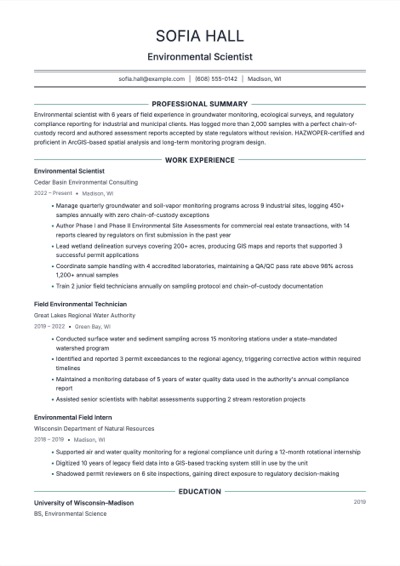
Full Environmental Scientist Resume Example
This is a complete fictional sample. Study the structure and evidence patterns, then replace every name, employer, number, skill, and accomplishment with information that is true for you.
Professional Summary
Environmental scientist with 6 years of field experience in groundwater monitoring, ecological surveys, and regulatory compliance reporting for industrial and municipal clients. Has logged more than 2,000 samples with a perfect chain-of-custody record and authored assessment reports accepted by state regulators without revision. HAZWOPER-certified and proficient in ArcGIS-based spatial analysis and long-term monitoring program design.
Work Experience
Environmental Scientist
2022 – PresentCedar Basin Environmental Consulting — Madison, WI
- Manage quarterly groundwater and soil-vapor monitoring programs across 9 industrial sites, logging 450+ samples annually with zero chain-of-custody exceptions
- Author Phase I and Phase II Environmental Site Assessments for commercial real estate transactions, with 14 reports cleared by regulators on first submission in the past year
- Lead wetland delineation surveys covering 200+ acres, producing GIS maps and reports that supported 3 successful permit applications
- Coordinate sample handling with 4 accredited laboratories, maintaining a QA/QC pass rate above 98% across 1,200+ annual samples
- Train 2 junior field technicians annually on sampling protocol and chain-of-custody documentation
Field Environmental Technician
2019 – 2022Great Lakes Regional Water Authority — Green Bay, WI
- Conducted surface water and sediment sampling across 15 monitoring stations under a state-mandated watershed program
- Identified and reported 3 permit exceedances to the regional agency, triggering corrective action within required timelines
- Maintained a monitoring database of 5 years of water quality data used in the authority's annual compliance report
- Assisted senior scientists with habitat assessments supporting 2 stream restoration projects
Environmental Field Intern
2018 – 2019Wisconsin Department of Natural Resources — Madison, WI
- Supported air and water quality monitoring for a regional compliance unit during a 12-month rotational internship
- Digitized 10 years of legacy field data into a GIS-based tracking system still in use by the unit
- Shadowed permit reviewers on 6 site inspections, gaining direct exposure to regulatory decision-making
Education
- BS, Environmental Science — University of Wisconsin–Madison · 2019
Certifications
- 40-Hour HAZWOPER Certification (OSHA)
- Certified Environmental Scientist — active
- Wetland Delineation Certificate, Society of Wetland Scientists
Achievement bullet patterns
Adapt the sentence pattern to your work. Never copy an employer, number, tool, or outcome that is not true for you.
- 1
Led quarterly groundwater and soil-vapor monitoring across 9 active sites, logging 450+ samples annually with a 100% chain-of-custody compliance rate
Adapt the pattern; do not copy facts that are not yours.
- 2
Authored 14 Phase I Environmental Site Assessments in one year, with zero findings returned for revision by reviewing regulators
Adapt the pattern; do not copy facts that are not yours.
- 3
Mapped 200 acres of wetland boundaries using GPS and ArcGIS, producing delineation reports that supported 3 permit approvals within regulatory deadlines
Adapt the pattern; do not copy facts that are not yours.
- 4
Coordinated with 4 accredited laboratories to process over 1,200 environmental samples annually, maintaining a QA/QC pass rate above 98%
Adapt the pattern; do not copy facts that are not yours.
Practical writing guidance
- 1
Quantify your fieldwork: 'Collected and logged 300+ soil and groundwater samples across 12 sites with zero chain-of-custody exceptions' proves rigor
- 2
Cite the monitoring programs you built or ran, including sample frequency, parameters tracked, and any exceedances you caught and reported
- 3
Name the regulations you work under (NEPA, CWA, RCRA, state equivalents) so ATS software and reviewers match you to the compliance work they need
- 4
Show report and permit outcomes, such as assessments accepted on first submission or permits secured within a stated timeline
- 5
Separate field science from engineering design in your bullets; hiring managers screening for this role want data collection and analysis, not remediation systems
- 6
List GIS and statistical tools by name since agencies and consultancies filter candidates by specific software proficiency
How to write an environmental scientist resume
Open with a summary built around monitoring scope, not job duties
Report sample counts, exceedances, and regulatory outcomes, not just tasks
Separate your fieldwork skills from engineering or design work
Frequently Asked Questions
What is the difference between an environmental scientist resume and an environmental engineer resume?
A scientist resume centers on field sampling, monitoring data, ecological surveys, and regulatory reporting. An engineer resume centers on designing treatment systems and remediation infrastructure. Keep bullets in the data-collection and reporting lane unless you genuinely did design work.
Do I need a specific degree to list on an environmental scientist resume?
Most employers expect a bachelor's degree in environmental science, biology, geology, or a related natural science, so list your degree and major under Education. Graduate coursework or a master's in environmental science or hydrology strengthens applications for senior fieldwork roles.
How should I present fieldwork on an environmental scientist resume?
Use specifics: number of sites, sample counts, parameters monitored, and any exceedances you identified. Mention safety certifications like HAZWOPER 40-hour training, since many field roles require it. Avoid vague phrases like 'conducted fieldwork' without the scope behind them.
Should I include GIS skills even for a compliance-focused role?
Yes. GIS mapping supports most environmental science deliverables, from wetland delineation to monitoring well networks, and postings often screen for ArcGIS or QGIS by name. List the specific platform and any spatial analysis you performed, even as a supporting task.