
Turn inspiration into your own evidence
Do not copy the career. Learn how the career is communicated.
Read the evidence
Notice where the example uses scale, change, ownership, and context.
Replace every fact
Write from your real work, even when your numbers or setting are different.
Check the result
Make sure the document remains readable, truthful, and aligned to the role.
Key Skills
Use only the skills you can support with real experience. The example shows the vocabulary; your evidence makes it credible.
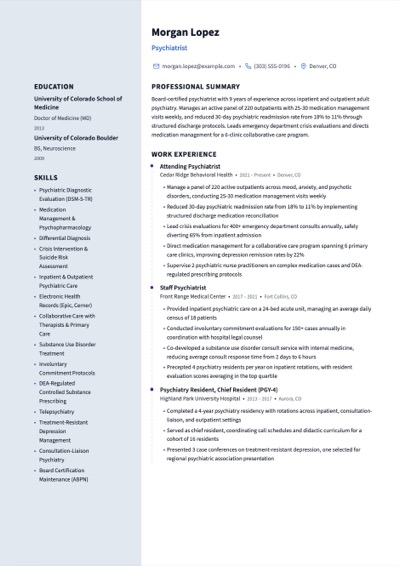
Full Psychiatrist Resume Example
This is a complete fictional sample. Study the structure and evidence patterns, then replace every name, employer, number, skill, and accomplishment with information that is true for you.
Professional Summary
Board-certified psychiatrist with 9 years of experience across inpatient and outpatient adult psychiatry. Manages an active panel of 220 outpatients with 25-30 medication management visits weekly, and reduced 30-day psychiatric readmission rate from 18% to 11% through structured discharge protocols. Leads emergency department crisis evaluations and directs medication management for a 6-clinic collaborative care program.
Work Experience
Attending Psychiatrist
2021 – PresentCedar Ridge Behavioral Health — Denver, CO
- Manage a panel of 220 active outpatients across mood, anxiety, and psychotic disorders, conducting 25-30 medication management visits weekly
- Reduced 30-day psychiatric readmission rate from 18% to 11% by implementing structured discharge medication reconciliation
- Lead crisis evaluations for 400+ emergency department consults annually, safely diverting 65% from inpatient admission
- Direct medication management for a collaborative care program spanning 6 primary care clinics, improving depression remission rates by 22%
- Supervise 2 psychiatric nurse practitioners on complex medication cases and DEA-regulated prescribing protocols
Staff Psychiatrist
2017 – 2021Front Range Medical Center — Fort Collins, CO
- Provided inpatient psychiatric care on a 24-bed acute unit, managing an average daily census of 18 patients
- Conducted involuntary commitment evaluations for 150+ cases annually in coordination with hospital legal counsel
- Co-developed a substance use disorder consult service with internal medicine, reducing average consult response time from 2 days to 6 hours
- Precepted 4 psychiatry residents per year on inpatient rotations, with resident evaluation scores averaging in the top quartile
Psychiatry Resident, Chief Resident (PGY-4)
2013 – 2017Highland Park University Hospital — Aurora, CO
- Completed a 4-year psychiatry residency with rotations across inpatient, consultation-liaison, and outpatient settings
- Served as chief resident, coordinating call schedules and didactic curriculum for a cohort of 16 residents
- Presented 3 case conferences on treatment-resistant depression, one selected for regional psychiatric association presentation
Education
- Doctor of Medicine (MD) — University of Colorado School of Medicine · 2013
- BS, Neuroscience — University of Colorado Boulder · 2009
Certifications
- Board Certified, Psychiatry — American Board of Psychiatry and Neurology (ABPN)
- DEA Registration (active)
- Licensed Physician — Colorado Medical Board (active)
Achievement bullet patterns
Adapt the sentence pattern to your work. Never copy an employer, number, tool, or outcome that is not true for you.
- 1
Managed a panel of 220 active outpatients across mood, anxiety, and psychotic disorders, conducting 25-30 medication management visits weekly
Adapt the pattern; do not copy facts that are not yours.
- 2
Reduced 30-day psychiatric readmission rate from 18% to 11% by implementing structured discharge medication reconciliation
Adapt the pattern; do not copy facts that are not yours.
- 3
Led crisis evaluations for 400+ emergency department consults annually, safely diverting 65% from inpatient admission through same-day stabilization plans
Adapt the pattern; do not copy facts that are not yours.
- 4
Directed medication management for a collaborative care program spanning 6 primary care clinics, improving depression remission rates by 22% within a year
Adapt the pattern; do not copy facts that are not yours.
Practical writing guidance
- 1
State your active patient panel size and typical weekly medication management visit volume in your summary
- 2
Report a clinical outcome number: readmission rate reduction, remission rate improvement, or crisis diversion percentage
- 3
List your credentials in a fixed order a credentialing office expects: MD/DO, board certification, state license, DEA registration
- 4
Never include identifying patient details; report outcomes in aggregate percentages or counts to stay HIPAA-compliant
- 5
Note any collaborative care or consultation-liaison experience, since health systems increasingly hire for integrated behavioral health roles
- 6
Mention subspecialty focus areas, such as geriatric, addiction, or child and adolescent psychiatry, if they match the position
How to write a psychiatrist resume
Lead your summary with panel size and prescribing scope
Report clinical outcomes as aggregate numbers, never case narratives
Sequence credentials the way a credentialing office reviews them
Frequently Asked Questions
What credentials should a psychiatrist resume list first?
Lead with your MD or DO, followed by board certification status with the American Board of Psychiatry and Neurology, active state medical license, and DEA registration. Credentialing offices verify these first, so a hiring manager expects them visible near the top, not buried in education.
How is a psychiatrist resume different from a psychologist's?
A psychiatrist resume centers on medical training and prescribing: MD, residency, board certification, medication outcomes. A psychologist resume centers on doctoral clinical training and psychotherapy without prescribing authority. Keep the emphasis on diagnosis and pharmacologic treatment.
Should a psychiatrist resume be one page or a full CV?
A two-page resume is standard for clinical hiring outside academia, focused on recent roles and outcomes. Academic or research-track positions typically require a full CV listing publications, presentations, and grants instead, so check which format the posting or recruiter specifically requests.
How do I show clinical outcomes without violating patient privacy?
Report only aggregate, de-identified metrics: readmission rate changes, panel size, remission percentages, or crisis diversion rates. Never include case specifics or identifying details. Aggregate numbers satisfy HIPAA and are exactly what hiring committees want to compare across candidates.