
Turn inspiration into your own evidence
Do not copy the career. Learn how the career is communicated.
Read the evidence
Notice where the example uses scale, change, ownership, and context.
Replace every fact
Write from your real work, even when your numbers or setting are different.
Check the result
Make sure the document remains readable, truthful, and aligned to the role.
Key Skills
Use only the skills you can support with real experience. The example shows the vocabulary; your evidence makes it credible.
Full Physician Resume Example
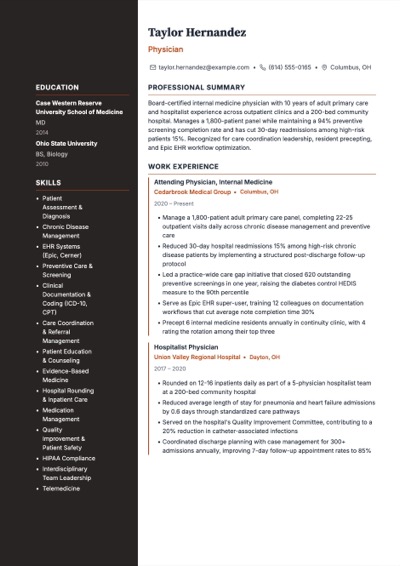
This is a complete fictional sample. Study the structure and evidence patterns, then replace every name, employer, number, skill, and accomplishment with information that is true for you.
Professional Summary
Board-certified internal medicine physician with 10 years of adult primary care and hospitalist experience across outpatient clinics and a 200-bed community hospital. Manages a 1,800-patient panel while maintaining a 94% preventive screening completion rate and has cut 30-day readmissions among high-risk patients 15%. Recognized for care coordination leadership, resident precepting, and Epic EHR workflow optimization.
Work Experience
Attending Physician, Internal Medicine
2020 – PresentCedarbrook Medical Group — Columbus, OH
- Manage a 1,800-patient adult primary care panel, completing 22-25 outpatient visits daily across chronic disease management and preventive care
- Reduced 30-day hospital readmissions 15% among high-risk chronic disease patients by implementing a structured post-discharge follow-up protocol
- Led a practice-wide care gap initiative that closed 620 outstanding preventive screenings in one year, raising the diabetes control HEDIS measure to the 90th percentile
- Serve as Epic EHR super-user, training 12 colleagues on documentation workflows that cut average note completion time 30%
- Precept 6 internal medicine residents annually in continuity clinic, with 4 rating the rotation among their top three
Hospitalist Physician
2017 – 2020Union Valley Regional Hospital — Dayton, OH
- Rounded on 12-16 inpatients daily as part of a 5-physician hospitalist team at a 200-bed community hospital
- Reduced average length of stay for pneumonia and heart failure admissions by 0.6 days through standardized care pathways
- Served on the hospital's Quality Improvement Committee, contributing to a 20% reduction in catheter-associated infections
- Coordinated discharge planning with case management for 300+ admissions annually, improving 7-day follow-up appointment rates to 85%
Internal Medicine Resident
2014 – 2017Lakeside University Hospital — Cleveland, OH
- Managed a continuity clinic panel of 150 patients across 3 years while completing inpatient, ICU, and subspecialty rotations
- Presented 4 case reports at departmental grand rounds, including one selected for regional conference poster presentation
- Precepted 8 third-year medical students during ambulatory rotations, receiving top-quartile teaching evaluations
Education
- MD — Case Western Reserve University School of Medicine · 2014
- BS, Biology — Ohio State University · 2010
Certifications
- Board Certified — American Board of Internal Medicine (active)
- State Medical License — Ohio (active)
- Basic Life Support (BLS) and Advanced Cardiac Life Support (ACLS) Certified
- DEA Registration (active)
Achievement bullet patterns
Adapt the sentence pattern to your work. Never copy an employer, number, tool, or outcome that is not true for you.
- 1
Managed a 1,800-patient adult primary care panel, completing 22-25 visits daily while maintaining a 94% preventive screening completion rate
Adapt the pattern; do not copy facts that are not yours.
- 2
Reduced 30-day hospital readmissions 15% among high-risk chronic disease patients through a structured post-discharge follow-up protocol
Adapt the pattern; do not copy facts that are not yours.
- 3
Led a care coordination initiative that closed 620 outstanding preventive care gaps in one year, raising the practice's diabetes control HEDIS measure to the 90th percentile
Adapt the pattern; do not copy facts that are not yours.
- 4
Precepted 6 internal medicine residents annually and served as EHR super-user, training 12 colleagues on Epic workflow optimization
Adapt the pattern; do not copy facts that are not yours.
Practical writing guidance
- 1
Quantify your patient panel size and visit volume: 'Managed a 1,800-patient panel with 22-25 visits daily' shows scale a hiring committee can benchmark.
- 2
Highlight quality metrics such as HEDIS scores, readmission rates, or preventive screening completion, since health systems hire on measurable outcomes.
- 3
State your board certification status and any subspecialty credentials near the top, since credentialing staff verify these before reading the rest.
- 4
Show care coordination impact: reduced ER visits, hospital readmissions avoided, or care gaps closed through outreach you led.
- 5
Name your EHR platform experience (Epic, Cerner, athenahealth), since practices standardize on one system and often screen for familiarity.
- 6
Include teaching, precepting, or committee leadership roles, which signal engagement beyond direct patient care.
How to write a physician resume
Lead with your panel size, visit volume, and one quality metric
Show care coordination and readmission impact, not just duties performed
Place board certification and licensure where credentialing staff look first
Frequently Asked Questions
How do I highlight patient panel size and productivity on a physician resume?
State your panel size, average daily visit volume, and setting, such as outpatient primary care or hospitalist rounding. Pair these with a quality metric like preventive screening rates or readmission reduction. Precise figures carry more weight than general statements about your practice style.
Should I list board certification before or after my work experience?
Place board certification and licensure in a dedicated section near the top, just below your summary, since credentialing staff verify these first. Include the certifying board, specialty, and status such as board-certified or board-eligible. Do not list license or certificate numbers on the resume itself.
How long should a physician resume be?
One to two pages for most practicing physicians, expanding to a full CV only for academic or research-affiliated positions that request one. Community and hospital-employed roles generally prefer a concise resume focused on recent clinical impact and quality metrics rather than a complete career history.
What if I am transitioning from residency to my first attending position?
Emphasize your continuity clinic panel size, procedures performed, and any quality improvement projects you led during residency. Include your case mix and patient volume to demonstrate readiness for independent practice, plus teaching or precepting experience.