
Turn inspiration into your own evidence
Do not copy the career. Learn how the career is communicated.
Read the evidence
Notice where the example uses scale, change, ownership, and context.
Replace every fact
Write from your real work, even when your numbers or setting are different.
Check the result
Make sure the document remains readable, truthful, and aligned to the role.
Key Skills
Use only the skills you can support with real experience. The example shows the vocabulary; your evidence makes it credible.
Full Public Relations Specialist Resume Example
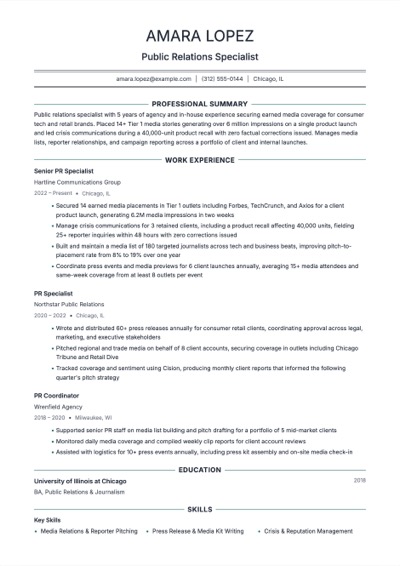
This is a complete fictional sample. Study the structure and evidence patterns, then replace every name, employer, number, skill, and accomplishment with information that is true for you.
Professional Summary
Public relations specialist with 5 years of agency and in-house experience securing earned media coverage for consumer tech and retail brands. Placed 14+ Tier 1 media stories generating over 6 million impressions on a single product launch and led crisis communications during a 40,000-unit product recall with zero factual corrections issued. Manages media lists, reporter relationships, and campaign reporting across a portfolio of client and internal launches.
Work Experience
Senior PR Specialist
2022 – PresentHartline Communications Group — Chicago, IL
- Secured 14 earned media placements in Tier 1 outlets including Forbes, TechCrunch, and Axios for a client product launch, generating 6.2M media impressions in two weeks
- Manage crisis communications for 3 retained clients, including a product recall affecting 40,000 units, fielding 25+ reporter inquiries within 48 hours with zero corrections issued
- Built and maintain a media list of 180 targeted journalists across tech and business beats, improving pitch-to-placement rate from 8% to 19% over one year
- Coordinate press events and media previews for 6 client launches annually, averaging 15+ media attendees and same-week coverage from at least 8 outlets per event
PR Specialist
2020 – 2022Northstar Public Relations — Chicago, IL
- Wrote and distributed 60+ press releases annually for consumer retail clients, coordinating approval across legal, marketing, and executive stakeholders
- Pitched regional and trade media on behalf of 8 client accounts, securing coverage in outlets including Chicago Tribune and Retail Dive
- Tracked coverage and sentiment using Cision, producing monthly client reports that informed the following quarter's pitch strategy
PR Coordinator
2018 – 2020Wrenfield Agency — Milwaukee, WI
- Supported senior PR staff on media list building and pitch drafting for a portfolio of 5 mid-market clients
- Monitored daily media coverage and compiled weekly clip reports for client account reviews
- Assisted with logistics for 10+ press events annually, including press kit assembly and on-site media check-in
Education
- BA, Public Relations & Journalism — University of Illinois at Chicago · 2018
Certifications
- Cision Media Database Certified User
- PRSA Accreditation in Public Relations (in progress)
Achievement bullet patterns
Adapt the sentence pattern to your work. Never copy an employer, number, tool, or outcome that is not true for you.
- 1
Secured 14 earned media placements in Tier 1 outlets including Forbes, TechCrunch, and Axios for a product launch, generating 6.2M media impressions in the first two weeks
Adapt the pattern; do not copy facts that are not yours.
- 2
Managed crisis communications during a product recall affecting 40,000 units, drafting the statement and fielding 25+ reporter inquiries within 48 hours with zero factual corrections issued
Adapt the pattern; do not copy facts that are not yours.
- 3
Built and maintained a media list of 180 targeted journalists across tech and business beats, improving pitch-to-placement rate from 8% to 19% over one year
Adapt the pattern; do not copy facts that are not yours.
- 4
Coordinated a press event for a company milestone that drew 22 media attendees and resulted in same-week coverage from 9 regional and 3 national outlets
Adapt the pattern; do not copy facts that are not yours.
Practical writing guidance
- 1
Lead every campaign bullet with the outlets and reach secured: 'Placed 14 stories in Tier 1 outlets including Forbes and TechCrunch, generating 6.2M media impressions' beats a generic mention of coverage
- 2
Distinguish earned media from paid or owned placements, since hiring managers specifically screen for earned coverage as the harder, more valuable skill
- 3
Quantify your media list and response rate if relevant, such as pitch-to-placement ratio, to show efficiency rather than volume alone
- 4
Document crisis response separately from routine launches, naming the situation type (product recall, executive controversy, data incident) and the outcome you helped drive
- 5
Name specific journalists' beats or outlets you have standing relationships with, without claiming personal friendship you cannot substantiate in an interview
- 6
Show measurement literacy by citing the tools you used to track coverage and sentiment, such as Cision, Muck Rack, or Meltwater, since clients expect reporting rigor
How to write a public relations specialist resume
Prove media relationships with named placements, not pitch counts
Give crisis and issues work its own space
Separate earned coverage from paid and owned media on the resume
Frequently Asked Questions
What's the difference between a PR specialist resume and a communications specialist resume?
A public relations resume centers on external, earned media: outlets covered, reporter relationships, and reach generated. A communications specialist resume centers on internal audiences like employees, tracked through readership and adoption metrics rather than press coverage.
How do I quantify PR results without inflated impression numbers?
Use verified metrics from monitoring tools like Cision or Meltwater, and be specific about what the number represents, such as unique visitors or estimated reach. Avoid vague 'potential reach' figures; PR hiring managers can usually spot unsubstantiated numbers immediately.
Should I list every outlet I've ever pitched?
No. List outlets where you actually secured coverage, prioritizing recognizable Tier 1 and trade publications relevant to the employer's industry. A shorter list of confirmed placements is far more credible than a long list implying broad pitching without results.
How important are crisis communications examples on a PR resume?
Very important for mid-level and senior roles. Crisis work demonstrates judgment under pressure that routine media relations does not test. Include one crisis or issues-management example with the situation type and outcome, since employers weigh this heavily for reputation-sensitive accounts.