
Turn inspiration into your own evidence
Do not copy the career. Learn how the career is communicated.
Read the evidence
Notice where the example uses scale, change, ownership, and context.
Replace every fact
Write from your real work, even when your numbers or setting are different.
Check the result
Make sure the document remains readable, truthful, and aligned to the role.
Key Skills
Use only the skills you can support with real experience. The example shows the vocabulary; your evidence makes it credible.
Full Surgeon Resume Example
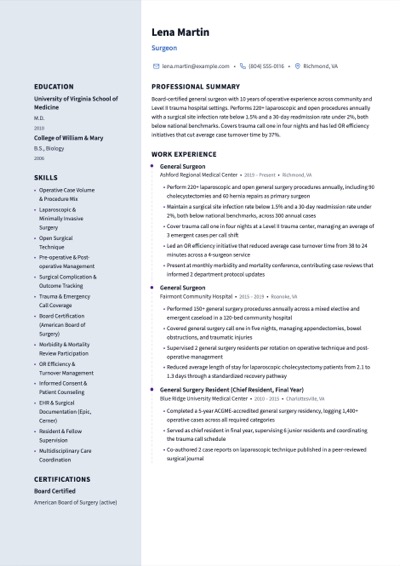
This is a complete fictional sample. Study the structure and evidence patterns, then replace every name, employer, number, skill, and accomplishment with information that is true for you.
Professional Summary
Board-certified general surgeon with 10 years of operative experience across community and Level II trauma hospital settings. Performs 220+ laparoscopic and open procedures annually with a surgical site infection rate below 1.5% and a 30-day readmission rate under 2%, both below national benchmarks. Covers trauma call one in four nights and has led OR efficiency initiatives that cut average case turnover time by 37%.
Work Experience
General Surgeon
2019 – PresentAshford Regional Medical Center — Richmond, VA
- Perform 220+ laparoscopic and open general surgery procedures annually, including 90 cholecystectomies and 60 hernia repairs as primary surgeon
- Maintain a surgical site infection rate below 1.5% and a 30-day readmission rate under 2%, both below national benchmarks, across 300 annual cases
- Cover trauma call one in four nights at a Level II trauma center, managing an average of 3 emergent cases per call shift
- Led an OR efficiency initiative that reduced average case turnover time from 38 to 24 minutes across a 4-surgeon service
- Present at monthly morbidity and mortality conference, contributing case reviews that informed 2 department protocol updates
General Surgeon
2015 – 2019Fairmont Community Hospital — Roanoke, VA
- Performed 150+ general surgery procedures annually across a mixed elective and emergent caseload in a 120-bed community hospital
- Covered general surgery call one in five nights, managing appendectomies, bowel obstructions, and traumatic injuries
- Supervised 2 general surgery residents per rotation on operative technique and post-operative management
- Reduced average length of stay for laparoscopic cholecystectomy patients from 2.1 to 1.3 days through a standardized recovery pathway
General Surgery Resident (Chief Resident, Final Year)
2010 – 2015Blue Ridge University Medical Center — Charlottesville, VA
- Completed a 5-year ACGME-accredited general surgery residency, logging 1,400+ operative cases across all required categories
- Served as chief resident in final year, supervising 6 junior residents and coordinating the trauma call schedule
- Co-authored 2 case reports on laparoscopic technique published in a peer-reviewed surgical journal
Education
- M.D. — University of Virginia School of Medicine · 2010
- B.S., Biology — College of William & Mary · 2006
Certifications
- Board Certified — American Board of Surgery (active)
- Licensed Physician — Virginia (active)
- Advanced Trauma Life Support (ATLS) Certified
- Advanced Cardiac Life Support (ACLS) Certified
Achievement bullet patterns
Adapt the sentence pattern to your work. Never copy an employer, number, tool, or outcome that is not true for you.
- 1
Performed 220+ laparoscopic and open general surgery procedures annually, including 90 cholecystectomies and 60 hernia repairs as primary surgeon
Adapt the pattern; do not copy facts that are not yours.
- 2
Maintained a 30-day readmission rate under 2% and a surgical site infection rate below 1.5%, both under national benchmarks, across 300 annual cases
Adapt the pattern; do not copy facts that are not yours.
- 3
Covered trauma call one in four nights across a Level II trauma center, managing an average of 3 emergent cases per call shift
Adapt the pattern; do not copy facts that are not yours.
- 4
Led an OR efficiency initiative that reduced average case turnover time from 38 to 24 minutes across a 4-surgeon general surgery service
Adapt the pattern; do not copy facts that are not yours.
Practical writing guidance
- 1
Break case volume down by procedure type and role: "performed 220 laparoscopic cholecystectomies as primary surgeon annually" beats a vague total
- 2
Report complication, infection, or readmission rates when your hospital tracks them, especially if they beat national benchmarks
- 3
State your call coverage frequency and typical case load per shift, since this is a major factor in surgical staffing decisions
- 4
List board certification and subspecialty fellowship training in a dedicated section, since privileging is granted procedure-by-procedure
- 5
Mention OR efficiency contributions, such as reduced turnover time or on-time first-case starts, if you have led quality initiatives
- 6
Quantify teaching and supervision if applicable, such as residents trained or M&M presentations delivered
How to write a surgeon resume
Lead with operative case volume by procedure, not years of experience
Attach outcomes and complication rates to your case volume, not just counts
State call coverage and board certification explicitly, not by inference
Frequently Asked Questions
How should I report operative case volume on a surgeon resume?
Break case volume down by procedure type and role (primary surgeon vs. first assist), such as "performed 220 laparoscopic cholecystectomies as primary surgeon annually." Aggregate numbers like "performed 500+ procedures" are far less useful to a credentialing committee than category-specific counts.
Should I include my complication and readmission rates?
Yes, if your hospital tracks them and they are favorable or in line with national benchmarks. A line such as "maintained a surgical site infection rate below 1.5%, under the national benchmark" demonstrates outcome quality, which credentialing committees weigh alongside raw case volume.
How do I describe call coverage on a surgeon resume?
State your call frequency and setting clearly, such as "covered trauma call one in four nights, managing an average of 3 emergent cases per call shift." This tells a hiring hospital exactly what coverage burden you can absorb, which is a major factor in surgical staffing decisions.
How is a surgeon resume different from a general physician resume?
A surgeon resume should center on operative case volume by procedure, surgical outcomes, and call coverage rather than outpatient panel size or chronic disease management. Credentialing committees are evaluating hands-on operative competence, so lead with the OR, not the clinic.