
Turn inspiration into your own evidence
Do not copy the career. Learn how the career is communicated.
Read the evidence
Notice where the example uses scale, change, ownership, and context.
Replace every fact
Write from your real work, even when your numbers or setting are different.
Check the result
Make sure the document remains readable, truthful, and aligned to the role.
Key Skills
Use only the skills you can support with real experience. The example shows the vocabulary; your evidence makes it credible.
Full Actor Resume Example
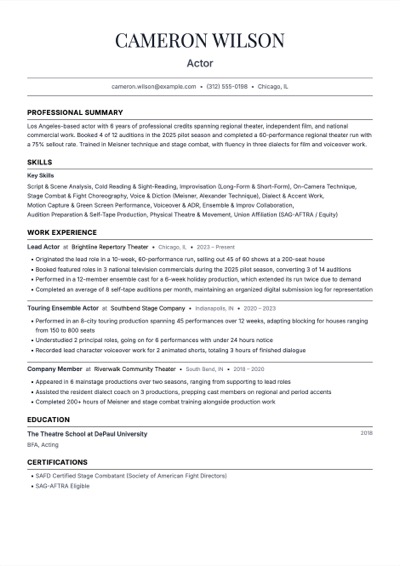
This is a complete fictional sample. Study the structure and evidence patterns, then replace every name, employer, number, skill, and accomplishment with information that is true for you.
Professional Summary
Los Angeles-based actor with 6 years of professional credits spanning regional theater, independent film, and national commercial work. Booked 4 of 12 auditions in the 2025 pilot season and completed a 60-performance regional theater run with a 75% sellout rate. Trained in Meisner technique and stage combat, with fluency in three dialects for film and voiceover work.
Work Experience
Lead Actor
2023 – PresentBrightline Repertory Theater — Chicago, IL
- Originated the lead role in a 10-week, 60-performance run, selling out 45 of 60 shows at a 200-seat house
- Booked featured roles in 3 national television commercials during the 2025 pilot season, converting 3 of 14 auditions
- Performed in a 12-member ensemble cast for a 6-week holiday production, which extended its run twice due to demand
- Completed an average of 8 self-tape auditions per month, maintaining an organized digital submission log for representation
Touring Ensemble Actor
2020 – 2023Southbend Stage Company — Indianapolis, IN
- Performed in an 8-city touring production spanning 45 performances over 12 weeks, adapting blocking for houses ranging from 150 to 800 seats
- Understudied 2 principal roles, going on for 6 performances with under 24 hours notice
- Recorded lead character voiceover work for 2 animated shorts, totaling 3 hours of finished dialogue
Company Member
2018 – 2020Riverwalk Community Theater — South Bend, IN
- Appeared in 6 mainstage productions over two seasons, ranging from supporting to lead roles
- Assisted the resident dialect coach on 3 productions, prepping cast members on regional and period accents
- Completed 200+ hours of Meisner and stage combat training alongside production work
Education
- BFA, Acting — The Theatre School at DePaul University · 2018
Certifications
- SAFD Certified Stage Combatant (Society of American Fight Directors)
- SAG-AFTRA Eligible
Achievement bullet patterns
Adapt the sentence pattern to your work. Never copy an employer, number, tool, or outcome that is not true for you.
- 1
Originated the lead role in a 10-week, 60-performance run at a 200-seat regional theater, selling out 45 of 60 performances
Adapt the pattern; do not copy facts that are not yours.
- 2
Booked featured roles in 3 national television commercials within a single pilot season, converting 3 of 14 auditions
Adapt the pattern; do not copy facts that are not yours.
- 3
Performed in an 8-city touring production spanning 45 performances over 12 weeks, adapting the role for houses ranging from 150 to 800 seats
Adapt the pattern; do not copy facts that are not yours.
- 4
Recorded lead character voiceover work across 2 animated shorts and 1 video game, totaling 6 hours of finished dialogue
Adapt the pattern; do not copy facts that are not yours.
Practical writing guidance
- 1
Quantify your run: 'Performed 60 shows over a 10-week run' shows stamina and reliability to a casting director evaluating a demanding schedule
- 2
List credits in three tiers (Film/TV, Theater, Voiceover) with role, production, and director or company, strongest work first within each tier
- 3
Include festival selections or award nominations with the festival name and year, since these substitute for reviews a casting director can verify
- 4
Keep the special skills section tight and true: only list skills you could perform on set without rehearsal, since callbacks test them
- 5
Note booking-to-audition ratios from a strong season, such as 'booked 4 of 12 auditions in 2025,' to signal you convert opportunities
- 6
Match your training section to the role type you submit for: comedic roles benefit from improv training, dramatic roles from Meisner or Uta Hagen technique
How to write an actor resume
Format credits the way casting directors expect, not like a corporate resume
Quantify runs, bookings, and callback rates the same way any other professional would
Keep the special skills section honest and organized by category
Frequently Asked Questions
How long should an actor resume be?
One page, always. Casting directors and agents review resumes in seconds and expect a single page stapled back-to-back with your headshot. If your credits overflow one page, cut older or less relevant work rather than shrinking the font past 10 points.
What order should credits appear in on an actor resume?
Group credits by category — Film/Television, Theater, Voiceover, Commercial — with your strongest or most recent work first in each category. Include role, production title, and director or production company. Skip a chronological work history outside acting entirely.
Should I list special skills I'm only somewhat good at?
No. Only list special skills you could perform on set with no rehearsal, since a casting director may test you on the spot. Common categories include dialects, sports, instruments, dance styles, and stage combat certifications. Overstating one can end a booking on shoot day.
Do I need an agent before submitting a resume for auditions?
No, many roles — student films, regional theater, background work, non-union commercials — accept direct submissions. An agent becomes valuable once you pursue union work or larger productions, since most casting directors for those projects only accept submissions through representation.