
Turn inspiration into your own evidence
Do not copy the career. Learn how the career is communicated.
Read the evidence
Notice where the example uses scale, change, ownership, and context.
Replace every fact
Write from your real work, even when your numbers or setting are different.
Check the result
Make sure the document remains readable, truthful, and aligned to the role.
Key Skills
Use only the skills you can support with real experience. The example shows the vocabulary; your evidence makes it credible.
Full Musician Resume Example
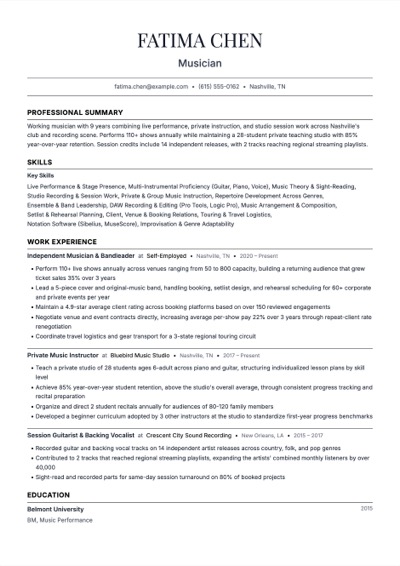
This is a complete fictional sample. Study the structure and evidence patterns, then replace every name, employer, number, skill, and accomplishment with information that is true for you.
Professional Summary
Working musician with 9 years combining live performance, private instruction, and studio session work across Nashville's club and recording scene. Performs 110+ shows annually while maintaining a 28-student private teaching studio with 85% year-over-year retention. Session credits include 14 independent releases, with 2 tracks reaching regional streaming playlists.
Work Experience
Independent Musician & Bandleader
2020 – PresentSelf-Employed — Nashville, TN
- Perform 110+ live shows annually across venues ranging from 50 to 800 capacity, building a returning audience that grew ticket sales 35% over 3 years
- Lead a 5-piece cover and original-music band, handling booking, setlist design, and rehearsal scheduling for 60+ corporate and private events per year
- Maintain a 4.9-star average client rating across booking platforms based on over 150 reviewed engagements
- Negotiate venue and event contracts directly, increasing average per-show pay 22% over 3 years through repeat-client rate renegotiation
- Coordinate travel logistics and gear transport for a 3-state regional touring circuit
Private Music Instructor
2017 – PresentBluebird Music Studio — Nashville, TN
- Teach a private studio of 28 students ages 6-adult across piano and guitar, structuring individualized lesson plans by skill level
- Achieve 85% year-over-year student retention, above the studio's overall average, through consistent progress tracking and recital preparation
- Organize and direct 2 student recitals annually for audiences of 80-120 family members
- Developed a beginner curriculum adopted by 3 other instructors at the studio to standardize first-year progress benchmarks
Session Guitarist & Backing Vocalist
2015 – 2017Crescent City Sound Recording — New Orleans, LA
- Recorded guitar and backing vocal tracks on 14 independent artist releases across country, folk, and pop genres
- Contributed to 2 tracks that reached regional streaming playlists, expanding the artists' combined monthly listeners by over 40,000
- Sight-read and recorded parts for same-day session turnaround on 80% of booked projects
Education
- BM, Music Performance — Belmont University · 2015
Achievement bullet patterns
Adapt the sentence pattern to your work. Never copy an employer, number, tool, or outcome that is not true for you.
- 1
Performed 110+ live shows annually across venues ranging from 50 to 800 capacity, growing repeat-audience ticket sales 35% over 3 years
Adapt the pattern; do not copy facts that are not yours.
- 2
Built and maintained a private teaching studio of 28 students across piano and guitar, achieving 85% year-over-year retention
Adapt the pattern; do not copy facts that are not yours.
- 3
Recorded session guitar and backing vocals on 14 independent releases, including 2 tracks that reached regional streaming playlists
Adapt the pattern; do not copy facts that are not yours.
- 4
Led a 5-piece cover band through 60+ corporate and wedding bookings per year, maintaining a 4.9-star average rating across booking platforms
Adapt the pattern; do not copy facts that are not yours.
Practical writing guidance
- 1
State your annual gig count and typical venue size, such as '90+ shows annually at 50-800 capacity venues,' since booking agents and venue owners want proof of reliability and draw
- 2
If you teach, list your active student count and retention rate, since a studio that keeps students year over year signals both teaching skill and business stability
- 3
Credit specific recording or session work by project type and outcome, such as tracks that charted, streamed, or were licensed, rather than a vague 'session musician' label
- 4
Group your work into sections by income stream (Performance, Instruction, Session Work) instead of forcing gigs into a single reverse-chronological job list
- 5
Note any original compositions, releases, or sync placements with a measurable result, such as streaming numbers or licensing fees
- 6
Include band leadership or logistics responsibilities, like booking, scheduling, or managing other musicians, since these show organizational skill beyond playing ability
How to write a musician resume
Structure the resume around income streams, not a single job ladder
Replace genre and instrument lists with performance and business numbers
Handle non-traditional employers and gaps without apologizing for them
Build a musician resume in Guul
Keyword screening often happens before a person reads your resume. These are the terms and credentials worth backing with real experience, not stuffing in.
Skills hiring software likely screens for
Keyword filters often match terms literally. Use the posting’s exact wording.
- Private & Classroom Music Instruction
- Ensemble Direction & Conducting
- Sight-Reading
- Music Theory & Ear Training
- Arranging & Orchestration
- Recording & Audio Editing
- Concert & Event Production
- Music Education Curriculum Planning
- Arts Program Administration
Certifications worth naming
List each one with its issuing body.
- State Teaching License with Music Endorsement (for K-12 posts)
- Nationally Certified Teacher of Music (NCTM), Music Teachers National Association
- Orff Schulwerk Teacher Training Levels, American Orff-Schulwerk Association
- Kodály Certification from an OAKE-endorsed program
- Avid Certified User: Pro Tools
Software and tools to name
Name only the tools you have actually used.
- Pro Tools
- Logic Pro
- Ableton Live
- Sibelius
- Dorico
- MuseScore
How Guul builds it
Start by deciding which resume you are building. For a gig, a session, or an orchestra application, the reader is a person, and ATS advice matters little. Many orchestras hire through auditions, often played behind a screen, and the resume mainly confirms training and experience. For a school, college, arts organization, or music tech company, the application often runs through a portal, and the problems are familiar ones: a performance history laid out in columns, ensemble names in a sidebar, and a heading like "On Stage" that a parser cannot map to Experience. In Guul, the portal version works best in Simple & Clean or Academic CV. Academic CV suits college and conservatory teaching jobs that expect degrees, the teachers you studied with, and performance lists. Simple & Clean suits K-12 posts, arts admin, and music tech roles. Creative Portfolio is for the version you hand to a person. Put the credential the posting asks for first: a teaching license and endorsement for schools, a degree and teaching record for colleges, and the software you actually use for audio or music tech jobs. Tailoring compares a pasted posting with your record and suggests plain job-title wording for work you currently describe loosely, without adding anything you have not done.
Templates that fit this role
What the ATS checker looks at for musician resumes
- Headings a parser can map, such as Teaching Experience and Performance, instead of creative labels
- Performance and ensemble lists in plain lines, not columns or a sidebar
- The license, endorsement, or degree a school or college posting asks for, stated where a screen looks first
- Freelance and self-employed dates written so overlapping gigs do not look like gaps
- Software names for audio and music tech roles, like Pro Tools or Ableton Live, matched to the posting
Frequently Asked Questions
How do I format a resume when I have never had a traditional job title?
Organize by income stream instead of forcing gigs into one chronological ladder. Use section headers like Performance, Instruction, and Session Work, and under each list the venues, students, or projects with dates and quantified outcomes, the same way a conventional resume lists employers.
Do I need to list every gig I have ever played?
No. List representative, recent, and notable engagements, such as recurring residencies, festival slots, or sessions tied to a released project. A summary line with a total count, such as '110+ shows annually,' covers volume without cluttering the page with every individual date.
How do I present both performing and teaching without the resume looking scattered?
Frame both as evidence of the same underlying skill set: musicianship, reliability, and client relationships. A one-line summary stating you combine performance and instruction, followed by clearly separated sections for each, reads as a deliberate portfolio career rather than an unfocused one.
What is the difference between a session musician resume and a bandleader resume?
A session musician resume emphasizes sight-reading speed, stylistic range, and studio reliability across other people's projects, credited by release. A bandleader resume emphasizes booking volume, setlist and rehearsal management, and audience or revenue growth for a group you run.
Do I even need an ATS-friendly resume as a musician?
Only for some applications. Bookings, sessions, and many freelance calls are decided by people who hear you, so a clean, readable page is enough. School districts, universities, larger arts organizations, and tech companies often take applications through online systems, and there the layout and headings matter. Guul's checker is useful for that second group and says nothing about how you play.
How do I apply for a music teaching job in a public school?
Most public school music posts ask for a state teaching license with a music endorsement, so put that near the top under a Licenses & Certifications heading. Then list teaching roles, including private studio teaching, with student numbers, grade levels, and the ensembles you directed. Performance work can follow in its own section.
Can I use Guul for a music tech or audio job?
Yes. Those companies usually hire like other tech firms, through an online system, so name the software and hardware you have used and describe projects in plain terms: what you built, recorded, or tested, and for whom. Tailoring matches your record against the posting's tool list and will not add a program you have not used.
Will Guul help with an orchestra audition?
Only with the paperwork. Many orchestras decide through auditions, and the resume mainly confirms training, teachers, and ensemble experience. Guul can keep that one page tidy and accurate, but it has no view into how a panel will judge your playing.