
Turn inspiration into your own evidence
Do not copy the career. Learn how the career is communicated.
Read the evidence
Notice where the example uses scale, change, ownership, and context.
Replace every fact
Write from your real work, even when your numbers or setting are different.
Check the result
Make sure the document remains readable, truthful, and aligned to the role.
Key Skills
Use only the skills you can support with real experience. The example shows the vocabulary; your evidence makes it credible.
Full Claims Adjuster Resume Example
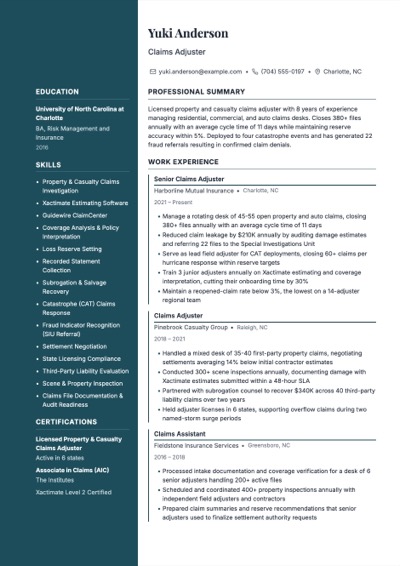
This is a complete fictional sample. Study the structure and evidence patterns, then replace every name, employer, number, skill, and accomplishment with information that is true for you.
Professional Summary
Licensed property and casualty claims adjuster with 8 years of experience managing residential, commercial, and auto claims desks. Closes 380+ files annually with an average cycle time of 11 days while maintaining reserve accuracy within 5%. Deployed to four catastrophe events and has generated 22 fraud referrals resulting in confirmed claim denials.
Work Experience
Senior Claims Adjuster
2021 – PresentHarborline Mutual Insurance — Charlotte, NC
- Manage a rotating desk of 45-55 open property and auto claims, closing 380+ files annually with an average cycle time of 11 days
- Reduced claim leakage by $210K annually by auditing damage estimates and referring 22 files to the Special Investigations Unit
- Serve as lead field adjuster for CAT deployments, closing 60+ claims per hurricane response within reserve targets
- Train 3 junior adjusters annually on Xactimate estimating and coverage interpretation, cutting their onboarding time by 30%
- Maintain a reopened-claim rate below 3%, the lowest on a 14-adjuster regional team
Claims Adjuster
2018 – 2021Pinebrook Casualty Group — Raleigh, NC
- Handled a mixed desk of 35-40 first-party property claims, negotiating settlements averaging 14% below initial contractor estimates
- Conducted 300+ scene inspections annually, documenting damage with Xactimate estimates submitted within a 48-hour SLA
- Partnered with subrogation counsel to recover $340K across 40 third-party liability claims over two years
- Held adjuster licenses in 6 states, supporting overflow claims during two named-storm surge periods
Claims Assistant
2016 – 2018Fieldstone Insurance Services — Greensboro, NC
- Processed intake documentation and coverage verification for a desk of 6 senior adjusters handling 200+ active files
- Scheduled and coordinated 400+ property inspections annually with independent field adjusters and contractors
- Prepared claim summaries and reserve recommendations that senior adjusters used to finalize settlement authority requests
Education
- BA, Risk Management and Insurance — University of North Carolina at Charlotte · 2016
Certifications
- Licensed Property & Casualty Claims Adjuster — Active in 6 states
- Associate in Claims (AIC) — The Institutes
- Xactimate Level 2 Certified
Achievement bullet patterns
Adapt the sentence pattern to your work. Never copy an employer, number, tool, or outcome that is not true for you.
- 1
Managed a rotating desk of 45-55 open property and auto claims, closing 380+ files annually with an average cycle time of 11 days
Adapt the pattern; do not copy facts that are not yours.
- 2
Reduced claim leakage by $210K annually by identifying inconsistent damage estimates and referring 22 files to the Special Investigations Unit
Adapt the pattern; do not copy facts that are not yours.
- 3
Deployed to 4 CAT events including two hurricane responses, closing 60+ field claims per deployment within carrier reserve targets
Adapt the pattern; do not copy facts that are not yours.
- 4
Negotiated third-party liability settlements averaging 14% below initial demand across 90+ bodily injury and property damage claims
Adapt the pattern; do not copy facts that are not yours.
Practical writing guidance
- 1
Lead with your closed-file volume: 'Closed 380+ property claims annually with average cycle time of 11 days' beats a vague duty list every time
- 2
State every jurisdiction you hold an adjuster license in — recruiters filter by state coverage before anything else on the resume
- 3
Quantify settlement accuracy, such as the percentage of files closed within reserve or the dollar amount of overpayment you prevented through audit
- 4
Name your claims platform experience specifically (Guidewire, Xactimate, Duck Creek) since ATS systems and hiring managers both search for these terms
- 5
Include CAT deployment history if you have it — carriers pay a premium for adjusters who can mobilize for hurricane or wildfire surge events
- 6
Show fraud detection results, like the number of SIU referrals you generated or the dollar value of claims denied after investigation
How to write a claims adjuster resume
Open with your licensed states and closed-file numbers
Translate your file history into measurable outcomes
Make your CAT and multi-line experience easy to find
Frequently Asked Questions
What licenses should a claims adjuster list on their resume?
List every state adjuster license you hold as active, including your resident state and any reciprocal licenses used for multi-state work. Group them under a Licenses heading rather than burying them in your summary, since recruiters filter by licensed states first.
How do I show claims volume without sounding repetitive?
Vary the angle each time: open caseload size in one bullet, annual closed-file count in another, and cycle time or accuracy in a third. Pulling different metrics from the same file history keeps the resume from reading like a single statistic repeated with new numbers.
Does independent adjusting experience count the same as staff experience?
Yes, and CAT deployment history is often a differentiator. List each deployment with the event, claim type, and files closed, since carriers value adjusters who can mobilize quickly during surge events even if the underlying work was contract-based rather than staff.
Should I mention specific software like Xactimate on my resume?
Always name the estimating and claims management platforms you have used, such as Xactimate, Guidewire, or Duck Creek. These are searched terms in most carrier applicant tracking systems, and listing them by name reduces onboarding friction for the hiring team.