
Turn inspiration into your own evidence
Do not copy the career. Learn how the career is communicated.
Read the evidence
Notice where the example uses scale, change, ownership, and context.
Replace every fact
Write from your real work, even when your numbers or setting are different.
Check the result
Make sure the document remains readable, truthful, and aligned to the role.
Key Skills
Use only the skills you can support with real experience. The example shows the vocabulary; your evidence makes it credible.
Full Underwriter Resume Example
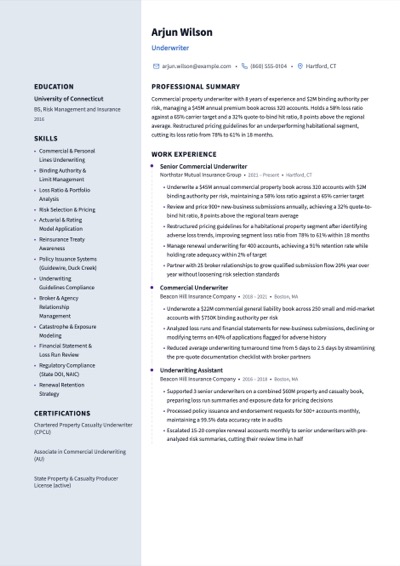
This is a complete fictional sample. Study the structure and evidence patterns, then replace every name, employer, number, skill, and accomplishment with information that is true for you.
Professional Summary
Commercial property underwriter with 8 years of experience and $2M binding authority per risk, managing a $45M annual premium book across 320 accounts. Holds a 58% loss ratio against a 65% carrier target and a 32% quote-to-bind hit ratio, 8 points above the regional average. Restructured pricing guidelines for an underperforming habitational segment, cutting its loss ratio from 78% to 61% in 18 months.
Work Experience
Senior Commercial Underwriter
2021 – PresentNorthstar Mutual Insurance Group — Hartford, CT
- Underwrite a $45M annual commercial property book across 320 accounts with $2M binding authority per risk, maintaining a 58% loss ratio against a 65% carrier target
- Review and price 900+ new-business submissions annually, achieving a 32% quote-to-bind hit ratio, 8 points above the regional team average
- Restructured pricing guidelines for a habitational property segment after identifying adverse loss trends, improving segment loss ratio from 78% to 61% within 18 months
- Manage renewal underwriting for 400 accounts, achieving a 91% retention rate while holding rate adequacy within 2% of target
- Partner with 25 broker relationships to grow qualified submission flow 20% year over year without loosening risk selection standards
Commercial Underwriter
2018 – 2021Beacon Hill Insurance Company — Boston, MA
- Underwrote a $22M commercial general liability book across 250 small and mid-market accounts with $750K binding authority per risk
- Analyzed loss runs and financial statements for new-business submissions, declining or modifying terms on 40% of applications flagged for adverse history
- Reduced average underwriting turnaround time from 5 days to 2.5 days by streamlining the pre-quote documentation checklist with broker partners
Underwriting Assistant
2016 – 2018Beacon Hill Insurance Company — Boston, MA
- Supported 3 senior underwriters on a combined $60M property and casualty book, preparing loss run summaries and exposure data for pricing decisions
- Processed policy issuance and endorsement requests for 500+ accounts monthly, maintaining a 99.5% data accuracy rate in audits
- Escalated 15-20 complex renewal accounts monthly to senior underwriters with pre-analyzed risk summaries, cutting their review time in half
Education
- BS, Risk Management and Insurance — University of Connecticut · 2016
Certifications
- Chartered Property Casualty Underwriter (CPCU)
- Associate in Commercial Underwriting (AU)
- State Property & Casualty Producer License (active)
Achievement bullet patterns
Adapt the sentence pattern to your work. Never copy an employer, number, tool, or outcome that is not true for you.
- 1
Underwrote $45M in annual commercial property premium across 320 accounts with $2M binding authority per risk, maintaining a 58% loss ratio against a 65% carrier target
Adapt the pattern; do not copy facts that are not yours.
- 2
Reviewed and priced 900+ new-business submissions annually, achieving a 32% quote-to-bind hit ratio, 8 points above the regional team average
Adapt the pattern; do not copy facts that are not yours.
- 3
Restructured pricing guidelines for a habitational property segment after identifying adverse loss trends, improving segment loss ratio from 78% to 61% within 18 months
Adapt the pattern; do not copy facts that are not yours.
- 4
Managed renewal underwriting for a $30M book of 400 accounts, achieving a 91% retention rate while holding rate adequacy within 2% of target
Adapt the pattern; do not copy facts that are not yours.
Practical writing guidance
- 1
State your binding authority limit explicitly, such as '$2M per risk,' since it is the first thing a hiring manager checks to gauge your seniority
- 2
Report your book's loss ratio against the carrier or line-of-business target, since this is the single metric that proves your pricing decisions held up
- 3
Quantify your policy and premium volume: 'Underwrote $45M in annual commercial property premium across 300+ accounts' shows scale
- 4
Mention your line of business precisely, whether commercial property, workers' comp, professional liability, or personal auto, since underwriting expertise does not transfer evenly across lines
- 5
Include broker or agency relationship results, such as growth in submissions or hit ratio, if your role involves distribution partnerships
- 6
List rating and policy administration systems by name (Guidewire, Duck Creek, Sapiens) since they are common ATS keyword filters at carriers
How to write an underwriter resume
State your binding authority before anything else
Let your loss ratio carry the argument, not adjectives about your judgment
Separate underwriting authority from adjacent roles so recruiters searching by title find you
Frequently Asked Questions
How do I show underwriting authority if I am not yet a senior underwriter?
State your current binding authority limit even if modest, such as '$250K per risk,' and note the escalation process for larger accounts. Carriers want to see you understand graduated authority and operate within your limit, which matters at entry level just as much as on a senior book.
What is the most important metric to include on an underwriter resume?
Loss ratio is the metric carriers trust most, since it directly measures whether your pricing decisions were sound over time. Pair it with your premium volume and binding authority so a hiring manager can judge both the scale of your book and the accuracy of your risk selection in context.
Should I list specific underwriting software and rating systems?
Yes, name the policy administration and rating platforms you have used, such as Guidewire, Duck Creek, or Sapiens, since carriers often standardize on one system and screen for direct experience with it. Include any proprietary rating tools relevant to your line of business.
How is an underwriter resume different from a credit analyst or insurance agent resume?
A credit analyst evaluates borrower risk for lending with no binding authority, while an underwriter holds a personal limit to price risk directly, so state your authority and loss ratio. An insurance agent sells and services policies instead of pricing risk, so their resume centers on retention.