
Turn inspiration into your own evidence
Do not copy the career. Learn how the career is communicated.
Read the evidence
Notice where the example uses scale, change, ownership, and context.
Replace every fact
Write from your real work, even when your numbers or setting are different.
Check the result
Make sure the document remains readable, truthful, and aligned to the role.
Key Skills
Use only the skills you can support with real experience. The example shows the vocabulary; your evidence makes it credible.
Full Economist Resume Example
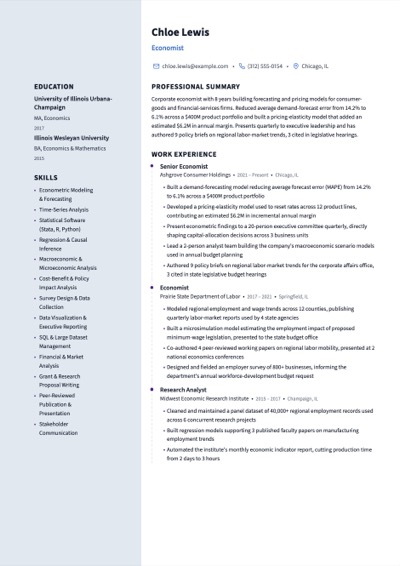
This is a complete fictional sample. Study the structure and evidence patterns, then replace every name, employer, number, skill, and accomplishment with information that is true for you.
Professional Summary
Corporate economist with 8 years building forecasting and pricing models for consumer-goods and financial-services firms. Reduced average demand-forecast error from 14.2% to 6.1% across a $400M product portfolio and built a pricing-elasticity model that added an estimated $6.2M in annual margin. Presents quarterly to executive leadership and has authored 9 policy briefs on regional labor-market trends, 3 cited in legislative hearings.
Work Experience
Senior Economist
2021 – PresentAshgrove Consumer Holdings — Chicago, IL
- Built a demand-forecasting model reducing average forecast error (MAPE) from 14.2% to 6.1% across a $400M product portfolio
- Developed a pricing-elasticity model used to reset rates across 12 product lines, contributing an estimated $6.2M in incremental annual margin
- Present econometric findings to a 20-person executive committee quarterly, directly shaping capital-allocation decisions across 3 business units
- Lead a 2-person analyst team building the company's macroeconomic scenario models used in annual budget planning
- Authored 9 policy briefs on regional labor-market trends for the corporate affairs office, 3 cited in state legislative budget hearings
Economist
2017 – 2021Prairie State Department of Labor — Springfield, IL
- Modeled regional employment and wage trends across 12 counties, publishing quarterly labor-market reports used by 4 state agencies
- Built a microsimulation model estimating the employment impact of proposed minimum-wage legislation, presented to the state budget office
- Co-authored 4 peer-reviewed working papers on regional labor mobility, presented at 2 national economics conferences
- Designed and fielded an employer survey of 800+ businesses, informing the department's annual workforce-development budget request
Research Analyst
2015 – 2017Midwest Economic Research Institute — Champaign, IL
- Cleaned and maintained a panel dataset of 40,000+ regional employment records used across 6 concurrent research projects
- Built regression models supporting 3 published faculty papers on manufacturing employment trends
- Automated the institute's monthly economic indicator report, cutting production time from 2 days to 3 hours
Education
- MA, Economics — University of Illinois Urbana-Champaign · 2017
- BA, Economics & Mathematics — Illinois Wesleyan University · 2015
Achievement bullet patterns
Adapt the sentence pattern to your work. Never copy an employer, number, tool, or outcome that is not true for you.
- 1
Built a demand-forecasting model that reduced average forecast error (MAPE) from 14.2% to 6.1% across a $400M product portfolio, informing quarterly inventory decisions
Adapt the pattern; do not copy facts that are not yours.
- 2
Authored 9 policy briefs on regional labor-market trends, 3 of which were cited directly in state legislative budget hearings
Adapt the pattern; do not copy facts that are not yours.
- 3
Developed a pricing-elasticity model used to reset rates across 12 product lines, contributing an estimated $6.2M in incremental annual margin
Adapt the pattern; do not copy facts that are not yours.
- 4
Presented econometric findings to a 20-person executive committee quarterly, directly shaping capital-allocation decisions across 3 business units
Adapt the pattern; do not copy facts that are not yours.
Practical writing guidance
- 1
Report forecast accuracy directly, such as a MAPE or error-margin figure, since that is the single number most hiring committees check first
- 2
Name the decision your analysis influenced, not just the model you built, since employers hire economists to change decisions, not to produce reports
- 3
Quantify the scale of data or the market you modeled, such as portfolio size, population size, or budget under analysis
- 4
List your statistical software stack explicitly (Stata, R, Python, EViews), since teams screen for tool overlap with their own pipeline
- 5
Cite publications, conference presentations, or policy briefs with readership or citation counts where available, not just titles
- 6
Tailor the balance of theory and application to the employer type: government and academic roles weight publications higher, corporate roles weight business impact higher
How to write an economist resume
Lead with a forecast-accuracy or decision-impact number
Match your publication-to-impact ratio to the employer type
Name your tool stack, then show it produced a defensible number
Frequently Asked Questions
Do I need a PhD to list economist as my title on a resume?
No. Many corporate and government economist roles hire at the master's level, and some analyst-to-economist tracks accept a strong bachelor's degree plus quantitative coursework. A PhD is generally expected for research-focused or central-bank policy roles, not for applied corporate positions.
How do I quantify forecasting accuracy if my employer never tracked it formally?
Calculate it yourself from historical forecast and actual figures you have access to, even for a sample period, and present it as a MAPE or error-margin range. A self-calculated but honestly labeled accuracy figure is far more persuasive than an unquantified claim of forecasting skill.
Should I include academic publications on a corporate economist resume?
Include only the ones most relevant to the target role, and keep the list short, no more than 3-4 entries with venue and year. For corporate roles, pair each publication with a one-line note on its business relevance rather than presenting it as a purely academic credential.
How is a corporate economist resume different from a government economist resume?
Corporate resumes should foreground business impact: revenue, cost, or pricing decisions your models shaped. Government and central-bank resumes weight publications, policy influence, and methodological rigor more heavily, and often expect a longer, more detailed academic and research history.