
Turn inspiration into your own evidence
Do not copy the career. Learn how the career is communicated.
Read the evidence
Notice where the example uses scale, change, ownership, and context.
Replace every fact
Write from your real work, even when your numbers or setting are different.
Check the result
Make sure the document remains readable, truthful, and aligned to the role.
Key Skills
Use only the skills you can support with real experience. The example shows the vocabulary; your evidence makes it credible.
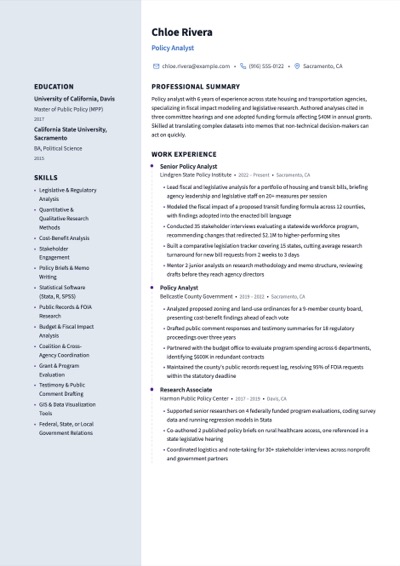
Full Policy Analyst Resume Example
This is a complete fictional sample. Study the structure and evidence patterns, then replace every name, employer, number, skill, and accomplishment with information that is true for you.
Professional Summary
Policy analyst with 6 years of experience across state housing and transportation agencies, specializing in fiscal impact modeling and legislative research. Authored analyses cited in three committee hearings and one adopted funding formula affecting $40M in annual grants. Skilled at translating complex datasets into memos that non-technical decision-makers can act on quickly.
Work Experience
Senior Policy Analyst
2022 – PresentLindgren State Policy Institute — Sacramento, CA
- Lead fiscal and legislative analysis for a portfolio of housing and transit bills, briefing agency leadership and legislative staff on 20+ measures per session
- Modeled the fiscal impact of a proposed transit funding formula across 12 counties, with findings adopted into the enacted bill language
- Conducted 35 stakeholder interviews evaluating a statewide workforce program, recommending changes that redirected $2.1M to higher-performing sites
- Built a comparative legislation tracker covering 15 states, cutting average research turnaround for new bill requests from 2 weeks to 3 days
- Mentor 2 junior analysts on research methodology and memo structure, reviewing drafts before they reach agency directors
Policy Analyst
2019 – 2022Bellcastle County Government — Sacramento, CA
- Analyzed proposed zoning and land-use ordinances for a 9-member county board, presenting cost-benefit findings ahead of each vote
- Drafted public comment responses and testimony summaries for 18 regulatory proceedings over three years
- Partnered with the budget office to evaluate program spending across 6 departments, identifying $600K in redundant contracts
- Maintained the county's public records request log, resolving 95% of FOIA requests within the statutory deadline
Research Associate
2017 – 2019Harmon Public Policy Center — Davis, CA
- Supported senior researchers on 4 federally funded program evaluations, coding survey data and running regression models in Stata
- Co-authored 2 published policy briefs on rural healthcare access, one referenced in a state legislative hearing
- Coordinated logistics and note-taking for 30+ stakeholder interviews across nonprofit and government partners
Education
- Master of Public Policy (MPP) — University of California, Davis · 2017
- BA, Political Science — California State University, Sacramento · 2015
Achievement bullet patterns
Adapt the sentence pattern to your work. Never copy an employer, number, tool, or outcome that is not true for you.
- 1
Authored a fiscal impact analysis of a proposed housing bill covering 40,000 units, cited in committee testimony and adopted into the final legislative text
Adapt the pattern; do not copy facts that are not yours.
- 2
Conducted 35 stakeholder interviews across 6 state agencies to evaluate a workforce training program, recommending changes that redirected $2.1M toward higher-performing sites
Adapt the pattern; do not copy facts that are not yours.
- 3
Built a comparative policy database tracking legislation across 15 states, cutting research turnaround for new bill requests from 2 weeks to 3 days
Adapt the pattern; do not copy facts that are not yours.
- 4
Presented cost-benefit findings on a proposed zoning reform to a 9-member city council, informing a unanimous vote to advance the measure
Adapt the pattern; do not copy facts that are not yours.
Practical writing guidance
- 1
Name the bill, rule, or program you analyzed, not just the topic: "Modeled fiscal impact of a proposed transit funding bill across 12 counties" beats "analyzed transportation policy"
- 2
Quantify your research footprint: datasets reviewed, stakeholder interviews conducted, or the size of the population a recommendation affected
- 3
Show what happened after your memo: whether a recommendation was adopted, cited in testimony, or shaped a funding decision
- 4
List the specific tools and methods you used (regression modeling, comparative case studies, Stata, GIS) since screeners search for them by name
- 5
Mention security clearance level or committee/agency access if relevant, since it is often a hard filter for government roles
- 6
Keep writing samples and testimony references handy; note in your resume that supporting documents are available on request
How to write a policy analyst resume
Open with the policy domain and the scale of your impact
Trace your work through to a real outcome
List tools and methods by name so ATS and reviewers both find them
Frequently Asked Questions
What should a policy analyst resume emphasize over a generic research resume?
Emphasize the specific policy domain, the level of government or organization you worked within, and what happened to your recommendations. Reviewers want evidence you understand how analysis moves through a legislative or regulatory process, not just that you can run statistics.
How long should a policy analyst resume be?
One page for early-career analysts, one to two pages once you have 5+ years across multiple agencies or issue areas. Government and nonprofit reviewers prefer concise resumes; move detailed writing samples and published reports to an appendix or portfolio link instead.
Do I need to include a security clearance on my policy analyst resume?
Yes, if you hold one and are applying to federal or defense-adjacent roles. State the clearance level near the top of your resume, since many postings filter applicants on this field before reading further. Omit it entirely if you do not hold one rather than noting "eligible."
Should I list every bill or program I ever touched?
No. Select the 4-6 projects with the clearest measurable outcome or highest visibility, such as testimony cited, funding redirected, or a program you evaluated that changed direction. A long list of every assignment dilutes the strongest ones.