
Turn inspiration into your own evidence
Do not copy the career. Learn how the career is communicated.
Read the evidence
Notice where the example uses scale, change, ownership, and context.
Replace every fact
Write from your real work, even when your numbers or setting are different.
Check the result
Make sure the document remains readable, truthful, and aligned to the role.
Key Skills
Use only the skills you can support with real experience. The example shows the vocabulary; your evidence makes it credible.
Full Actuary Resume Example
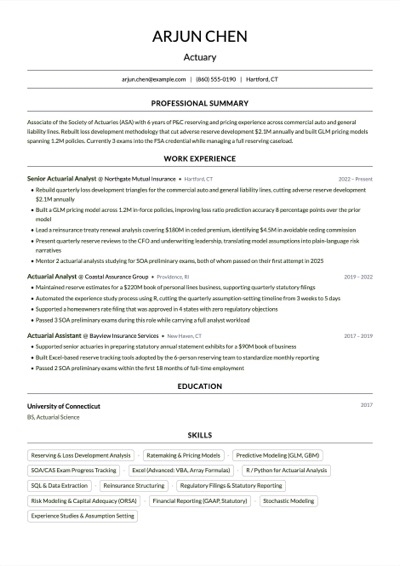
This is a complete fictional sample. Study the structure and evidence patterns, then replace every name, employer, number, skill, and accomplishment with information that is true for you.
Professional Summary
Associate of the Society of Actuaries (ASA) with 6 years of P&C reserving and pricing experience across commercial auto and general liability lines. Rebuilt loss development methodology that cut adverse reserve development $2.1M annually and built GLM pricing models spanning 1.2M policies. Currently 3 exams into the FSA credential while managing a full reserving caseload.
Work Experience
Senior Actuarial Analyst
2022 – PresentNorthgate Mutual Insurance — Hartford, CT
- Rebuild quarterly loss development triangles for the commercial auto and general liability lines, cutting adverse reserve development $2.1M annually
- Built a GLM pricing model across 1.2M in-force policies, improving loss ratio prediction accuracy 8 percentage points over the prior model
- Lead a reinsurance treaty renewal analysis covering $180M in ceded premium, identifying $4.5M in avoidable ceding commission
- Present quarterly reserve reviews to the CFO and underwriting leadership, translating model assumptions into plain-language risk narratives
- Mentor 2 actuarial analysts studying for SOA preliminary exams, both of whom passed on their first attempt in 2025
Actuarial Analyst
2019 – 2022Coastal Assurance Group — Providence, RI
- Maintained reserve estimates for a $220M book of personal lines business, supporting quarterly statutory filings
- Automated the experience study process using R, cutting the quarterly assumption-setting timeline from 3 weeks to 5 days
- Supported a homeowners rate filing that was approved in 4 states with zero regulatory objections
- Passed 3 SOA preliminary exams during this role while carrying a full analyst workload
Actuarial Assistant
2017 – 2019Bayview Insurance Services — New Haven, CT
- Supported senior actuaries in preparing statutory annual statement exhibits for a $90M book of business
- Built Excel-based reserve tracking tools adopted by the 6-person reserving team to standardize monthly reporting
- Passed 2 SOA preliminary exams within the first 18 months of full-time employment
Education
- BS, Actuarial Science — University of Connecticut · 2017
Certifications
- Associate of the Society of Actuaries (ASA)
- SOA Predictive Analytics Certificate
Achievement bullet patterns
Adapt the sentence pattern to your work. Never copy an employer, number, tool, or outcome that is not true for you.
- 1
Reduced reserve adverse development by $2.1M annually by rebuilding the loss development triangles for the commercial auto line
Adapt the pattern; do not copy facts that are not yours.
- 2
Built a GLM pricing model across 1.2M policies that improved loss ratio prediction accuracy by 8 percentage points
Adapt the pattern; do not copy facts that are not yours.
- 3
Passed 5 of 7 SOA exams while maintaining a full-time reserving role, completing the ASA credential 14 months ahead of the department average
Adapt the pattern; do not copy facts that are not yours.
- 4
Led a reinsurance treaty renewal analysis covering $180M in ceded premium, identifying $4.5M in avoidable ceding commission
Adapt the pattern; do not copy facts that are not yours.
Practical writing guidance
- 1
List exam status precisely: 'ASA, 3 exams toward FSA, VEE complete' tells a recruiter exactly where you stand faster than a vague 'pursuing FSA'
- 2
Quantify reserve or pricing impact in dollars: 'Improved reserve accuracy, reducing adverse development $2.1M year-over-year'
- 3
Name the modeling tools and platforms by exact name (R, Python, AXIS, GGY, Prophet), since these are literal ATS keyword matches
- 4
Cite the size of the book of business you supported, in premium volume or policy count, to signal the scope of your responsibility
- 5
Highlight cross-functional work with underwriting, finance, or product teams, since actuaries who can explain models to non-actuaries are scarce
- 6
Include committee or working group participation, such as rate filing committees, to show engagement beyond individual contributor work
How to write an actuary resume
State your exam credential and progress in the first two lines
Convert model performance into dollar and loss-ratio impact
Name your technical stack literally, and match it to the job posting
Build an actuary resume in Guul
Keyword screening often happens before a person reads your resume. These are the terms and credentials worth backing with real experience, not stuffing in.
Skills hiring software likely screens for
Keyword filters often match terms literally. Use the posting’s exact wording.
- Pricing & Ratemaking
- Loss Reserving
- Experience Studies
- Assumption Setting
- Predictive Modeling (GLM)
- Cash Flow Testing
- Valuation
- Capital Modeling
- Stochastic Modeling
- Statutory & GAAP Reporting
- Rate Filings
Certifications worth naming
List each one with its issuing body.
- Associate of the Society of Actuaries (ASA)
- Fellow of the Society of Actuaries (FSA)
- Associate of the Casualty Actuarial Society (ACAS)
- Fellow of the Casualty Actuarial Society (FCAS)
- Chartered Enterprise Risk Analyst (CERA), SOA
- Member of the American Academy of Actuaries (MAAA)
- VEE Credits (SOA / CAS)
Software and tools to name
Name only the tools you have actually used.
- Microsoft Excel (VBA)
- R
- Python
- SQL
- SAS
- Prophet
- AXIS
- ResQ
- Emblem
- Arius
How Guul builds it
Actuarial resumes usually lose out on placement and wording, not content. Exam progress ends up at the bottom under Education, or gets written as “pursuing credentials,” so a screen looking for ASA, ACAS, or specific exam names finds nothing concrete. Software lists get squeezed into a two-column table that may scramble in parsing, or shrink to “statistical tools” when the posting asked for R, SAS, or Prophet by name. Rotational programs cause their own confusion when several short rotations appear under one title with no dates of their own. Put your exam status at the start of the summary or in its own short section right after it: your credential if you hold one, otherwise the exams passed by name, VEE status, and your next sitting if it is scheduled. Then list experience, with each rotation as its own dated entry, and a skills section grouped by work area, such as pricing, reserving, or valuation. Chronological Classic and Minimalist ATS keep this in one clean column. Entry Level suits students with exams and an internship but little full-time work. Paste a posting and tailoring compares its tools and practice area with your record. It suggests exact names where you have the experience and never adds an exam you have not passed.
Templates that fit this role
What the ATS checker looks at for actuary resumes
- Exam progress stated by exam name and credential track, not as “pursuing credentials”
- Tool names from the pasted posting, such as SAS, Prophet, or AXIS, matched against the tools you list
- Practice area terms, such as pricing, reserving, or valuation, present in experience bullets
- Rotational program assignments split into separate dated entries
- Tables or columns in the skills section that may scramble when the file is read as plain text
Frequently Asked Questions
How should I list actuarial exam progress on my resume?
State your credential status precisely near the top: ASA or FSA if credentialed, or the exact exam count passed toward one, including VEE completion. Recruiters and hiring actuaries screen exam status before reading further, so bury it and you risk being filtered out.
Should I include exam scores or just pass/fail status?
List only pass/fail status and exam names or numbers, never numeric scores. Actuarial employers care that you passed on your expected timeline, not your exact grade, and scores are not something firms typically request or verify.
How technical should an actuary resume's skills section be?
Very. Name the exact software (Excel with VBA, R, Python, SQL, AXIS, Prophet, ResQ) and techniques (GLM, GBM, stochastic reserving) you use, since actuarial hiring managers and ATS systems both screen for literal tool names, not phrases like 'data analysis.'
Is a one-page resume enough for an experienced actuary?
Experienced actuaries with 7+ years and multiple lines of business typically need two pages to cover exam history, technical skills, and quantified project impact without cramming. Entry-level and student actuaries pursuing their first exams should stay to one page.
How does Guul tailor an actuary resume to a posting?
Paste the posting and Guul picks out the line of business, practice area, credential level, and software it names, for example group health pricing with SAS and Excel. It compares them to what you entered and suggests exact wording where you have that experience. Where you do not, it points out the gap. It will not list an exam, a tool, or a line of business you have not worked with.
Where should exam progress go on an actuary resume?
Near the top, in the body of the page, so a screen and a hiring actuary both see it early. Name the exams you have passed and your track, SOA or CAS, and add your VEE status. Keep it current, because an out-of-date exam count is an easy thing for an interviewer to question.
Which Guul template suits an actuarial student with only an internship?
Entry Level puts education, exams, and projects first, which fits when an internship is your only actuarial work. Once you have a full-time role or two, Chronological Classic or Minimalist ATS make experience the lead section. All three use a single column, but run the checker on the finished file to confirm how it reads.
Can Guul promise my resume gets past an insurer’s ATS?
No. Each employer configures its own system, and no tool can honestly promise a result. Guul simulates likely parsing across six named ATS families and shows the evidence behind each finding. That helps you catch common issues, such as an exam line buried in a table, before you apply.