
Turn inspiration into your own evidence
Do not copy the career. Learn how the career is communicated.
Read the evidence
Notice where the example uses scale, change, ownership, and context.
Replace every fact
Write from your real work, even when your numbers or setting are different.
Check the result
Make sure the document remains readable, truthful, and aligned to the role.
Key Skills
Use only the skills you can support with real experience. The example shows the vocabulary; your evidence makes it credible.
Full Editor Resume Example
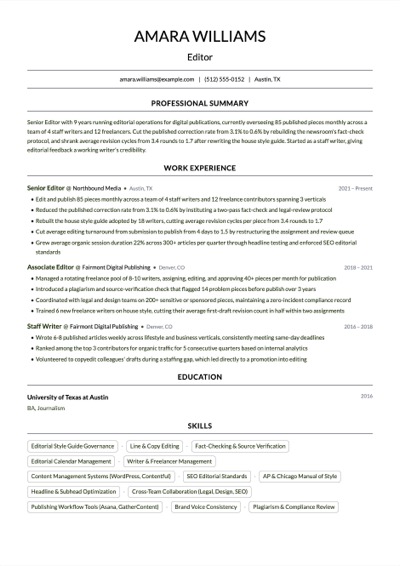
This is a complete fictional sample. Study the structure and evidence patterns, then replace every name, employer, number, skill, and accomplishment with information that is true for you.
Professional Summary
Senior Editor with 9 years running editorial operations for digital publications, currently overseeing 85 published pieces monthly across a team of 4 staff writers and 12 freelancers. Cut the published correction rate from 3.1% to 0.6% by rebuilding the newsroom's fact-check protocol, and shrank average revision cycles from 3.4 rounds to 1.7 after rewriting the house style guide. Started as a staff writer, giving editorial feedback a working writer's credibility.
Work Experience
Senior Editor
2021 – PresentNorthbound Media — Austin, TX
- Edit and publish 85 pieces monthly across a team of 4 staff writers and 12 freelance contributors spanning 3 verticals
- Reduced the published correction rate from 3.1% to 0.6% by instituting a two-pass fact-check and legal-review protocol
- Rebuilt the house style guide adopted by 18 writers, cutting average revision cycles per piece from 3.4 rounds to 1.7
- Cut average editing turnaround from submission to publish from 4 days to 1.5 by restructuring the assignment and review queue
- Grew average organic session duration 22% across 300+ articles per quarter through headline testing and enforced SEO editorial standards
Associate Editor
2018 – 2021Fairmont Digital Publishing — Denver, CO
- Managed a rotating freelance pool of 8-10 writers, assigning, editing, and approving 40+ pieces per month for publication
- Introduced a plagiarism and source-verification check that flagged 14 problem pieces before publish over 3 years
- Coordinated with legal and design teams on 200+ sensitive or sponsored pieces, maintaining a zero-incident compliance record
- Trained 6 new freelance writers on house style, cutting their average first-draft revision count in half within two assignments
Staff Writer
2016 – 2018Fairmont Digital Publishing — Denver, CO
- Wrote 6-8 published articles weekly across lifestyle and business verticals, consistently meeting same-day deadlines
- Ranked among the top 3 contributors for organic traffic for 5 consecutive quarters based on internal analytics
- Volunteered to copyedit colleagues' drafts during a staffing gap, which led directly to a promotion into editing
Education
- BA, Journalism — University of Texas at Austin · 2016
Achievement bullet patterns
Adapt the sentence pattern to your work. Never copy an employer, number, tool, or outcome that is not true for you.
- 1
Edited and published 85 pieces monthly across a team of 4 staff writers and 12 freelancers, cutting average editing turnaround from 4 days to 1.5
Adapt the pattern; do not copy facts that are not yours.
- 2
Reduced the published correction rate from 3.1% to 0.6% by instituting a two-pass fact-check and legal-review protocol across the newsroom
Adapt the pattern; do not copy facts that are not yours.
- 3
Rebuilt the house style guide adopted by 18 writers, cutting average revision cycles per piece from 3.4 rounds to 1.7
Adapt the pattern; do not copy facts that are not yours.
- 4
Grew average organic session duration 22% across 300+ articles per quarter through headline testing and enforced SEO editorial standards
Adapt the pattern; do not copy facts that are not yours.
Practical writing guidance
- 1
State your publication pipeline volume — pieces edited per week or month, and the size of the writer pool you manage
- 2
Report an accuracy or correction-rate metric, since reducing published errors is the clearest proof of editorial judgment
- 3
Show turnaround time improvement from submission to publish, since speed under quality constraints is what separates senior editors
- 4
Quantify style guide adoption: how many writers follow it, or how much revision cycles shrank after you introduced or rebuilt one
- 5
Include a traffic or engagement outcome tied to editorial decisions, such as headline testing or SEO standards you enforced
- 6
Separate your own writing credits from your editing credits clearly, since a hiring manager for an editor role is screening for the latter
How to write an editor resume
Lead with pipeline scale: how much you edit, and how fast
Prove editorial judgment with an accuracy or correction metric
Show you can run a writer pool, not just polish sentences
Frequently Asked Questions
How is an editor resume different from a copywriter or technical writer resume?
Copywriters and technical writers are screened on their own writing output. Editors are screened on how well they manage and improve other people's work: pipeline volume, correction rates, writer development, and style-guide governance, not a personal portfolio of authored pieces.
Should I include a portfolio if I'm applying as an editor?
Include one, but shift its focus: show before-and-after edits, a style guide you built, or a project you shepherded from draft to publish, rather than only finished articles you wrote. A short edited-versus-original comparison demonstrates judgment more directly than polished prose alone.
How do I quantify editorial impact if my publication doesn't track error rates formally?
Track it yourself for a sample period: corrections issued, factual errors caught before publish, or pieces returned for revision. Even an informally gathered rate, honestly labeled, is more persuasive to a hiring editor than a vague claim about maintaining quality standards.
What if I manage freelancers but they're not technically my direct reports?
List the pool size and describe your actual authority: assigning work, approving drafts, and enforcing deadlines and style, even without formal HR reporting lines. Editorial hiring managers care about functional management experience, and freelancer coordination at scale counts as real management.