
Turn inspiration into your own evidence
Do not copy the career. Learn how the career is communicated.
Read the evidence
Notice where the example uses scale, change, ownership, and context.
Replace every fact
Write from your real work, even when your numbers or setting are different.
Check the result
Make sure the document remains readable, truthful, and aligned to the role.
Key Skills
Use only the skills you can support with real experience. The example shows the vocabulary; your evidence makes it credible.
Full Biologist Resume Example
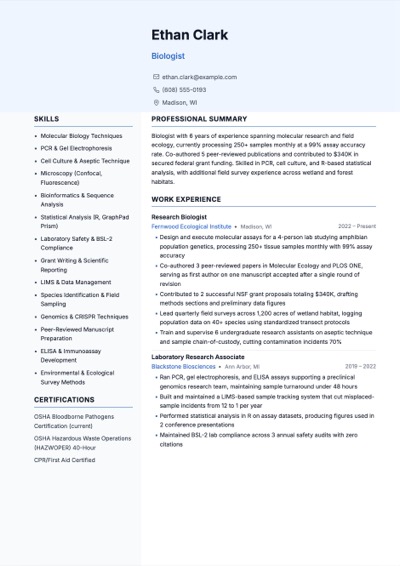
This is a complete fictional sample. Study the structure and evidence patterns, then replace every name, employer, number, skill, and accomplishment with information that is true for you.
Professional Summary
Biologist with 6 years of experience spanning molecular research and field ecology, currently processing 250+ samples monthly at a 99% assay accuracy rate. Co-authored 5 peer-reviewed publications and contributed to $340K in secured federal grant funding. Skilled in PCR, cell culture, and R-based statistical analysis, with additional field survey experience across wetland and forest habitats.
Work Experience
Research Biologist
2022 – PresentFernwood Ecological Institute — Madison, WI
- Design and execute molecular assays for a 4-person lab studying amphibian population genetics, processing 250+ tissue samples monthly with 99% assay accuracy
- Co-authored 3 peer-reviewed papers in Molecular Ecology and PLOS ONE, serving as first author on one manuscript accepted after a single round of revision
- Contributed to 2 successful NSF grant proposals totaling $340K, drafting methods sections and preliminary data figures
- Lead quarterly field surveys across 1,200 acres of wetland habitat, logging population data on 40+ species using standardized transect protocols
- Train and supervise 6 undergraduate research assistants on aseptic technique and sample chain-of-custody, cutting contamination incidents 70%
Laboratory Research Associate
2019 – 2022Blackstone Biosciences — Ann Arbor, MI
- Ran PCR, gel electrophoresis, and ELISA assays supporting a preclinical genomics research team, maintaining sample turnaround under 48 hours
- Built and maintained a LIMS-based sample tracking system that cut misplaced-sample incidents from 12 to 1 per year
- Performed statistical analysis in R on assay datasets, producing figures used in 2 conference presentations
- Maintained BSL-2 lab compliance across 3 annual safety audits with zero citations
Field Research Technician
2017 – 2019Great Lakes Wildlife Survey — Traverse City, MI
- Collected specimen and habitat data across 800 acres of forest and wetland during 2 breeding seasons, identifying 3 previously unrecorded amphibian breeding sites
- Entered and quality-checked field data for a 15,000-record survey database used in a state biodiversity report
- Assisted principal investigators with equipment calibration and permit compliance for a 6-person seasonal field crew
Education
- MS, Ecology and Evolutionary Biology — University of Michigan · 2019
- BS, Biology — Michigan State University · 2017
Certifications
- OSHA Bloodborne Pathogens Certification (current)
- OSHA Hazardous Waste Operations (HAZWOPER) 40-Hour
- CPR/First Aid Certified
Achievement bullet patterns
Adapt the sentence pattern to your work. Never copy an employer, number, tool, or outcome that is not true for you.
- 1
Processed 250+ tissue and blood samples monthly using PCR, gel electrophoresis, and ELISA, sustaining a 99% assay accuracy rate across a 4-person research lab
Adapt the pattern; do not copy facts that are not yours.
- 2
Co-authored 5 peer-reviewed publications in journals including Molecular Ecology and PLOS ONE, contributing to $340K in secured NSF and NIH grant funding
Adapt the pattern; do not copy facts that are not yours.
- 3
Led field surveys across 1,200 acres of wetland habitat, logging population data on 40+ species and identifying 3 previously unrecorded breeding sites
Adapt the pattern; do not copy facts that are not yours.
- 4
Trained 6 undergraduate research assistants on aseptic cell culture technique, reducing contamination incidents 70% over two semesters
Adapt the pattern; do not copy facts that are not yours.
Practical writing guidance
- 1
Quantify lab throughput: 'Processed 250+ tissue samples per month with 99% assay accuracy' proves capacity, not just familiarity
- 2
State grant dollar amounts you secured or contributed to, even as a co-investigator or research assistant on the proposal
- 3
List publication count with journal names and your author position (first, co-first, contributing) rather than just 'published research'
- 4
For field biology roles, quantify survey scope: acres covered, species logged, or specimens collected per season
- 5
Name your statistical and bioinformatics tools (R, Python, BLAST, GraphPad Prism) since hiring managers screen for specific software
- 6
Trim a two-page academic CV to one page for industry applications by cutting conference posters and keeping funded grants
How to write a biologist resume
Signal which biology track you're targeting in your first three lines
Turn lab and field duties into measurable output
List publications and grants in a format reviewers can scan in seconds
Frequently Asked Questions
What should a biologist include on their resume if they don't have a PhD?
Emphasize hands-on lab or field techniques, specific instruments and software you've used, and any research assistantships or internships with measurable output. List your degree and any poster presentations or co-authored papers. Technical proficiency and reliability in the lab matter as much as academic pedigree for many industry roles.
How do I list publications on a biology resume?
Create a dedicated Publications section listing citations in standard format, most recent first, with your author position noted. Limit an industry-focused resume to your 3-5 most relevant papers and link to a full list on Google Scholar or ORCID if you have more. Academic or postdoc applications can carry a fuller list.
Should a field biologist and a lab biologist format their resumes differently?
The core structure stays the same, but emphasis shifts. Field biologists should lead with survey scope, species expertise, and permitting or GIS experience; lab biologists should lead with assay techniques, instrumentation, and sample throughput. Tailor your skills section and bullet order to the specific opening.
What certifications help a biology resume stand out?
Useful credentials include OSHA Bloodborne Pathogen and Hazardous Waste training, Certified Wildlife Biologist status from The Wildlife Society for field roles, and vendor-specific instrument certifications. These signal safety compliance and specialized competence that employers value in regulated lab environments.