
Turn inspiration into your own evidence
Do not copy the career. Learn how the career is communicated.
Read the evidence
Notice where the example uses scale, change, ownership, and context.
Replace every fact
Write from your real work, even when your numbers or setting are different.
Check the result
Make sure the document remains readable, truthful, and aligned to the role.
Key Skills
Use only the skills you can support with real experience. The example shows the vocabulary; your evidence makes it credible.
Full Chemist Resume Example
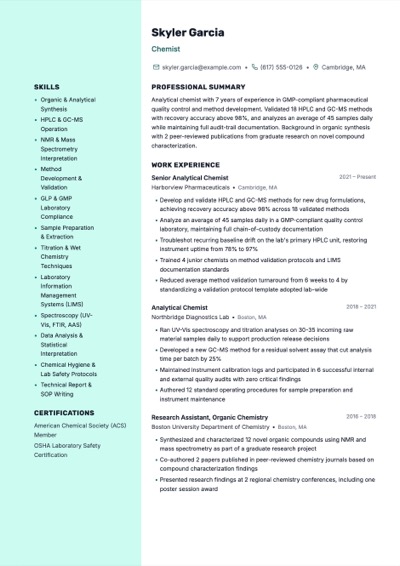
This is a complete fictional sample. Study the structure and evidence patterns, then replace every name, employer, number, skill, and accomplishment with information that is true for you.
Professional Summary
Analytical chemist with 7 years of experience in GMP-compliant pharmaceutical quality control and method development. Validated 18 HPLC and GC-MS methods with recovery accuracy above 98%, and analyzes an average of 45 samples daily while maintaining full audit-trail documentation. Background in organic synthesis with 2 peer-reviewed publications from graduate research on novel compound characterization.
Work Experience
Senior Analytical Chemist
2021 – PresentHarborview Pharmaceuticals — Cambridge, MA
- Develop and validate HPLC and GC-MS methods for new drug formulations, achieving recovery accuracy above 98% across 18 validated methods
- Analyze an average of 45 samples daily in a GMP-compliant quality control laboratory, maintaining full chain-of-custody documentation
- Troubleshot recurring baseline drift on the lab's primary HPLC unit, restoring instrument uptime from 78% to 97%
- Trained 4 junior chemists on method validation protocols and LIMS documentation standards
- Reduced average method validation turnaround from 6 weeks to 4 by standardizing a validation protocol template adopted lab-wide
Analytical Chemist
2018 – 2021Northbridge Diagnostics Lab — Boston, MA
- Ran UV-Vis spectroscopy and titration analyses on 30-35 incoming raw material samples daily to support production release decisions
- Developed a new GC-MS method for a residual solvent assay that cut analysis time per batch by 25%
- Maintained instrument calibration logs and participated in 6 successful internal and external quality audits with zero critical findings
- Authored 12 standard operating procedures for sample preparation and instrument maintenance
Research Assistant, Organic Chemistry
2016 – 2018Boston University Department of Chemistry — Boston, MA
- Synthesized and characterized 12 novel organic compounds using NMR and mass spectrometry as part of a graduate research project
- Co-authored 2 papers published in peer-reviewed chemistry journals based on compound characterization findings
- Presented research findings at 2 regional chemistry conferences, including one poster session award
Education
- MS, Chemistry — Boston University · 2018
- BS, Chemistry — University of Massachusetts Amherst · 2016
Certifications
- American Chemical Society (ACS) Member
- OSHA Laboratory Safety Certification
Achievement bullet patterns
Adapt the sentence pattern to your work. Never copy an employer, number, tool, or outcome that is not true for you.
- 1
Developed and validated an HPLC method for a new drug formulation, achieving 99.2% recovery accuracy and reducing analysis time by 25%
Adapt the pattern; do not copy facts that are not yours.
- 2
Analyzed an average of 45 samples daily using GC-MS and UV-Vis spectroscopy in a GMP-compliant quality control laboratory
Adapt the pattern; do not copy facts that are not yours.
- 3
Synthesized and characterized 12 novel organic compounds over 18 months, resulting in 2 co-authored publications in peer-reviewed journals
Adapt the pattern; do not copy facts that are not yours.
- 4
Troubleshot a recurring baseline drift issue on the lab's primary HPLC unit, restoring instrument uptime from 78% to 97%
Adapt the pattern; do not copy facts that are not yours.
Practical writing guidance
- 1
Name the instruments you operate independently, such as HPLC, GC-MS, or NMR, since lab managers screen resumes for specific instrument keywords
- 2
State your sample throughput, such as '40 samples analyzed daily,' to show reviewers you can handle production-lab volume, not just occasional bench work
- 3
Quantify method development or validation work, including how many methods you validated and any precision or accuracy improvements achieved
- 4
Mention regulatory frameworks you worked under, like GLP or GMP, since compliance experience is often a hard requirement for pharma and QC labs
- 5
Include any publications, patents, or presented posters if you come from a research background, since they demonstrate independent scientific contribution
- 6
Describe troubleshooting you performed on instrumentation or methods, since equipment reliability is a constant concern for lab managers
How to write a chemist resume
Name your instruments and let them do the screening work
Turn method development into a measurable accomplishment
Signal regulatory rigor and, if relevant, research output
Frequently Asked Questions
What should a chemist include on their resume?
List the instruments you operate, such as HPLC, GC-MS, or NMR, along with sample throughput, methods you developed or validated, and any regulatory framework like GLP or GMP. Include publications if you have a research background. Named instruments matter more than general descriptions.
How is a chemist resume different from a chemical engineer resume?
A chemist resume emphasizes synthesis, analytical instrumentation, and method development at the bench. A chemical engineer resume emphasizes process design and plant scale-up. If your work centers on compounds and instruments rather than running a process, present yourself as the chemist.
Should I include my thesis or research publications on a chemist resume?
Yes, especially for R&D or academic-adjacent roles. List publications with journal name and year, and summarize your thesis topic in one or two lines if it is relevant to the position. For QC or production-lab roles, keep this section brief and prioritize instrument and method experience instead.
How important are GLP and GMP experience on a chemist resume?
Very important for pharmaceutical and regulated manufacturing labs, where GLP or GMP compliance is often a hard requirement. State it explicitly if you have it. If you lack direct experience, highlight documentation discipline, SOP adherence, or audit participation that shows comparable rigor.