
Turn inspiration into your own evidence
Do not copy the career. Learn how the career is communicated.
Read the evidence
Notice where the example uses scale, change, ownership, and context.
Replace every fact
Write from your real work, even when your numbers or setting are different.
Check the result
Make sure the document remains readable, truthful, and aligned to the role.
Key Skills
Use only the skills you can support with real experience. The example shows the vocabulary; your evidence makes it credible.
Full Forensic Scientist Resume Example
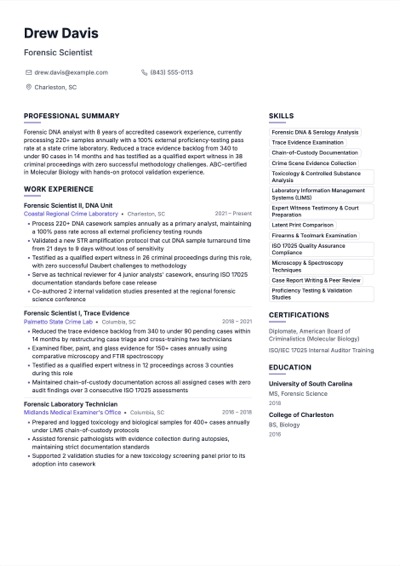
This is a complete fictional sample. Study the structure and evidence patterns, then replace every name, employer, number, skill, and accomplishment with information that is true for you.
Professional Summary
Forensic DNA analyst with 8 years of accredited casework experience, currently processing 220+ samples annually with a 100% external proficiency-testing pass rate at a state crime laboratory. Reduced a trace evidence backlog from 340 to under 90 cases in 14 months and has testified as a qualified expert witness in 38 criminal proceedings with zero successful methodology challenges. ABC-certified in Molecular Biology with hands-on protocol validation experience.
Work Experience
Forensic Scientist II, DNA Unit
2021 – PresentCoastal Regional Crime Laboratory — Charleston, SC
- Process 220+ DNA casework samples annually as a primary analyst, maintaining a 100% pass rate across all external proficiency testing rounds
- Validated a new STR amplification protocol that cut DNA sample turnaround time from 21 days to 9 days without loss of sensitivity
- Testified as a qualified expert witness in 26 criminal proceedings during this role, with zero successful Daubert challenges to methodology
- Serve as technical reviewer for 4 junior analysts' casework, ensuring ISO 17025 documentation standards before case release
- Co-authored 2 internal validation studies presented at the regional forensic science conference
Forensic Scientist I, Trace Evidence
2018 – 2021Palmetto State Crime Lab — Columbia, SC
- Reduced the trace evidence backlog from 340 to under 90 pending cases within 14 months by restructuring case triage and cross-training two technicians
- Examined fiber, paint, and glass evidence for 150+ cases annually using comparative microscopy and FTIR spectroscopy
- Testified as a qualified expert witness in 12 proceedings across 3 counties during this role
- Maintained chain-of-custody documentation across all assigned cases with zero audit findings over 3 consecutive ISO 17025 assessments
Forensic Laboratory Technician
2016 – 2018Midlands Medical Examiner's Office — Columbia, SC
- Prepared and logged toxicology and biological samples for 400+ cases annually under LIMS chain-of-custody protocols
- Assisted forensic pathologists with evidence collection during autopsies, maintaining strict documentation standards
- Supported 2 validation studies for a new toxicology screening panel prior to its adoption into casework
Education
- MS, Forensic Science — University of South Carolina · 2018
- BS, Biology — College of Charleston · 2016
Certifications
- Diplomate, American Board of Criminalistics (Molecular Biology)
- ISO/IEC 17025 Internal Auditor Training
Achievement bullet patterns
Adapt the sentence pattern to your work. Never copy an employer, number, tool, or outcome that is not true for you.
- 1
Processed 220+ DNA casework samples annually as a primary analyst, maintaining a 100% pass rate across all external proficiency testing rounds
Adapt the pattern; do not copy facts that are not yours.
- 2
Reduced the trace evidence backlog from 340 to under 90 pending cases within 14 months by restructuring case triage and cross-training two technicians
Adapt the pattern; do not copy facts that are not yours.
- 3
Testified as a qualified expert witness in 38 criminal proceedings across 3 counties, with zero successful Daubert or Frye challenges to methodology
Adapt the pattern; do not copy facts that are not yours.
- 4
Validated a new STR amplification protocol that cut DNA sample turnaround time from 21 days to 9 days without loss of sensitivity
Adapt the pattern; do not copy facts that are not yours.
Practical writing guidance
- 1
State your specialty area first (DNA, toxicology, trace, firearms) since labs hire against a named discipline, not a general forensic title
- 2
Quantify caseload throughput and any backlog reduction — labs are measured on turnaround time and expect their scientists to be too
- 3
Report your testimony record, including how many times you have qualified as an expert witness and in what jurisdictions
- 4
Mention your accreditation and quality-assurance fluency directly, citing ISO 17025 or your lab's specific accrediting body
- 5
List proficiency testing results if consistently passed, since this is a credibility signal hiring panels specifically look for
- 6
Describe any method validation or new-technique implementation work, since labs value scientists who improve, not just run, protocols
How to write a forensic scientist resume
Name your specialty and caseload before your general credentials
Speak the accreditation and quality-assurance language labs are audited on
Report your testimony record as a credibility metric
Frequently Asked Questions
What degree do I need to become a forensic scientist?
Most labs require a bachelor's degree in forensic science, chemistry, biology, or a related natural science, with coursework in genetics and statistics. DNA and toxicology specialties often prefer a master's degree. List coursework and any thesis or capstone casework tied to your specialty.
How should I present courtroom testimony experience on my resume?
State how many times you have testified as a qualified expert witness, the jurisdictions involved, and whether any methodology challenges were raised. Noting zero successful Daubert or Frye challenges signals your analysis withstands adversarial scrutiny, which hiring panels weigh heavily.
Is ABC certification worth including on a forensic scientist resume?
Yes. American Board of Criminalistics certification in your discipline is a recognized, verifiable credential many labs require for senior analyst roles. List it by discipline and pair it with a caseload or accuracy metric so it reads as applied competence, not a bare credential.
How is a forensic scientist different from a crime scene technician?
Crime scene technicians collect and document evidence in the field; forensic scientists analyze that evidence in an accredited lab and often testify to the results. If you have done both, separate the roles so a hiring lab sees exactly which disciplines you are qualified to perform.