
Turn inspiration into your own evidence
Do not copy the career. Learn how the career is communicated.
Read the evidence
Notice where the example uses scale, change, ownership, and context.
Replace every fact
Write from your real work, even when your numbers or setting are different.
Check the result
Make sure the document remains readable, truthful, and aligned to the role.
Key Skills
Use only the skills you can support with real experience. The example shows the vocabulary; your evidence makes it credible.
Full Optometrist Resume Example
This is a complete fictional sample. Study the structure and evidence patterns, then replace every name, employer, number, skill, and accomplishment with information that is true for you.
Professional Summary
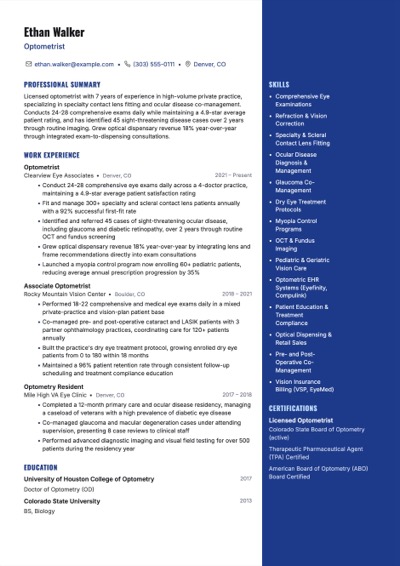
Licensed optometrist with 7 years of experience in high-volume private practice, specializing in specialty contact lens fitting and ocular disease co-management. Conducts 24-28 comprehensive exams daily while maintaining a 4.9-star average patient rating, and has identified 45 sight-threatening disease cases over 2 years through routine imaging. Grew optical dispensary revenue 18% year-over-year through integrated exam-to-dispensing consultations.
Work Experience
Optometrist
2021 – PresentClearview Eye Associates — Denver, CO
- Conduct 24-28 comprehensive eye exams daily across a 4-doctor practice, maintaining a 4.9-star average patient satisfaction rating
- Fit and manage 300+ specialty and scleral contact lens patients annually with a 92% successful first-fit rate
- Identified and referred 45 cases of sight-threatening ocular disease, including glaucoma and diabetic retinopathy, over 2 years through routine OCT and fundus screening
- Grew optical dispensary revenue 18% year-over-year by integrating lens and frame recommendations directly into exam consultations
- Launched a myopia control program now enrolling 60+ pediatric patients, reducing average annual prescription progression by 35%
Associate Optometrist
2018 – 2021Rocky Mountain Vision Center — Boulder, CO
- Performed 18-22 comprehensive and medical eye exams daily in a mixed private-practice and vision-plan patient base
- Co-managed pre- and post-operative cataract and LASIK patients with 3 partner ophthalmology practices, coordinating care for 120+ patients annually
- Built the practice's dry eye treatment protocol, growing enrolled dry eye patients from 0 to 180 within 18 months
- Maintained a 96% patient retention rate through consistent follow-up scheduling and treatment compliance education
Optometry Resident
2017 – 2018Mile High VA Eye Clinic — Denver, CO
- Completed a 12-month primary care and ocular disease residency, managing a caseload of veterans with a high prevalence of diabetic eye disease
- Co-managed glaucoma and macular degeneration cases under attending supervision, presenting 8 case reviews to clinical staff
- Performed advanced diagnostic imaging and visual field testing for over 500 patients during the residency year
Education
- Doctor of Optometry (OD) — University of Houston College of Optometry · 2017
- BS, Biology — Colorado State University · 2013
Certifications
- Licensed Optometrist — Colorado State Board of Optometry (active)
- Therapeutic Pharmaceutical Agent (TPA) Certified
- American Board of Optometry (ABO) Board Certified
Achievement bullet patterns
Adapt the sentence pattern to your work. Never copy an employer, number, tool, or outcome that is not true for you.
- 1
Conducted 24-28 comprehensive eye exams daily across a high-volume optometric practice, maintaining a 4.9-star average patient satisfaction rating
Adapt the pattern; do not copy facts that are not yours.
- 2
Fit and managed 300+ specialty and scleral contact lens patients annually with a 92% successful first-fit rate
Adapt the pattern; do not copy facts that are not yours.
- 3
Identified and referred 45 cases of sight-threatening ocular disease, including glaucoma and diabetic retinopathy, over 2 years through routine OCT and fundus screening
Adapt the pattern; do not copy facts that are not yours.
- 4
Grew optical dispensary revenue 18% year-over-year by integrating lens and frame recommendations directly into exam consultations
Adapt the pattern; do not copy facts that are not yours.
Practical writing guidance
- 1
State your daily or weekly patient exam volume, such as '24-28 comprehensive exams daily,' since throughput is one of the first things a practice compares across candidates
- 2
Quantify specialty contact lens fitting success, including scleral or specialty lens fit rates, since these patients are higher-value and harder to retain
- 3
Note ocular disease cases you identified or co-managed, such as glaucoma or diabetic retinopathy referrals, to prove diagnostic vigilance beyond routine refractions
- 4
Include your optical dispensary or product revenue contribution if you work in a practice with retail sales, since this directly affects a practice owner's bottom line
- 5
List your state license and any TPA (therapeutic pharmaceutical agent) certification explicitly, since scope of practice varies by state and employers screen for it
- 6
Mention EHR systems and any telehealth or teleoptometry experience, since practices increasingly screen for technology fluency alongside clinical skill
How to write an optometrist resume
State exam volume and specialty scope in the first two lines
Prove diagnostic vigilance and revenue contribution with real numbers
Structure licensure and technology fluency for fast ATS and human screening
Frequently Asked Questions
What should a new graduate optometrist include on their resume?
New graduates should list clinical rotation sites and exam volume completed during externships, any specialty clinic experience such as low vision or pediatric rotations, and board exam status. Include research or case presentations to round out limited paid experience.
Should I list my state license and TPA certification on my resume?
Yes, list your state optometric license and TPA (therapeutic pharmaceutical agent) certification in a dedicated licenses section, since scope of practice for treating ocular disease varies significantly by state. Confirm active status but omit the license number itself for security.
How is a retail chain optometrist resume different from a private practice one?
Retail chain roles emphasize exam throughput and consistent patient satisfaction scores across high volume. Private practice roles reward specialty scope, patient retention, and revenue contribution, since you are more directly tied to the practice's financial performance.
How important are specialty certifications like dry eye or myopia control training?
They matter increasingly, since dry eye and myopia management have become significant revenue drivers for practices. List completed certification programs and any measurable patient outcomes or enrollment numbers you achieved, since these show you can build a service line, not just perform exams.