
Turn inspiration into your own evidence
Do not copy the career. Learn how the career is communicated.
Read the evidence
Notice where the example uses scale, change, ownership, and context.
Replace every fact
Write from your real work, even when your numbers or setting are different.
Check the result
Make sure the document remains readable, truthful, and aligned to the role.
Key Skills
Use only the skills you can support with real experience. The example shows the vocabulary; your evidence makes it credible.
Full Orthodontist Resume Example
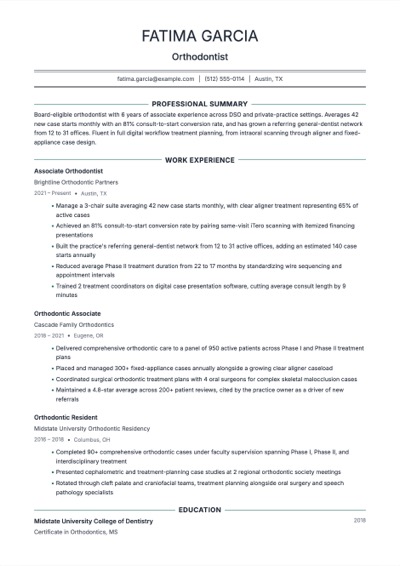
This is a complete fictional sample. Study the structure and evidence patterns, then replace every name, employer, number, skill, and accomplishment with information that is true for you.
Professional Summary
Board-eligible orthodontist with 6 years of associate experience across DSO and private-practice settings. Averages 42 new case starts monthly with an 81% consult-to-start conversion rate, and has grown a referring general-dentist network from 12 to 31 offices. Fluent in full digital workflow treatment planning, from intraoral scanning through aligner and fixed-appliance case design.
Work Experience
Associate Orthodontist
2021 – PresentBrightline Orthodontic Partners — Austin, TX
- Manage a 3-chair suite averaging 42 new case starts monthly, with clear aligner treatment representing 65% of active cases
- Achieved an 81% consult-to-start conversion rate by pairing same-visit iTero scanning with itemized financing presentations
- Built the practice's referring general-dentist network from 12 to 31 active offices, adding an estimated 140 case starts annually
- Reduced average Phase II treatment duration from 22 to 17 months by standardizing wire sequencing and appointment intervals
- Trained 2 treatment coordinators on digital case presentation software, cutting average consult length by 9 minutes
Orthodontic Associate
2018 – 2021Cascade Family Orthodontics — Eugene, OR
- Delivered comprehensive orthodontic care to a panel of 950 active patients across Phase I and Phase II treatment plans
- Placed and managed 300+ fixed-appliance cases annually alongside a growing clear aligner caseload
- Coordinated surgical orthodontic treatment plans with 4 oral surgeons for complex skeletal malocclusion cases
- Maintained a 4.8-star average across 200+ patient reviews, cited by the practice owner as a driver of new referrals
Orthodontic Resident
2016 – 2018Midstate University Orthodontic Residency — Columbus, OH
- Completed 90+ comprehensive orthodontic cases under faculty supervision spanning Phase I, Phase II, and interdisciplinary treatment
- Presented cephalometric and treatment-planning case studies at 2 regional orthodontic society meetings
- Rotated through cleft palate and craniofacial teams, treatment planning alongside oral surgery and speech pathology specialists
Education
- Certificate in Orthodontics, MS — Midstate University College of Dentistry · 2018
- Doctor of Dental Surgery (DDS) — University of Iowa College of Dentistry · 2015
Certifications
- Licensed Orthodontist — State Board of Dental Examiners (active)
- Invisalign Diamond Provider
- Board Eligible — American Board of Orthodontics
- BLS Certification — American Heart Association
Achievement bullet patterns
Adapt the sentence pattern to your work. Never copy an employer, number, tool, or outcome that is not true for you.
- 1
Averaged 42 new case starts monthly across a 3-chair suite, with clear aligner cases accounting for 65% of the active patient roster
Adapt the pattern; do not copy facts that are not yours.
- 2
Converted 81% of consultations into signed treatment plans by pairing same-visit digital scanning with itemized financing options
Adapt the pattern; do not copy facts that are not yours.
- 3
Grew the general-dentist referral network from 12 to 31 active referring offices over 3 years, adding roughly 140 annual case starts
Adapt the pattern; do not copy facts that are not yours.
- 4
Reduced average Phase II treatment time from 22 to 17 months by standardizing wire sequencing protocols across the associate team
Adapt the pattern; do not copy facts that are not yours.
Practical writing guidance
- 1
Lead with monthly case starts: 'Averaged 45 new case starts monthly across a two-chair DSO location' tells a hiring director your throughput immediately
- 2
State your aligner-to-bracket mix, since practices staffing for a digital workflow want doctors already fluent in scanner-driven treatment planning
- 3
Report your consult-to-start conversion rate, because a doctor who closes cases at the chair reduces marketing spend the practice would otherwise carry
- 4
Quantify referral growth from general dentists by name count or case volume, not just 'strong referral relationships'
- 5
Include your Invisalign provider tier (Diamond, Platinum) and any board certification progress with the American Board of Orthodontics
- 6
If you supervised residents or treatment coordinators, note team size and how it affected chair turnover or case volume
How to write an orthodontist resume
Open with case starts, conversion rate, and aligner mix
Document your referral network as a built asset, not a given
Show digital workflow fluency, not just software names
Frequently Asked Questions
What do DSOs look for on an orthodontist resume?
DSOs prioritize predictable production: monthly case starts, consult conversion rate, aligner adoption percentage, and comfort with a centralized scanning workflow. Lead your summary with these figures before treatment philosophy, since DSO recruiters screen for throughput first.
Should I list my Invisalign provider tier?
Yes. Provider tiers such as Diamond or Platinum signal case volume and treatment complexity to a hiring practice without them needing to ask. Place the tier next to your clear aligner skill listing or in your credentials section, and update it each renewal period since tiers reset annually.
How should a new orthodontist without production history present their resume?
Substitute residency case logs for production numbers: total cases managed, phase I versus phase II split, and complex surgical or interdisciplinary cases you treatment-planned under faculty supervision. Reviewers accept residency case counts as a proxy for early production capacity.
How long should an orthodontist resume be?
One page for doctors under five years post-residency; two pages once you have board certification progress, multiple locations, or referral network achievements worth detailing. Keep treatment philosophy brief and let case metrics carry the page instead.