
Turn inspiration into your own evidence
Do not copy the career. Learn how the career is communicated.
Read the evidence
Notice where the example uses scale, change, ownership, and context.
Replace every fact
Write from your real work, even when your numbers or setting are different.
Check the result
Make sure the document remains readable, truthful, and aligned to the role.
Key Skills
Use only the skills you can support with real experience. The example shows the vocabulary; your evidence makes it credible.
Full Probation Officer Resume Example
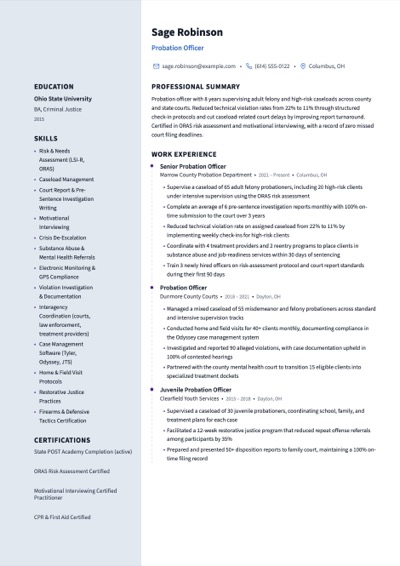
This is a complete fictional sample. Study the structure and evidence patterns, then replace every name, employer, number, skill, and accomplishment with information that is true for you.
Professional Summary
Probation officer with 8 years supervising adult felony and high-risk caseloads across county and state courts. Reduced technical violation rates from 22% to 11% through structured check-in protocols and cut caseload-related court delays by improving report turnaround. Certified in ORAS risk assessment and motivational interviewing, with a record of zero missed court filing deadlines.
Work Experience
Senior Probation Officer
2021 – PresentMarrow County Probation Department — Columbus, OH
- Supervise a caseload of 65 adult felony probationers, including 20 high-risk clients under intensive supervision using the ORAS risk assessment
- Complete an average of 6 pre-sentence investigation reports monthly with 100% on-time submission to the court over 3 years
- Reduced technical violation rate on assigned caseload from 22% to 11% by implementing weekly check-ins for high-risk clients
- Coordinate with 4 treatment providers and 2 reentry programs to place clients in substance abuse and job-readiness services within 30 days of sentencing
- Train 3 newly hired officers on risk-assessment protocol and court report standards during their first 90 days
Probation Officer
2018 – 2021Dunmore County Courts — Dayton, OH
- Managed a mixed caseload of 55 misdemeanor and felony probationers across standard and intensive supervision tracks
- Conducted home and field visits for 40+ clients monthly, documenting compliance in the Odyssey case management system
- Investigated and reported 90 alleged violations, with case documentation upheld in 100% of contested hearings
- Partnered with the county mental health court to transition 15 eligible clients into specialized treatment dockets
Juvenile Probation Officer
2015 – 2018Clearfield Youth Services — Dayton, OH
- Supervised a caseload of 30 juvenile probationers, coordinating school, family, and treatment plans for each case
- Facilitated a 12-week restorative justice program that reduced repeat offense referrals among participants by 35%
- Prepared and presented 50+ disposition reports to family court, maintaining a 100% on-time filing record
Education
- BA, Criminal Justice — Ohio State University · 2015
Certifications
- State POST Academy Completion (active)
- ORAS Risk Assessment Certified
- Motivational Interviewing Certified Practitioner
- CPR & First Aid Certified
Achievement bullet patterns
Adapt the sentence pattern to your work. Never copy an employer, number, tool, or outcome that is not true for you.
- 1
Supervised a caseload of 65 adult felony probationers, including 20 high-risk clients under intensive supervision using the ORAS risk assessment
Adapt the pattern; do not copy facts that are not yours.
- 2
Completed 140 pre-sentence investigation reports over 2 years with 100% on-time submission to the court
Adapt the pattern; do not copy facts that are not yours.
- 3
Reduced technical violation rate on assigned caseload from 22% to 11% by implementing weekly check-ins for high-risk clients
Adapt the pattern; do not copy facts that are not yours.
- 4
Coordinated with 4 treatment providers and 2 reentry programs to place 45 clients in substance abuse or job-readiness services within 30 days of sentencing
Adapt the pattern; do not copy facts that are not yours.
Practical writing guidance
- 1
State your caseload size and type: "Supervised a caseload of 65 adult felony probationers, including 20 high-risk clients under intensive supervision"
- 2
Quantify compliance and outcome rates, such as violation rates, successful case closures, or reductions in technical violations under your supervision
- 3
Name the risk-assessment tools you use (LSI-R, ORAS, COMPAS) since agencies filter for familiarity with their specific instrument
- 4
Highlight court-facing work: number of pre-sentence investigations completed, hearings attended, or reports submitted on deadline
- 5
Show interagency collaboration, such as partnerships with treatment providers, law enforcement, or reentry programs that improved outcomes
- 6
Include relevant certifications (POST, defensive tactics, firearms, CPR) in a dedicated section since these are often mandatory screening criteria
How to write a probation officer resume
Lead with caseload size and supervision level
Turn supervision duties into measurable compliance outcomes
Make court-facing documentation and certifications easy to verify
Frequently Asked Questions
What caseload details should I include on a probation officer resume?
Include your average caseload size, the population type (adult, juvenile, felony, or misdemeanor), and the supervision level (standard, intensive, or high-risk). These numbers let a hiring panel immediately gauge whether your experience matches the department's staffing standards.
Do I need to list specific risk-assessment tools?
Yes, list any risk-assessment instruments you have used, such as LSI-R, ORAS, or COMPAS. Departments often standardize on one tool, and direct experience with it removes a training burden for the hiring agency. If you are certified to administer or score the tool, state that explicitly.
How should I present court-related experience?
Quantify pre-sentence investigations, violation hearings, and court reports by volume and timeliness, such as reports completed per month and your on-time submission rate. Courts value officers whose documentation withstands scrutiny in contested hearings, so mention that record if you have one.
Is a criminal justice degree required to become a probation officer?
Most agencies require a bachelor's degree, often in criminal justice, social work, or psychology, plus a state POST or equivalent academy. List your degree, academy completion, and certification prominently, since these are hard eligibility requirements screened before experience.